


Hey friend, how’s it going? 🌻
We spend so much time as B2B marketers deciding what content to create. Blogs, ebooks, case studies, webinars, comparison pages, thought leadership. But I wanted to understand something from the buyer’s perspective:
What information are they actively looking for before they even speak to a vendor? And whose information do they actually trust?
So I spent some time going through Reddit discussions (with help from Jamila Piplyawala) where people were asking for software recommendations, sharing their experiences, and comparing tools. I also looked at research from TrustRadius and Forrester to see whether those conversations reflected broader buying behavior.
A few interesting patterns emerged. And some of them made me rethink how I approach bottom-of-funnel content.
Let’s get into it 👇
📌 TL;DR
Buyers often begin with a problem rather than a list of vendors.
AI and online communities can introduce them to tools they haven’t considered.
Reviews matter, but buyers look for specific experiences and credible details.
Peer recommendations remain influential, particularly when someone has used the product.
Vendor content still has a role, especially when it helps buyers evaluate their specific use case.
Demos, trials, and practical product evidence can be more influential than marketing collateral.
1. Before buyers evaluate your product, they need to discover it
One pattern that emerged from the Reddit discussions was how buyers described their requirements before asking for product recommendations.
In a project management discussion on Reddit, the original poster described an Excel-based workflow and asked the community for alternatives.
The responses introduced different products, but the useful information went beyond product names. People discussed how tools worked for their needs, what limitations they encountered, and which alternatives might fit.
The original poster later updated the thread, saying the recommendations had broadened their perspective and introduced them to tools they wanted to explore.
Three patterns stood out from this discussion:
Problem-led discovery: Buyers can begin by describing an operational problem without knowing which products could solve it.
Experience-led recommendations: Specific workflows, limitations, and firsthand experiences provide context beyond a list of product names.
Community-driven awareness: A recommendation can introduce a buyer to a vendor they weren’t previously considering.
Now, here’s where the broader B2B research becomes interesting.
According to TrustRadius’s 2026 B2B Buying Research:
79% of buyers had heard of the product they eventually purchased before beginning their research.
83% shortlisted three or fewer products, with an average shortlist of just 2.7.
67% ultimately purchased the product that was their first choice when they created their shortlist.
These numbers suggest that brand familiarity and early consideration are particularly important in B2B software purchases.
And that’s where I see the value of communities and AI-assisted discovery.
TrustRadius also found that 63% of buyers used AI during their buying process. AI tools and community discussions can help buyers identify possible solutions before they reach vendor websites or start comparing specific products.
The implication for B2B content marketers is fairly significant.
If our content strategy focuses entirely on people already searching for our product category or comparing known vendors, we may miss opportunities to reach buyers who are still trying to understand their problem and explore their options.
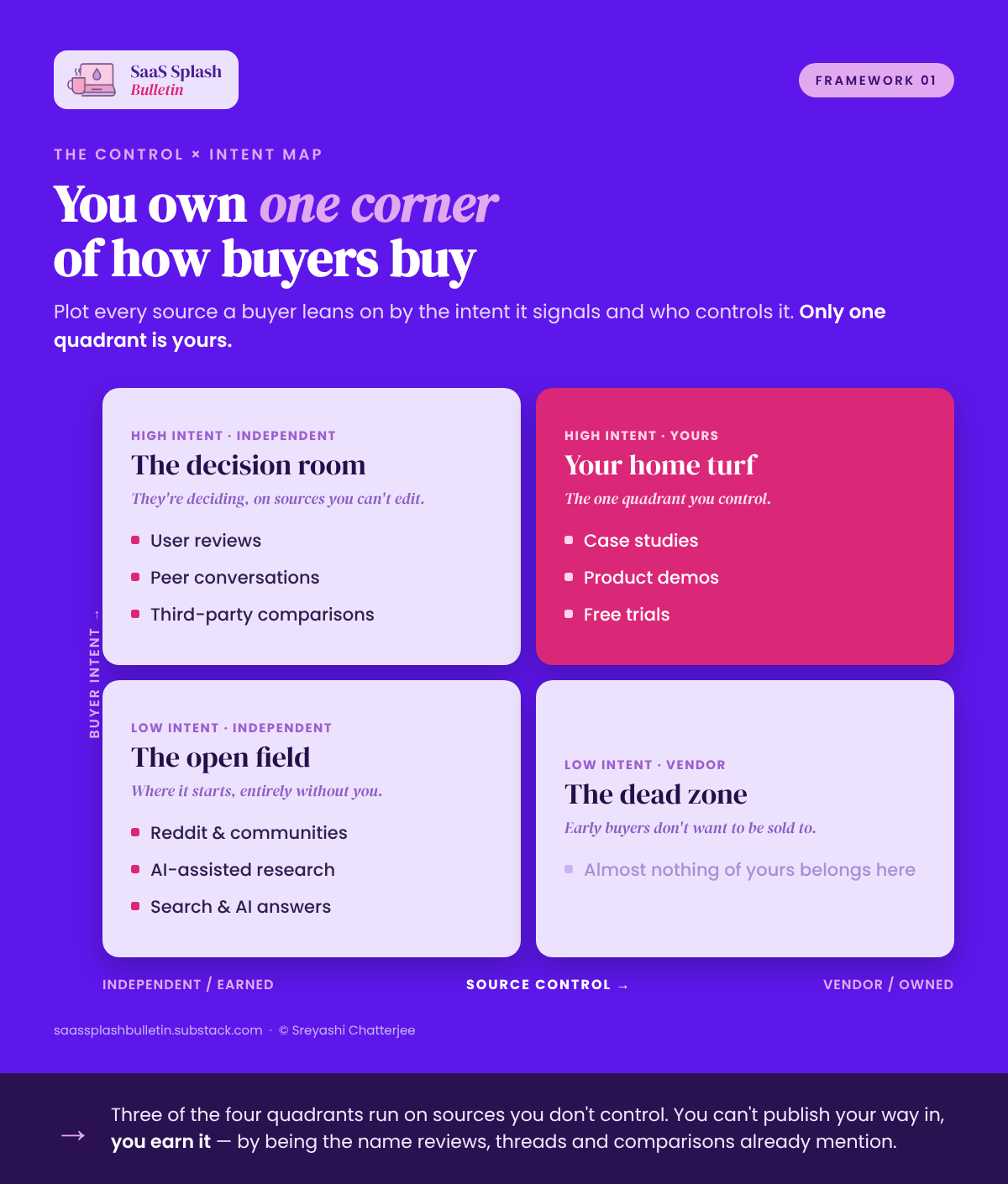
Methodology note: An illustrative framework developed from my qualitative analysis of software-buying discussions, supported by TrustRadius’s 2026 research. Buyers may revisit stages or use multiple sources simultaneously.
2. Buyers rely on reviews, but they also question how credible those reviews are
One of the clearest findings across the research was the importance of third-party reviews in software evaluation.
According to TrustRadius, 74% of buyers consulted user reviews during their buying process, with most turning to software review platforms.
G2 Digital Markets’ State of Software Buying in 2026 adds another perspective:
43% of respondents in G2’s March 2026 B2B buyer survey said software review sites influenced which vendors made their shortlist.
39% of respondents in its broader Software Buying Trends survey selected review and comparison sites among their most influential research sources.
Buyers used review filters such as industry, company size and role to find feedback relevant to their circumstances.
But the Reddit discussions revealed an interesting contradiction.
In this discussion about G2, Capterra and TrustRadius, contributors questioned whether software reviews were genuinely useful, how representative they were and whether positive reviews could always be trusted.
Other contributors defended review platforms and discussed their usefulness for comparing products.
So the pattern isn’t simply that buyers trust third-party reviews.
Buyers actively seek independent opinions, but they still evaluate the credibility of those opinions.
From the discussions I reviewed, three signals appeared particularly useful:
Specificity: Does the reviewer describe the actual problem they were solving?
Context: Is their company, industry or workflow comparable to mine?
Trade-offs: Do they explain limitations and frustrations alongside the benefits?
This helps explain why a detailed review from someone with a similar use case can be more informative than a generic five-star rating.
3. Buyers want information from people who understand their situation
Here’s something that became clearer when I compared the Reddit discussions with published buyer research.
Buyers aren’t necessarily looking for the most authoritative-sounding opinion.
They’re looking for an opinion that helps them understand whether a product will work in their circumstances.
According to Forrester, 82% of B2B buyers trust coworkers and internal management, making them the most trusted information source in that study.
TrustRadius found that 53% of buyers spoke with a peer who had used the product. Among those buyers, everyone found those conversations at least somewhat helpful.
G2’s research also found that 49% of software buyers selected industry experts among their most influential research sources.
The common thread is relevant experience.
Consider two recommendations:
“We’ve used this project management tool for two years. It’s excellent.”
Versus:
“We manage 20 concurrent client projects across three departments. The tool works well for resource allocation, but reporting becomes difficult when projects share the same team members.”
The second recommendation gives a buyer considerably more information to work with.
And that was the kind of distinction I noticed in the project management discussions on Reddit.
Contributors frequently explained the workflows, organizational requirements, and limitations behind their recommendations.
It also explains why industry-specific communities can be useful during research. Buyers can ask questions that generic product descriptions may not answer.
One limitation worth acknowledging: practitioner newsletters and podcasts didn’t appear prominently in the public discussions I reviewed. That doesn’t establish that buyers ignore them. It simply means I found stronger, more observable evidence of peer conversations, review platforms, and communities in this sample.
4. AI has become an important research source. But visibility doesn’t automatically translate into trust.
The role of AI in software research is becoming difficult to ignore.
G2’s March 2026 survey of 1,076 B2B decision-makers found that 55% identified AI chat as a source influencing which vendors made their shortlist. That was higher than the rates on software review sites (43%) and vendor websites (36%) in the same survey.
But there’s another number I find equally important.
According to TrustRadius, 94% of buyers who used AI fact-checked its output at least some of the time.
This suggests that AI is becoming an important means of discovering and researching software, while buyers continue to seek validation elsewhere.
The two studies measure different things, so I wouldn’t directly compare their percentages as if they came from the same survey.
What they collectively suggest is a distinction between being discovered and being believed.
For marketers, getting mentioned in an AI-generated answer is valuable.
But what happens next?
If someone discovers your software through ChatGPT, they may still want to check independent reviews, compare features, consult colleagues, or understand how the product works in practice.
And if those sources don’t support the original recommendation, visibility alone may not be enough.
5. Buyers aren’t just evaluating features. They’re evaluating whether the software fits their reality.
This was one of the more interesting patterns in my Reddit research.
In the same discussion about project management software, one contributor described building a customized solution rather than relying entirely on existing software.
The reason wasn’t that the available products lacked features. It was that those features didn’t adequately support the complexity of their particular workflow.
The contributor described a visual effects studio with multiple concurrent projects, changing timelines, and complicated resource requirements.
They had built an initial version of a customized scheduling solution using newer development tools.
Now, one Reddit comment doesn’t establish that buyers are abandoning SaaS to build their own tools.
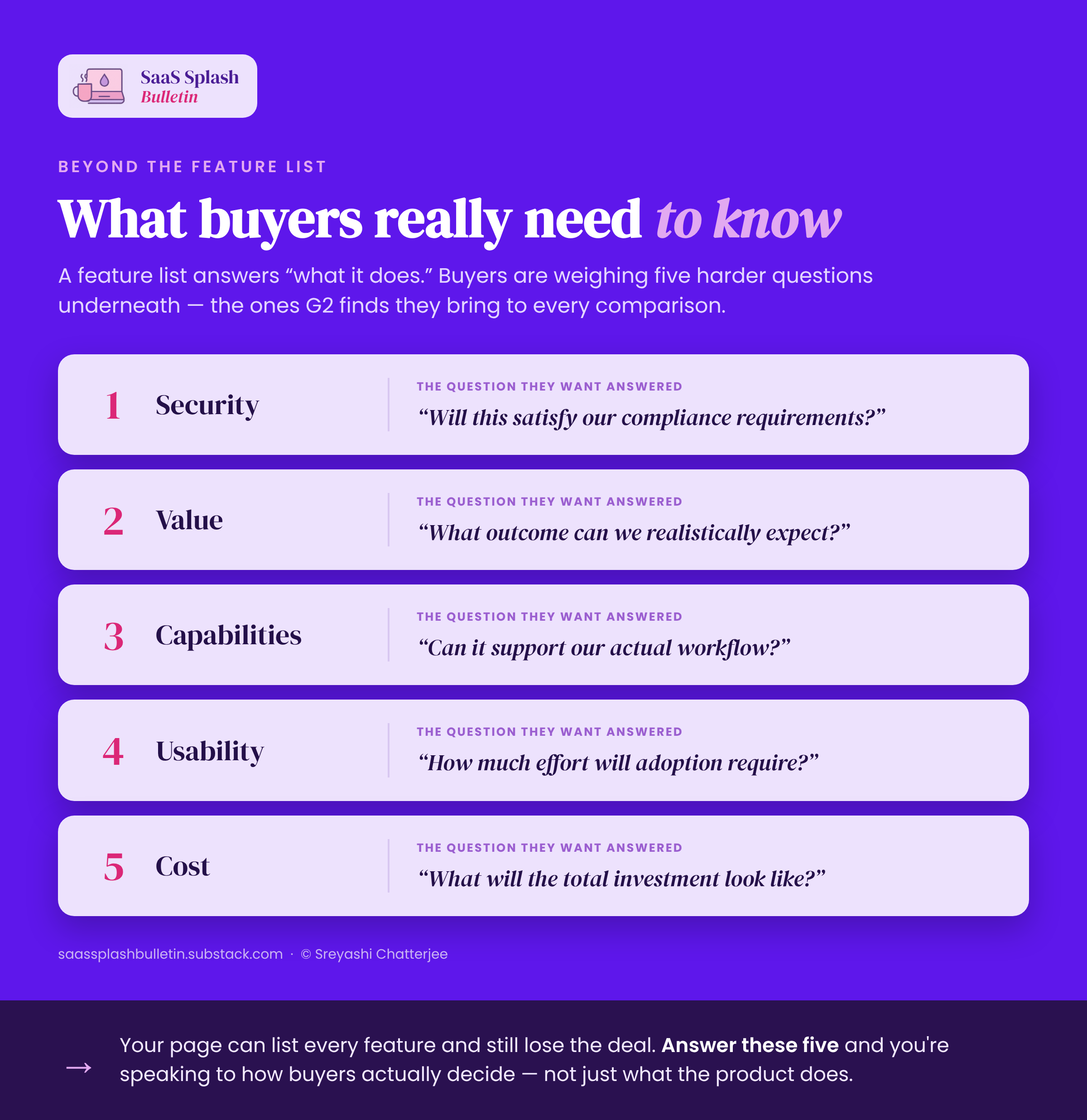
But it illustrates a frustration worth examining: software can offer an extensive feature set and still fail to solve a buyer’s specific problem. G2’s report helps quantify what buyers look for when evaluating software on review and comparison sites.
The most commonly sought information included:
58%: Security details
51%: Value for money
51%: Clear feature information
48%: Ease of use
47%: Pricing
Notice how much of this goes beyond simply asking whether a product has a feature.
Buyers want to understand whether the product is secure, practical, affordable, and suitable for their environment. And this has implications for the kind of content we create.
A generic case study about improving efficiency may demonstrate value.
But a case study explaining how a financial services company implemented the software, integrated it with existing systems, and handled its specific compliance requirements gives a prospective buyer much more to evaluate.
The same applies to comparison pages, product documentation and demonstrations.6. There’s still a gap between what vendors promote and what buyers find useful
This was another finding I didn’t want to overlook.
TrustRadius asked vendors which resources they considered most influential.
Sales representatives ranked highest in the vendor responses. But when buyers were asked about influential resources, free trials, product demos, and prior experience came out ahead.
The report found:
77% rated free trials or accounts as influential.
73% rated product demos as influential.
72% rated their own prior experience as influential.
These figures reinforce something I’ve been thinking about. Buyers aren’t avoiding vendor information altogether. They still need to understand the product.
But they seem to place greater value on information and experiences that help them assess it for themselves.
6. Buyers want to experience the product before they commit
There’s another disconnect worth examining: what vendors believe influences purchasing decisions versus what buyers find useful.
TrustRadius’s 2026 research found that vendors considered sales representatives their most influential resource.
But buyers placed substantial value on independent evaluation and hands-on product experiences.
G2’s research makes the importance of product experience even clearer. 50% of buyers cited a trial as a decisive factor in their purchase decision, compared with 35% influenced by a sales presentation.
And product experience can work against vendors too.
According to G2, the three most commonly reported reasons for removing a vendor from the final shortlist were:
55%: Security or compliance gaps
52%: Unfavorable contract terms
50%: Poor trial experiences
This is important because it shows that buyers aren’t only looking for evidence that a product works. They’re also looking for reasons it might not.
A product demonstration that only shows ideal scenarios may not answer the questions buyers actually have.
What happens when their existing data is imported?
How does the product handle exceptions?
What integrations are supported?
What limitations should they anticipate?
And what happens after they sign the contract?
The same G2 report found that 61% of buyers experienced at least one unexpected implementation disruption in the previous 18 months.
Among buyers who experienced implementation disruptions, integration issues and data migration problems were common, as were delays.
That makes implementation information relevant before the purchase, even though the problems themselves may emerge afterward.
What does all this mean for B2B SaaS content marketers?
After reviewing the Reddit discussions and comparing them with the published research, I think there are five areas worth reconsidering.
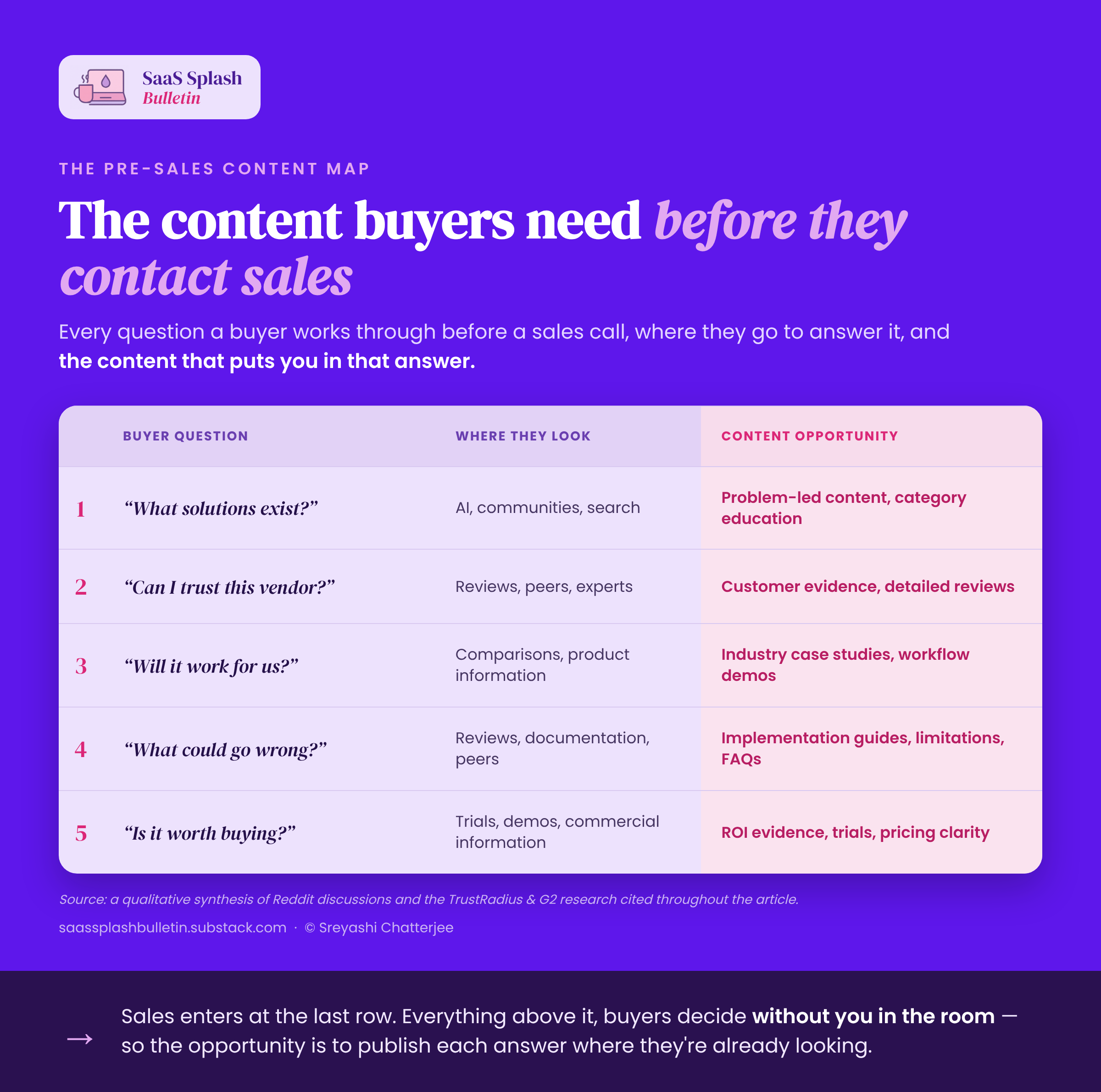
1. Create content for buyers who don’t know your product category yet.
Problem-led articles, educational resources, and participation in relevant communities can help buyers discover possible solutions before they have a vendor shortlist.
2. Make independent customer evidence easier to find.
Detailed reviews and firsthand experiences can help buyers validate claims. The most useful evidence includes context, trade-offs and real-world outcomes.
3. Make case studies much more specific.
Instead of relying only on broad success stories, explain the customer’s industry, requirements, implementation challenges and measurable results.
4. Treat product evaluation content as a priority.
Security documentation, integration information, pricing explanations, comparison pages, demos and trials can answer questions buyers may otherwise have to bring to sales.
5. Think beyond AI visibility.
Being recommended by an AI tool may help a vendor enter the consideration set. But buyers still need credible information to validate that recommendation.
My biggest takeaway
Before doing this research, I was primarily interested in which content formats buyers trusted most. But the more useful finding was how much their information needs change depending on what they’re trying to establish.
A buyer discovering a product needs different information from someone validating a recommendation.
Someone comparing two vendors needs different proof from someone assessing implementation risks.
And someone trying to justify a purchase internally may need an entirely different set of answers.
That makes me question how often we organize B2B content around formats and publishing calendars rather than actual buyer questions.
Because a buyer might not care whether the answer comes from a blog, a review, a case study, or a product demo.
They care whether it gives them enough information to make a better decision.
And perhaps that’s where our content strategy should begin.
📚 Check out my digital products & services purchased and loved by 270+ writers and marketers
AI+Human Content Playbook: For Content Marketers only. Essentially, for those under pressure to produce a large volume of content, it limits their ability to learn and experiment with other aspects of content marketing.
💡New update: A Claude skill.md file to accelerate your writing workflow! No price change.
SaaS Content Marketer Handbook: 1-YEAR handbook for content marketers joining a product startup, includes realistic goals, execution steps, and all the templates and frameworks you’ll need.
BOFU Content E-book: Get my updated BOFU Content e-book that covers three new chapters on BOFU content beyond alternatives and comparisons, BOFU attribution, and AI workflows for BOFU content.
💡New update: A ready-to-run Claude skill that writes BOFU comparison content end-to-end: "[Competitor] alternatives," X vs Y, product reviews, and "best [category] software" listicles.
Say hi on LinkedIn 👋
Onwards and upwards,
Sreyashi