


Hey friend, how’s it going? 🌻
I have been doing a lot of research on original research lately, because we are planning to publish one at my current company.
You already know the typical formats. The State of AI. The State of SEO. The State of whatever your industry cares about this year. So while I was digging around, I started saving the survey-led pieces that did something different, and I built myself a swipe file.
I am sharing three ideas from my swipe file today. I have intentionally left out the usual downloadable reports and gated lead magnets. The three that I have picked here are different in their own way. Be it in the type of data it collects, how the data is presented, or how the report is positioned.
I will break down what makes each one work as we go. Let’s get into it 👇
📌 TL;DR
Original research doesn’t need a new idea; it needs a different presentation. Same survey, three genuinely different plays.
Ahrefs shows the positioning play: lead with a raging problem your audience already fears, then let your proprietary data settle the argument. Works only if the data is truly yours.
AirOps shows the distribution play: go deep enough that the vocabulary filters your audience, then ungate the whole thing. For a niche expert reader, removing friction beats collecting emails.
Cognism shows the data-type play: research built on your own product usage data is the most defensible kind, because nobody can replicate your users. Bonus: the findings can prove the problem you solve without pitching.
Across all three, the data you have determines how you can position the report. Pick the play your data actually earns, not the one you wish it did.
#1 Pick a raging problem and back it with your proprietary data
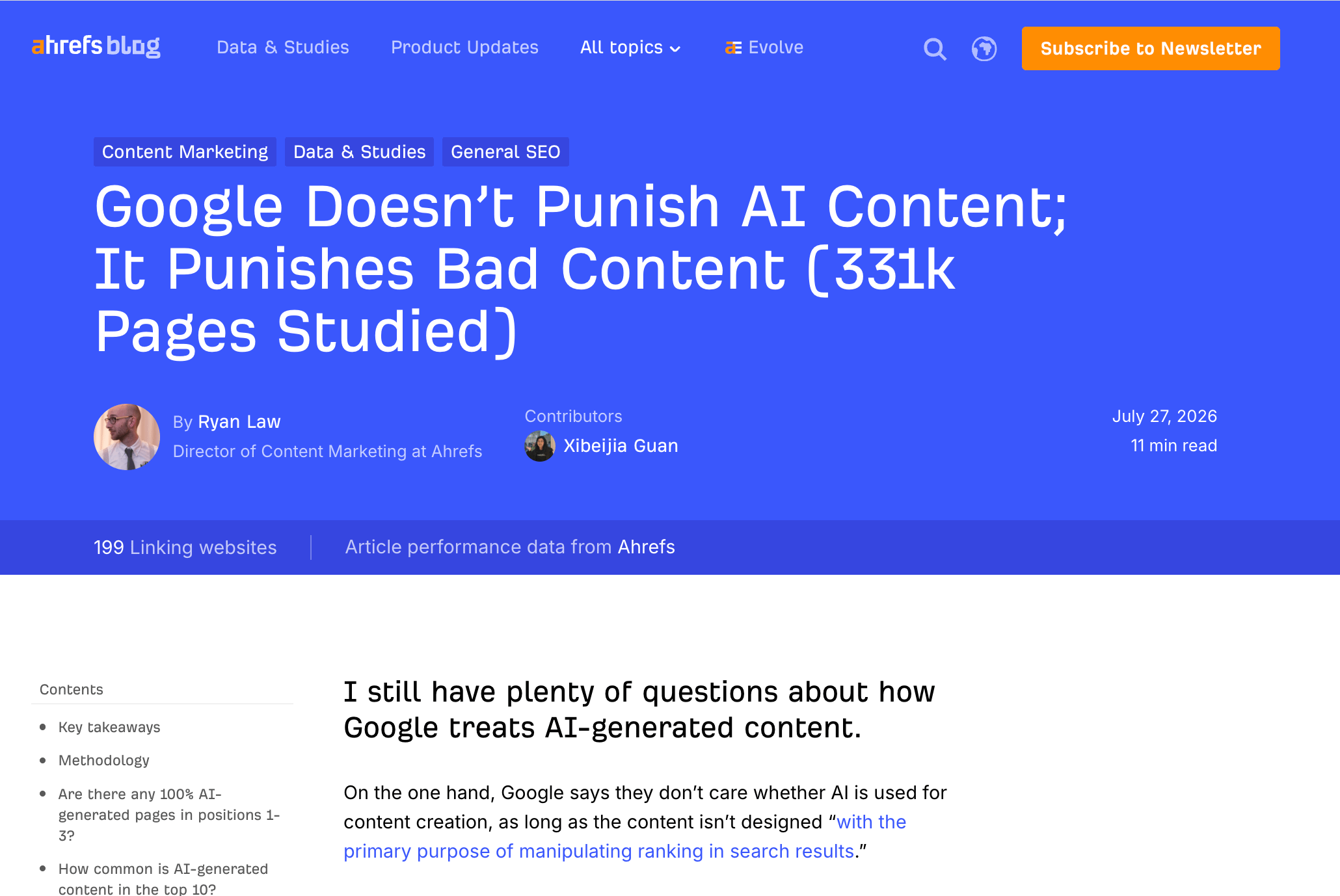
If you follow the SEO tool world, you already know that Ahrefs, Semrush, and their peers publish a steady stream of AI search reports and write-ups. Worth watching, even when the results are not the point. As a content strategist, this is the category to study because these companies sit on enormous amounts of data and use it about as well as anyone else.
The report style they lean on, and the one I keep coming back to, works like this. They pick a challenge their potential users are actually facing, then use their own data to establish it, back it up, or break it down.
This one above is a good example, written by Ryan Law; the problem it opens with is that marketers are now scared to use AI in any capacity, convinced Google will punish them for it. That fear is the hook. Then they answer it with data, and the answer is that Google is not punishing AI content; it is punishing bad content.
Notice the data type too. This whole study runs on pages. For a tool like Ahrefs, pulling pages is easy, whether for a specific industry or across no particular domain at all. Read their methodology, and you will see how much that access shapes what they can publish.
One honest caveat. This positioning does not fit every brand. If you do not sit on a proprietary data set, you cannot credibly break down a problem this way. But for martech and data-rich SaaS, it is one of the strongest ways to frame a report.
What I learned from it:
Lead with a problem your audience already feels, not a topic. “Are marketers right to fear AI content?” beats “The State of AI Content.”
Turn that problem into the hook, then let your data settle the argument for you.
Use data you actually own. The positioning only holds up if the numbers are yours to analyze.
Read the methodology before you borrow the format. It is only repeatable if you have similar access.
📚 Some of the latest, most-read editions:
#2 Make it a detailed report, but ungated
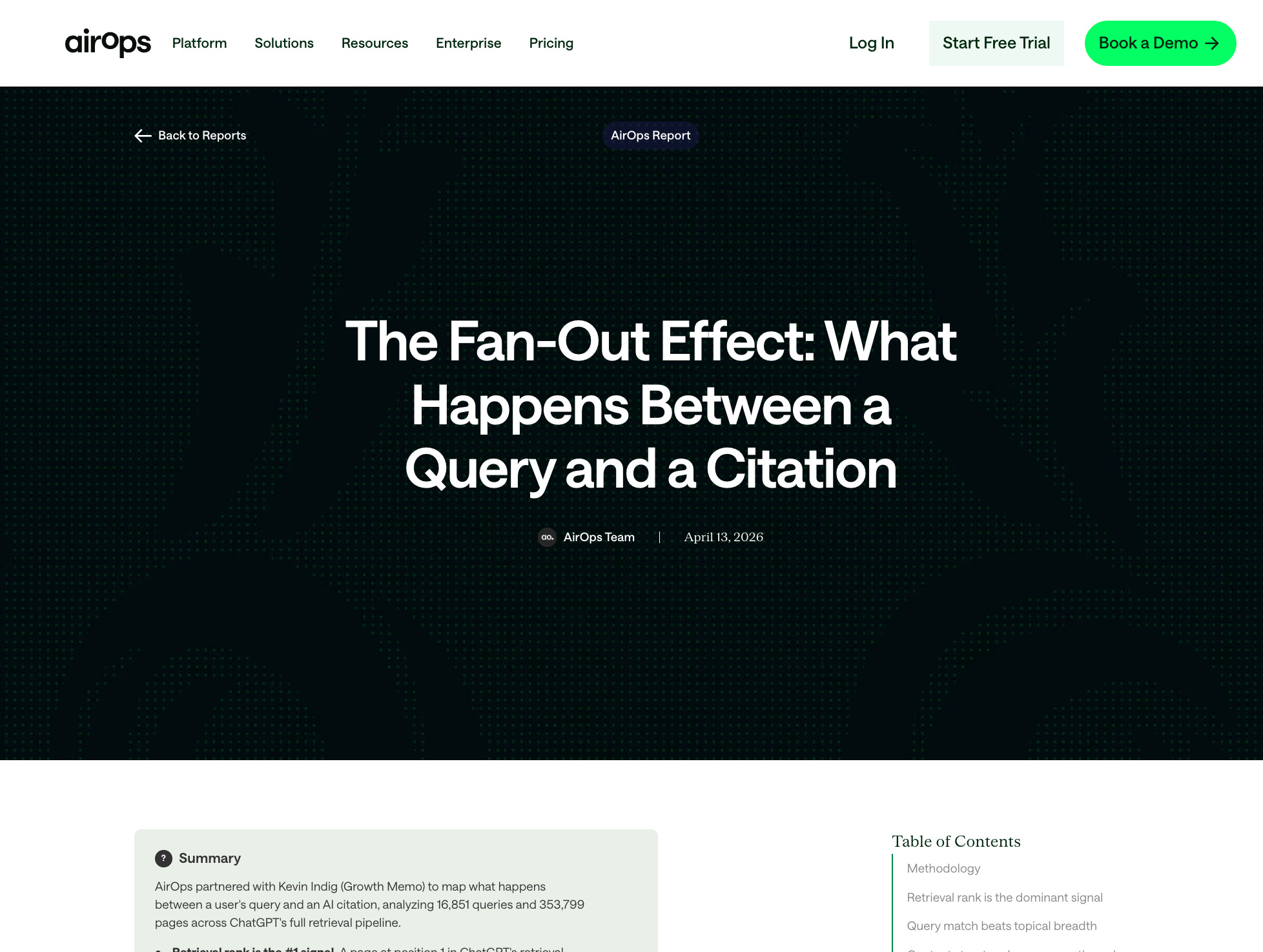
Next on my list is AirOps. Same category as before. Brands like AirOps and Profound also publish a steady stream of AI search research. But this one stood out to me for two reasons.
The first is depth. Put this next to the Ahrefs piece, and the difference is obvious. This is research research. The Ahrefs study answers one clean question with a few clear data points. This one maps an entire pipeline: what happens in the gap between a user’s query and an AI citation. That is a far narrower, far more technical problem, and they treat it that way. They tested retrieval rank, heading match, content length, schema, freshness, authority, one after another, with controlled comparisons for each.
The second is who it is for. This is not written for any writer or any content marketer. It is written for someone who already understands how fan-out works, how citations get chosen, how AI engines actually retrieve. The vocabulary assumes it. The structure assumes it. They made no attempt to widen the audience, and that is the point.
The data collection itself is not that different from Ahrefs in principle. AirOps has a user base, so they can track prompts, queries, and pages at scale and build trends from them. The raw capability is similar. What is different is how far they chose to take it. Same well, much deeper bucket.
Worth noting too: this is not a one-and-done report. If you look at their blog, they slice this same study into problem-specific posts, each one framed around a single finding. That is the same move Ahrefs makes, and it is a good reminder that one serious research project can feed a quarter of content if you break it apart by problem.
But here is why I included this AirOps study: they kept a report this detailed completely ungated. No form, no download, no email wall. For a study this heavy, that is a deliberate bet, and I think it works for two connected reasons.
One, the report is niche, and the small group of people who can fully appreciate it is exactly the audience AirOps wants in the room.
Two, that audience has zero patience for friction. Someone who understands AI engines that well is not going to trade their email to read your gated PDF.
So AirOps removes the gate and reaches them directly, betting on trust and reach with the right people. That is the real lesson here. Gating is not a default setting. It is a positioning choice, and sometimes the more strategic move is to give the whole thing away.
What I learned from it:
Match the depth to the audience. A niche, technical reader wants controlled findings and real rigor, not a skim-friendly overview.
Pick a problem specific enough that the vocabulary alone filters your audience. If everyone understands the title, it may be too broad to signal expertise.
One serious study is a content engine. Break it into problem-specific posts, each built around a single finding, the way both AirOps and Ahrefs do.
Treat gating as a decision, not a habit. Ask who you are trying to reach before you ask for their email.
For a high-expertise audience, ungating can be the stronger play. Remove friction when the people you want most are the least willing to tolerate it.
#3 Product usage patterns that present a trend
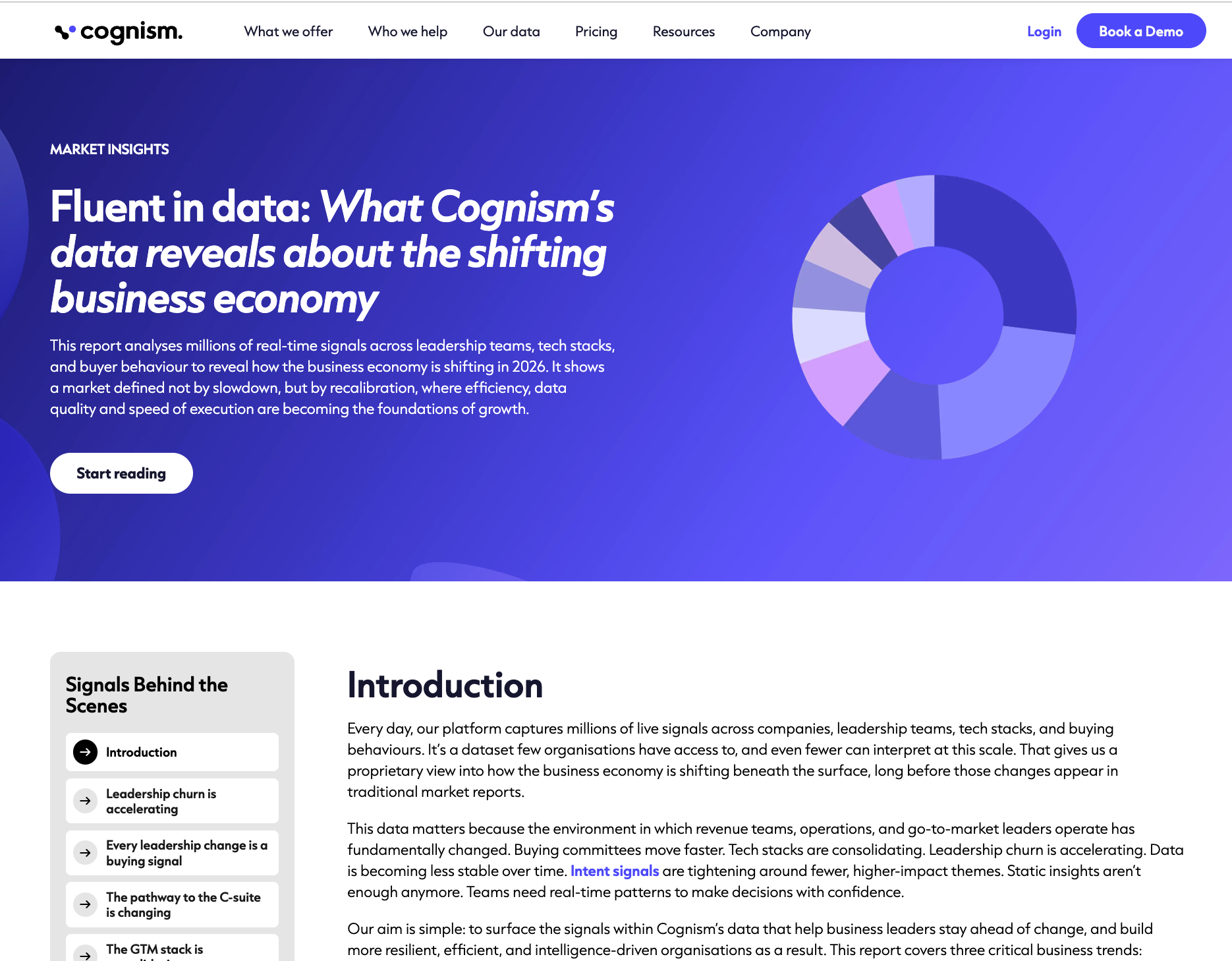
Last one, Cognism. Ahrefs and AirOps both sit on a lot of data, but it is data about the outside world. Ahrefs looks at pages and SERPs. AirOps ran queries through an AI engine and watched the results come back. In both cases, the data is something they went out and observed.
Cognism’s report runs on a different type of data entirely. This is product usage data. Their platform is a sales intelligence and data-as-a-service tool, so every day it captures live signals as customers use it: leadership changing roles, tech stacks shifting, records going stale, intent tightening around certain topics. The report is not built on data they collected for the study. It is built on the exhaust of the product simply doing its job. That difference changes what they can credibly say, and it is worth breaking down properly.
First, this is the strongest possible version of “only we could have published this.” Ahrefs’ page data has close substitutes; Semrush sees a similar web. AirOps’ query approach could be replicated by Profound with enough effort. But the signal data flowing through Cognism’s platform is genuinely non-replicable, because it is a direct product of their specific user base doing specific things. Nobody can reverse-engineer your product’s usage. When your data is your product’s behavior, the moat around the research is real, not stylistic.
Second, the findings double as proof of the problem the product solves. Look at the data decay section. Cognism uses its own data to show that around 30% of C-suite records become inaccurate within a year, and that revenue leadership records (CRO, CMO) decay fastest of all. That finding is interesting on its own, but it is also a precise description of the exact pain Cognism’s “always-on” data exists to fix. The research does not sit next to the pitch. It is the pitch, established as a market fact before anyone mentions the product. And notice they were willing to admit their own data decays, which most vendors would bury. Naming the problem honestly is what makes the eventual solution believable.
Third, usage data lets you claim authority over the market itself, not just your niche. AirOps can speak with authority about AI citations. Cognism, because its signals span companies, leadership, hiring, and buying behavior, can make claims about where the whole business economy is heading in 2026. That is a category-leadership move. You stop being a vendor with a good tool and become the source people quote when they describe the state of the market. Very few data types let you legitimately reach that high.
Now, the trade-off: this format has a real failure mode. Usage-data reports slide into product ads faster than any other kind. The line between “here is a genuine market shift” and “here is why you should buy us” is thin, and readers can smell it the moment you cross it. Cognism mostly stays on the right side because each finding is framed first as a market pattern and second as a product implication. But you can feel it tip toward the end, with the demo CTA and the People Moves widget. That is the tax on this format. If you write research based on your own usage data, the discipline is to let the trend stand on its own and let the product implication follow as a consequence, never as the point.
What I took from it:
Product usage data is the most defensible data you can build research on, because it cannot be replicated. If your product generates signal as a byproduct, that exhaust is a research asset most teams ignore.
The best usage data research proves the problem your product solves without pitching it. Establish the pain as a market fact first, then let the reader connect it to you.
Be willing to name a problem that implicates your own data. Cognism admitting that its records are decaying is what makes the fix credible. Transparency reads as confidence.
Usage data can earn you authority over the whole market, not just your corner of it. If your signals are broad enough, you can credibly narrate the state of an industry, which is a stronger position than owning one topic.
Watch the tipping point. This format degrades into an ad the fastest. Keep every finding standing on its own merit and let the product implication trail it, never lead.
📚 Check out my digital products & services purchased and loved by 270+ writers and marketers
AI+Human Content Playbook: For Content Marketers only. Essentially, for those under pressure to produce a large volume of content, it limits their ability to learn and experiment with other aspects of content marketing.
💡New update: A Claude skill.md file to accelerate your writing workflow! No price change.
SaaS Content Marketer Handbook: 1-YEAR handbook for content marketers joining a product startup, includes realistic goals, execution steps, and all the templates and frameworks you’ll need.
AMA: SaaS Content Marketing | 45 Minutes: Strategy, writing, analytics, conversion, SEO, AEO, career direction- nothing is off limits. Share your website or portfolio in advance, and I’ll come prepared with specific answers rather than generic advice.
Say hi on LinkedIn 👋
Onwards and upwards,
Sreyashi
Sreyashi I have also noticed many agencies starting to create a category of their own and publishing mini e books. Is there a way around without publishing mini e books.