


Hey friend, how’s it going? 🌻
Last week, I analyzed 10 SaaS comparison pages to understand whether they’re still worth investing in as a content marketing strategy.
One article stood out: Zapier’s Claude vs. ChatGPT comparison.
Its estimated organic traffic was declining. Its total ranking keywords were falling. Yet its visibility across AI search engines was growing significantly.
That made me curious.
What was happening to its organic search performance?
What was the article doing particularly well?
And why was it appearing more frequently in AI-generated responses?
I also received some interesting comments on my LinkedIn post about this article. A few people questioned whether the growth in AI visibility was concentrated on one platform, whether balanced comparisons attract more citations, and whether traffic alone is enough to evaluate comparison content.
So, for this week’s edition, I decided to investigate.
Let’s get into it 👇
📌 TL;DR
Organic traffic declined, but rankings tell a different story. Zapier’s article lost approximately 5,600 estimated monthly organic visits and 139 ranking keywords over six months. However, its top-three keyword rankings increased by 19.
Its core comparison queries are still performing. The article gained estimated traffic for queries such as “claude vs chatgpt” and “is claude better than chatgpt,” even as other keyword variations declined.
AI visibility increased across multiple engines. Ahrefs recorded approximately 1,200 additional AI responses, with notable increases across Perplexity, Google AI Overviews, ChatGPT, and Google AI Mode.
The content itself has several strengths. A clean structure, direct introduction, firsthand testing, consistent comparison criteria, and practical use cases make the article useful.
The biggest lesson: Organic traffic, search rankings, and AI visibility don’t always move together. We need to evaluate them separately.
The performance snapshot: One article, different outcomes
Let’s start with the numbers. Here’s what Ahrefs reports for Zapier’s Claude vs. ChatGPT article over the last six months.
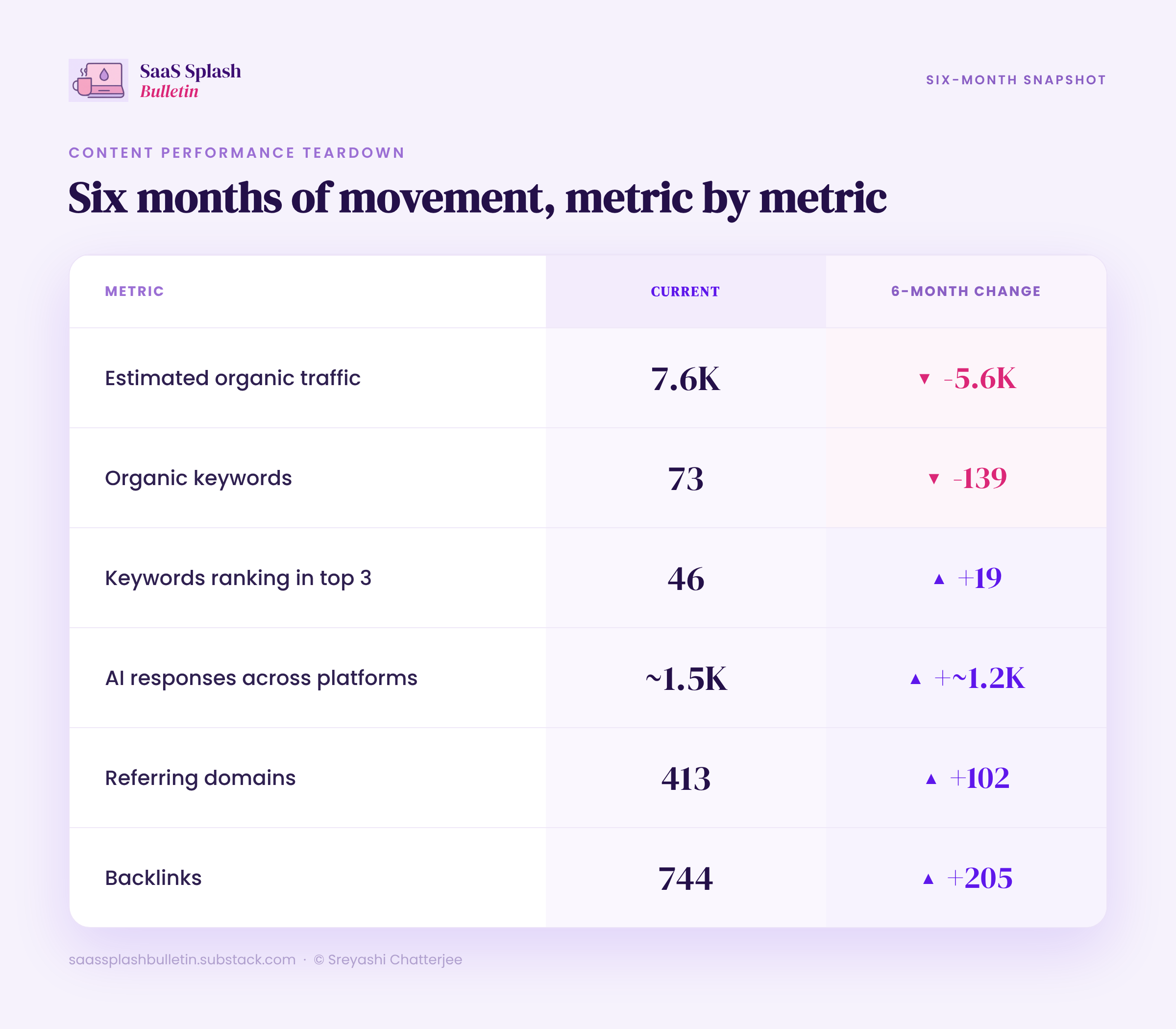
The first thing that caught my attention was the decline in estimated organic traffic.
The article lost approximately 5,600 monthly visits over six months. That’s substantial. But look at the third row.
Despite losing 139 ranking keywords overall, the article gained 19 keywords in the top three positions. This is an interesting contrast.
It suggests that although the article ranks for fewer keywords overall, its visibility for some queries has strengthened.
And that brings us to the next question.
Why is organic traffic declining despite strong rankings?
I wanted to understand whether the traffic decline reflected a broader deterioration in search performance or something more nuanced.
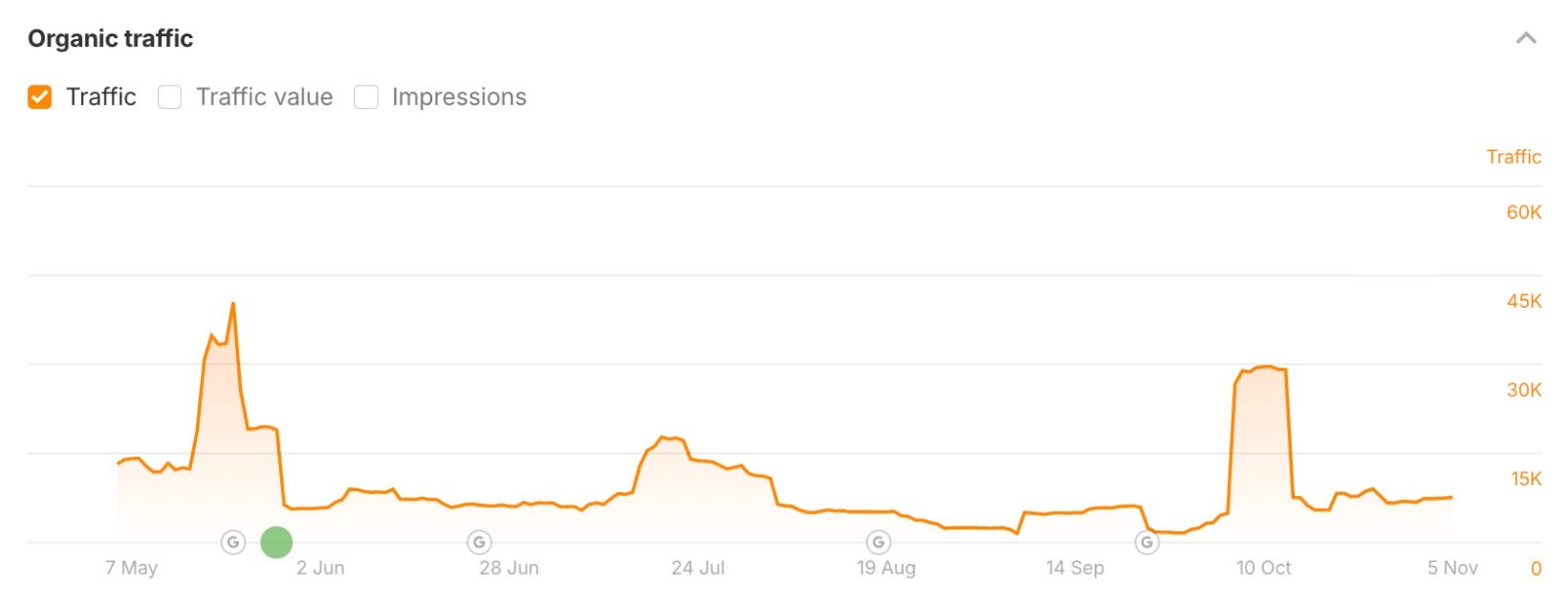
So I looked at its individual keyword performance. Here are some examples from Ahrefs:
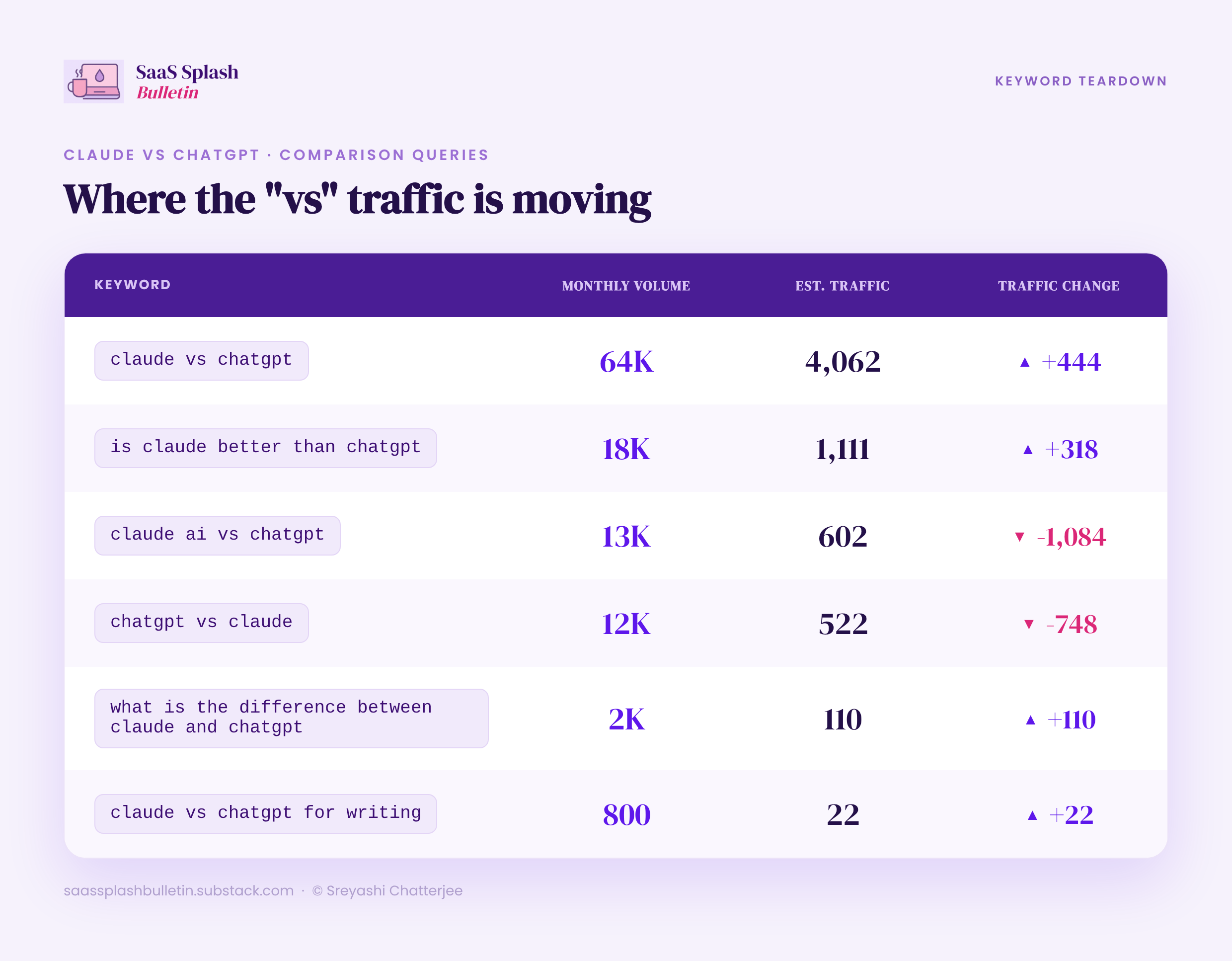
Now, this is interesting. The article has gained estimated traffic for two important queries:
“claude vs chatgpt”: +444
“is claude better than chatgpt”: +318
At the same time, it has lost considerable traffic for other variations of the same topic. For example, “claude ai vs chatgpt” declined by 1,084, while “chatgpt vs claude” declined by 748.
So, while the overall organic traffic trend is negative, the performance of individual keywords isn’t uniformly negative.
My interpretation
I see three things worth noting.
The article hasn’t lost its relevance for the core topic.
It continues to attract estimated traffic for highly relevant comparison searches.
Keyword coverage and ranking quality are different things.
The article ranks for fewer keywords overall, but its number of top-three rankings has increased.
We can’t automatically blame AI search for the traffic decline.
Search demand, competing content, ranking changes, SERP features, and click-through behavior could all contribute.
Without historical search demand and click-through data, we can’t isolate the cause.
We can say that the article’s overall estimated traffic has declined, even though some important comparison queries and top-ranking positions have improved.
That’s an important distinction when evaluating content performance.
What makes Zapier’s comparison article effective?
Now, let’s move beyond the numbers. I spent time reading the article to understand what makes it useful from a content marketing perspective. And I think Zapier gets several fundamentals right.
A clean, logical structure
One of the first things I noticed was the structure.
The article has a clear table of contents, a direct introduction, an at-a-glance comparison, and detailed sections covering different capabilities.
There’s a natural progression from understanding the overall differences to exploring specific use cases. The reader doesn’t have to search through several paragraphs of background information before getting to the actual comparison.
This is particularly important for bottom-of-funnel content.
Someone searching for “Claude vs. ChatGPT” is usually trying to understand which tool is better suited to their needs.
Zapier doesn’t make that unnecessarily complicated.
The introduction gets straight to the point
Another thing I liked was the introduction. It establishes what the article will compare and quickly moves toward the information readers are looking for.
There’s no unnecessary buildup or lengthy explanation of why AI tools are becoming popular. And that’s refreshing.
I’ve seen comparison articles where the first several paragraphs are devoted to generic industry context.
But someone searching for a direct product comparison probably doesn’t need convincing that the category matters. They need answers.
Firsthand product testing
This is probably my favorite part of the article.
It doesn’t read like someone simply collected features from two product websites. The writer appears to have spent time using both tools and comparing their performance across different tasks.
There are observations about the experience, practical examples, and explanations of where the products differ. That makes the content feel more credible.
Think about the difference between these two approaches.
✅ Feature-based comparison:
Product A supports document analysis. Product B also supports document analysis.
✅ Experience-based comparison:
Here’s how both products handle the same document analysis task, where their outputs differ, and which experience might work better for a particular user.
The second approach gives readers something they can actually use.
Consistent comparison criteria
Another strength is that the article compares the products across similar capabilities. This sounds obvious, but it’s something comparison articles don’t always do well.
If you’re evaluating two products, the criteria should remain reasonably consistent. Otherwise, you risk comparing unrelated strengths and drawing conclusions that aren’t particularly useful.
Zapier organizes its analysis around recognizable capabilities and use cases, making it easier to understand where each product performs differently.
Simple, relatable use cases
The article is detailed, but it doesn’t require readers to be AI researchers to understand it. It connects capabilities to everyday tasks.
That’s important because not everyone searching for “Claude vs. ChatGPT” wants technical benchmarks. Some people want to know which tool is better for writing, coding, research, or their daily workflows.
The article makes those differences accessible. And this is something I strongly believe about content marketing:
Being detailed doesn’t mean you have to make the content complicated.
Balanced recommendations
One of the comments on my LinkedIn post raised an interesting point about fairness.
Does a comparison article become more valuable to AI search engines when it treats competing products fairly?

I can’t establish that from this example. But I do think Zapier’s balanced approach makes the content more useful.
The article acknowledges the strengths and limitations of both products rather than declaring a single universal winner. That’s how real product decisions work. Different products are better suited to different needs.
And a comparison that recognizes those trade-offs is more helpful than one designed to make a particular product win every category.
📚 Related reading: When comparison content becomes too promotional
In one of my previous newsletters, I examined a ClickUp comparison article that was losing organic traffic and seemed to favor ClickUp without sufficiently justifying its recommendations.
It’s an interesting contrast to Zapier’s more balanced approach and a reminder that comparison content should help readers evaluate alternatives rather than simply promote one product.
How could this article be even better (IMO)?
I like the article overall, but there are a few areas where I think it could be stronger.
More transparency around testing
The firsthand observations are valuable.
However, I’d appreciate a more explicit explanation of the testing methodology.
For example:
Which model versions were tested?
Were the same prompts used across both products?
Were tests repeated to account for inconsistent outputs?
Were the results based on free or paid versions?
This is especially relevant when comparing AI tools, where model versions and outputs can change frequently.
A short methodology section could make the analysis more transparent.
A stronger decision-oriented summary
The article already includes an at-a-glance comparison, which is useful.
But I’d consider adding a more prominent summary showing which product is better suited to specific needs and why.
For example, a short “Choose Claude if...” and “Choose ChatGPT if...” section near the beginning could help readers who don’t want to go through the entire article.
The detailed analysis could then support those recommendations.
The challenge of keeping AI comparisons updated
This isn’t necessarily a weakness unique to Zapier.
It’s a challenge for anyone creating comparison content about rapidly evolving products.
Claude and ChatGPT regularly introduce new models, features, and capabilities. A comparison that was accurate a few months ago may need substantial revisions. Zapier has updated the article, which is a positive sign.
But for this type of content, freshness should mean reviewing the actual comparisons, not simply updating the publication date.
🚀 Need help growing your career in SaaS marketing?
In my 45-minute 1:1 calls, I can help you with:
Resume and portfolio reviews
Job interview preparation
Moving from content marketing to product marketing
Building stronger SEO, AEO/GEO, and analytics skills as a content professional
Content strategy, conversions, and freelancing
Share your questions and relevant links in advance, and I’ll come prepared with specific, actionable suggestions. ✨
45 minutes | ₹1,599
Why is the article gaining AI search visibility?
Now comes the question that initially piqued my curiosity.
If estimated organic traffic is declining, why is the article appearing more frequently in AI responses?
One person commented on my LinkedIn post that the answer might depend on whether the increase in visibility came from a single AI engine or several.
Fortunately, Ahrefs provides a platform-level breakdown.
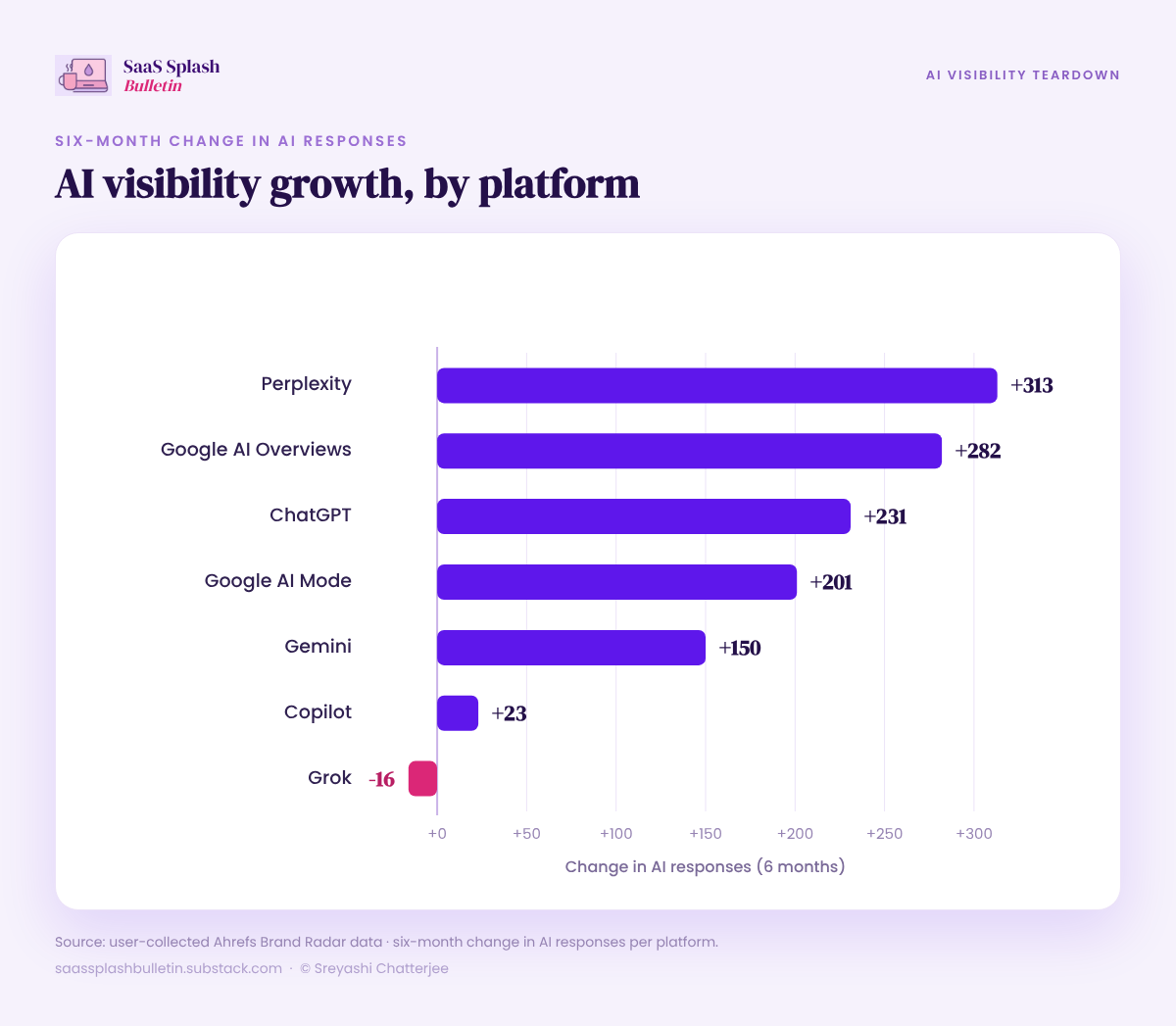
The first observation is that the increase isn’t concentrated on a single platform.
Perplexity recorded the largest increase, followed by Google AI Overviews, ChatGPT, and Google AI Mode. This suggests the article is gaining visibility across different AI search experiences.
However, these numbers represent Ahrefs’ tracked AI responses. They shouldn’t automatically be interpreted as citations to this exact URL or as referral traffic.
Why might this article be gaining visibility?
I see a few possible explanations.
1. It directly addresses comparison-oriented questions.
The article contains detailed answers about product differences, strengths, limitations, and use cases.
These are the kinds of questions users might ask an AI assistant when deciding between two tools.
2. Its content is structured around specific capabilities.
The sections make it relatively straightforward to identify information about particular tasks.
For example, someone asking which tool is better for writing doesn’t necessarily need a complete summary of both products.
They need relevant information about writing capabilities.
Zapier has dedicated content that addresses such questions.
3. It includes firsthand observations and practical examples.
Rather than relying exclusively on generic product descriptions, the article provides experience-based comparisons.
Those observations may make it a useful source of information. But there’s an important limitation here. We can’t conclude that firsthand testing, structured sections, or balanced recommendations caused the increase in AI visibility.
Those are plausible explanations, not verified ranking factors.
Five lessons for B2B SaaS content marketers
After reviewing the article and its performance, here are the five takeaways.
#1 Evaluate comparison content beyond organic traffic
Organic traffic remains important, but it shouldn’t be the only metric.
Look at keyword relevance, ranking positions, commercial queries, AI visibility, and, where available, referrals and conversions. A page can lose overall traffic while strengthening its position for certain important queries.
#2 Make the comparison genuinely useful
Don’t create comparison content simply because a competitor keyword has search volume. Think about the decision someone is trying to make.
What do they need to know?
Which differences matter?
What trade-offs should they consider? Build the article around those questions.
#3 Invest in firsthand experience
If you’re comparing products, use them wherever possible.
Test comparable workflows, document the results, and explain the differences.
Even simple observations can make the content more useful than a generic feature comparison.
#4 Be fair to competing products
A comparison shouldn’t require your product to win every category. Acknowledge where alternatives perform well.
Readers are more likely to find the content useful when it helps them understand genuine trade-offs.
#5 Measure AI visibility separately from search traffic
AI visibility metrics can provide useful information, but they don’t replace organic traffic or conversion data.
Track which engines are showing improvement, whether your content is actually cited, and whether that visibility translates into meaningful visits or outcomes.
Avoid treating every AI appearance as a business result.
Final thoughts
When I first looked at Zapier’s Claude vs. ChatGPT article, the decline in organic traffic and increase in AI visibility seemed like the most interesting part.
But after examining the keyword data and reading the article more closely, I think the bigger lesson is about how we evaluate comparison content.
The article has experienced a loss of estimated traffic and overall keyword coverage. Yet it has gained top-three rankings, continues to attract traffic for important comparison queries, and appears more frequently in tracked AI responses.
And from a content perspective, I think it gets several fundamentals right.
It’s structured clearly. It gets to the point. It compares products through practical experience. And it helps readers understand differences without unnecessarily complicating the subject.
I can’t say those qualities caused its growth in AI visibility. But I can say they make it a useful comparison article.
For me, the takeaway is: Don’t judge comparison content by a single performance metric. And don’t lose sight of the reader’s decision when optimizing for search engines.
📚 Check out my digital products & services purchased and loved by 270+ writers and marketers
AI+Human Content Playbook: For Content Marketers only. Essentially, for those under pressure to produce a large volume of content, it limits their ability to learn and experiment with other aspects of content marketing.
💡New update: A Claude skill.md file to accelerate your writing workflow! No price change.
SaaS Content Marketer Handbook: 1-YEAR handbook for content marketers joining a product startup, includes realistic goals, execution steps, and all the templates and frameworks you’ll need.
BOFU Content E-book: Get my updated BOFU Content e-book that covers three new chapters on BOFU content beyond alternatives and comparisons, BOFU attribution, and AI workflows for BOFU content.
💡New update: A ready-to-run Claude skill that writes BOFU comparison content end-to-end: "[Competitor] alternatives," X vs Y, product reviews, and "best [category] software" listicles.
Say hi on LinkedIn 👋
Onwards and upwards,
Sreyashi
Measuring them separately makes sense, since AI visibility doesn't hold still either. We asked ChatGPT twice for the best accounting firm in Zurich and only two names showed up both times.
Useful case, and it matches what we saw from the other side. Zapier is exactly the kind of site the engines cite. We asked ChatGPT 6,710 blind "best tool for..." questions on behalf of 1,339 recently launched tools, and it named 0 of them. With live web search on it was still 0 of 125: it retrieved 2,703 domains, cited 687, and the citations mostly went to the incumbents' own sites and docs.
So your #5 matters even more for smaller SaaS. AI visibility doesn't move with traffic, and for a newer product the baseline is often zero. It's worth measuring before you write the comparison page, not after.
If anyone wants a quick baseline, we run a free check: 5 buying questions in your category, about 30 seconds, no signup (disclosure: it's ours, and we sell monitoring for this): https://aisotools.com/audit?utm_source=substack&utm_medium=comment&utm_campaign=dist-20261107-substack-saassplash&ref=dist-20261107-substack-saassplash