


Hey friend, how’s it going? 🌻
Lately, I’ve been thinking about a skill that I believe will become increasingly important for content marketers: judgment.
We talk a lot about how AI is changing content creation. And yes, it has made research, writing, analysis, and execution significantly faster. But there are decisions AI can’t reliably make for us.
Which content idea deserves our time?
Which article is actually good enough to publish?
Which metric matters most?
And when should we stop investing in something that isn’t working?
I went through a couple of Reddit discussions about the biggest challenges content marketers face today.
Interestingly, many of the responses pointed toward the same underlying problem: creating content has become easier, but knowing what to create, prioritize, and measure remains difficult.
So, how do we actually get better at making those decisions?
Let’s get into it 👇
📌 TL;DR
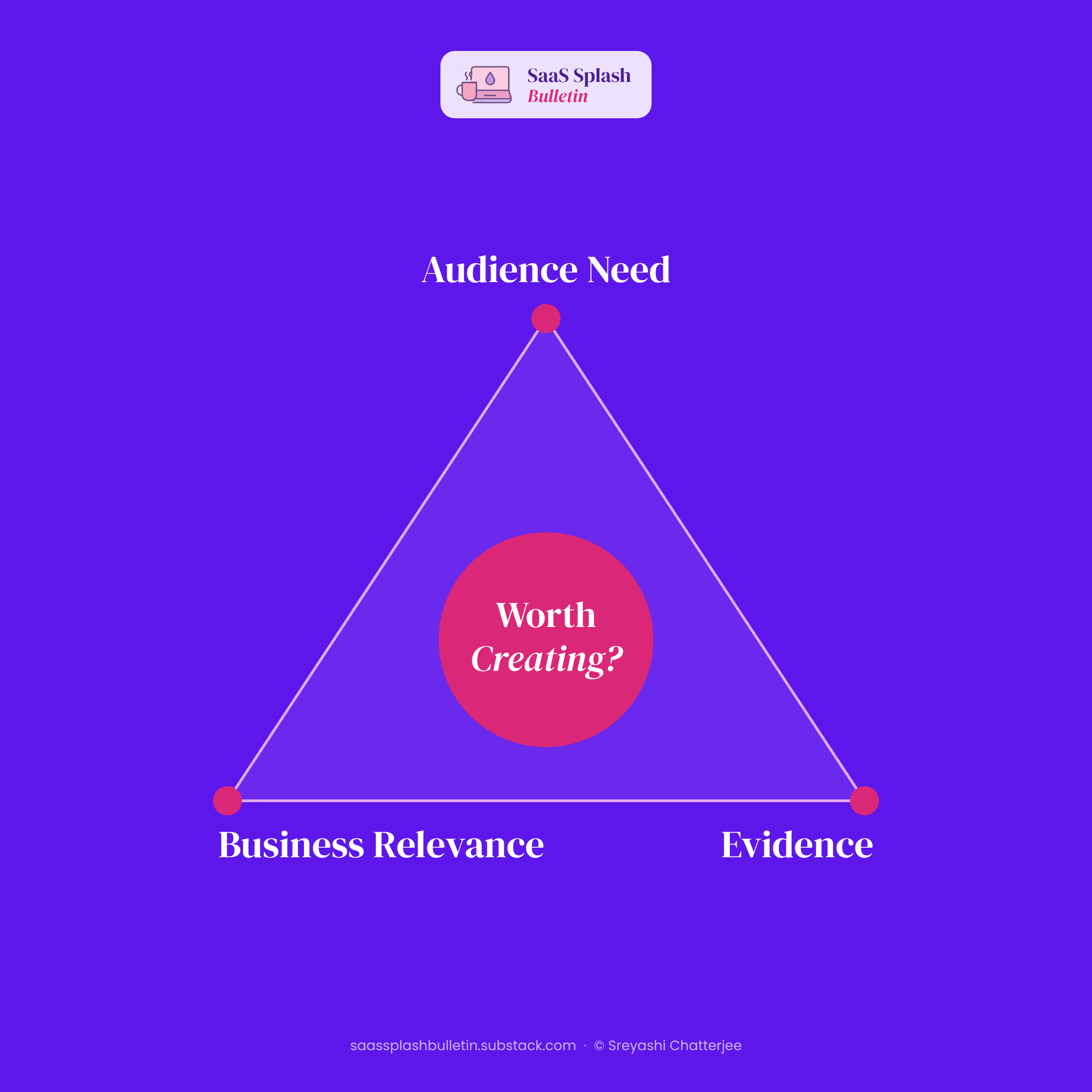
Prioritize content based on audience needs, business relevance, and evidence.
Judge content quality beyond writing and presentation.
Test assumptions before investing months in execution.
Choose metrics based on what each piece of content should achieve.
Build better judgment by documenting decisions, evaluating outcomes, and learning from them.
1. Knowing what deserves to be created
One pattern that emerged from the discussions was the difficulty of identifying content opportunities that contribute to business outcomes.
In a thread about content marketing challenges, one contributor described spending months publishing helpful blog posts that generated traffic but barely converted.

They reported changing their approach by working backward from closed deals, asking customers what they searched for before discovering the product, and building content around those questions.
Their reported results:
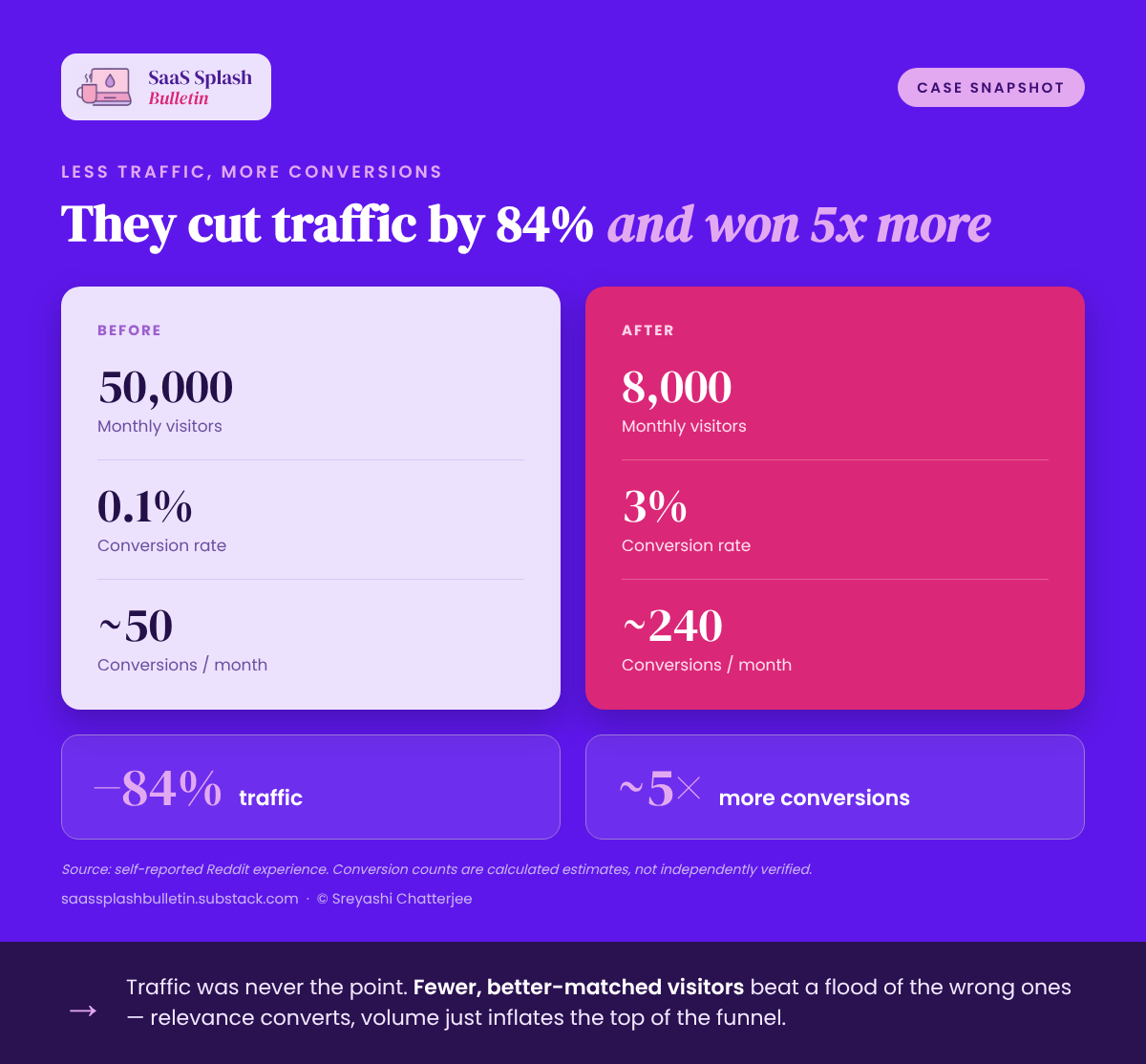
The interesting part is the decision behind the results.
They stopped treating traffic potential as the primary reason to create content and started looking for evidence of actual buyer demand.
That’s the first judgment skill: distinguishing an attractive content opportunity from a relevant one.
Before committing to a topic, I would ask:
Is there evidence that our audience actually cares about this problem?
Does it connect to something our product or expertise can genuinely address?
Do we have a perspective or evidence worth adding?
A competitor ranking for a keyword is useful information. It isn’t necessarily a reason to create the same article.
2. Knowing what is good enough to publish
Another recurring concern was the growing volume of generic content.
In one of the discussions, contributors talked about AI-generated content that sounds polished but fails to convert, and how much harder it has become to produce something genuinely useful.
I think there’s an important distinction here.
Well-written content and valuable content aren’t necessarily the same thing.
An article can have excellent structure, clear explanations, and perfect grammar while offering very little that readers couldn’t find in ten other articles.
So how do we judge quality?
I’d use four questions before publishing:
Relevance: Does this answer a specific question our audience has?
Originality: What perspective, example, or evidence are we adding?
Credibility: Can we substantiate the important claims?
Usefulness: Will someone understand or do something differently after reading it?
And based on those answers, make one of three decisions: Publish. Improve. Reject.
Sometimes the best editorial decision is to avoid publishing something that adds little value.
3. Knowing what will work before wasting months on it
This might be the most difficult judgment to develop.
How do you know whether a content strategy will work before you’ve invested months in executing it?
The short answer is that you can’t know with certainty. But you can get better at evaluating your assumptions.
We create quarterly plans, commit to topic clusters, and invest in campaigns based on assumptions that haven’t necessarily been tested.
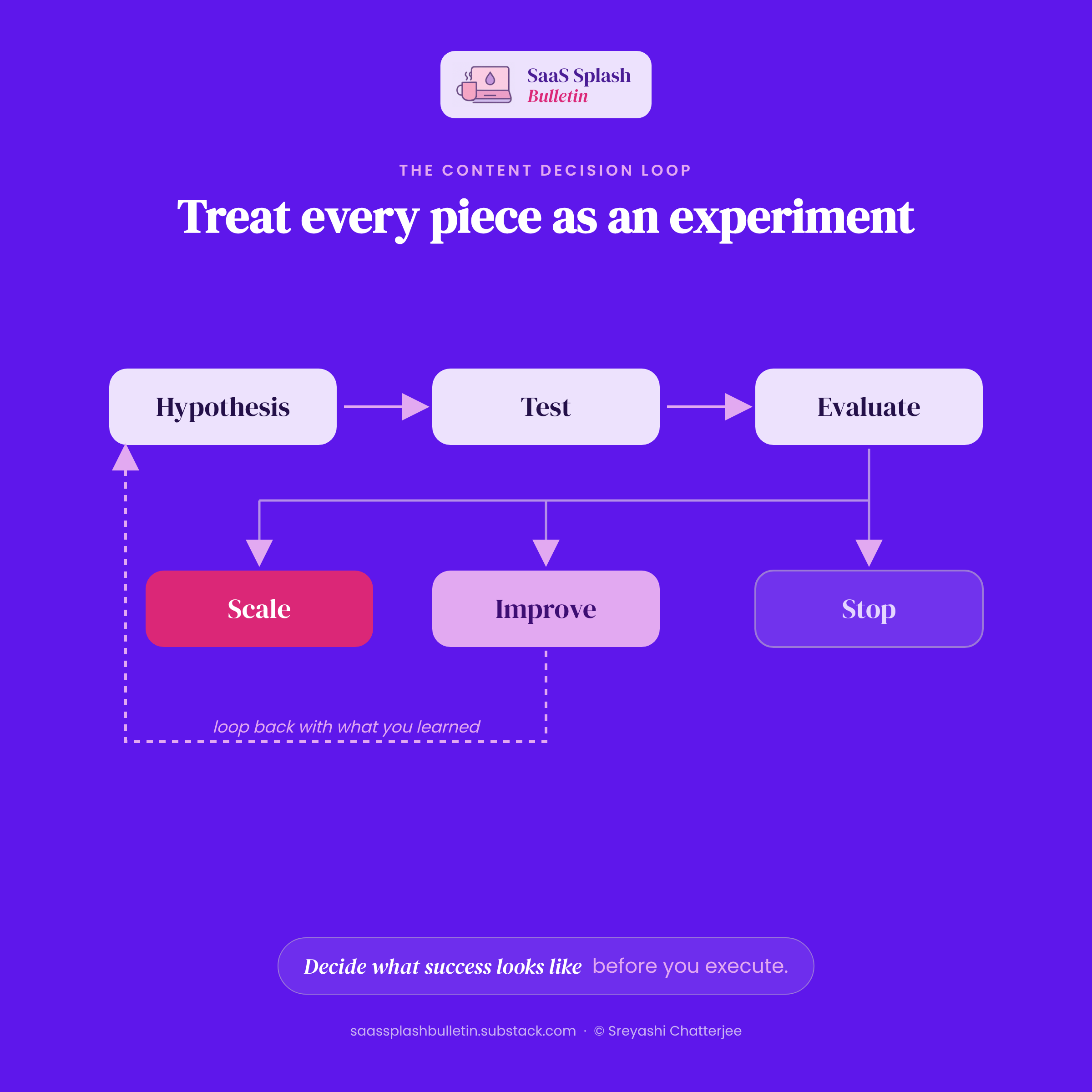
What if we treated more content decisions as hypotheses?
For example:
Hypothesis: Our audience needs more practical content about evaluating AI tools.
Before committing to a certain number of articles, we could:
Validate the problem through customer conversations and community research.
Publish one strong article addressing a specific question.
Distribute it to the intended audience.
Evaluate relevant engagement and buyer signals over a suitable period.
Then decide whether to expand, improve, or change direction.
Of course, some outcomes, particularly organic search growth, take longer to emerge. A short test can’t tell us everything.
But it can help us identify weak assumptions before scaling an entire initiative.
4. Knowing which metrics actually matter
This is where judgment becomes particularly interesting.
We have more marketing data than ever. Search Console, Google Analytics, CRM dashboards, social analytics, and now AI-visibility platforms.
But having access to data doesn’t necessarily mean we know how to interpret it.
The Reddit discussions raised concerns about proving content ROI, fragmented distribution, and unclear attribution.
Many contributors on Reddit specifically questioned how teams determine whether content influences pipeline, trust, sales conversations, or brand visibility, rather than simply generating traffic.
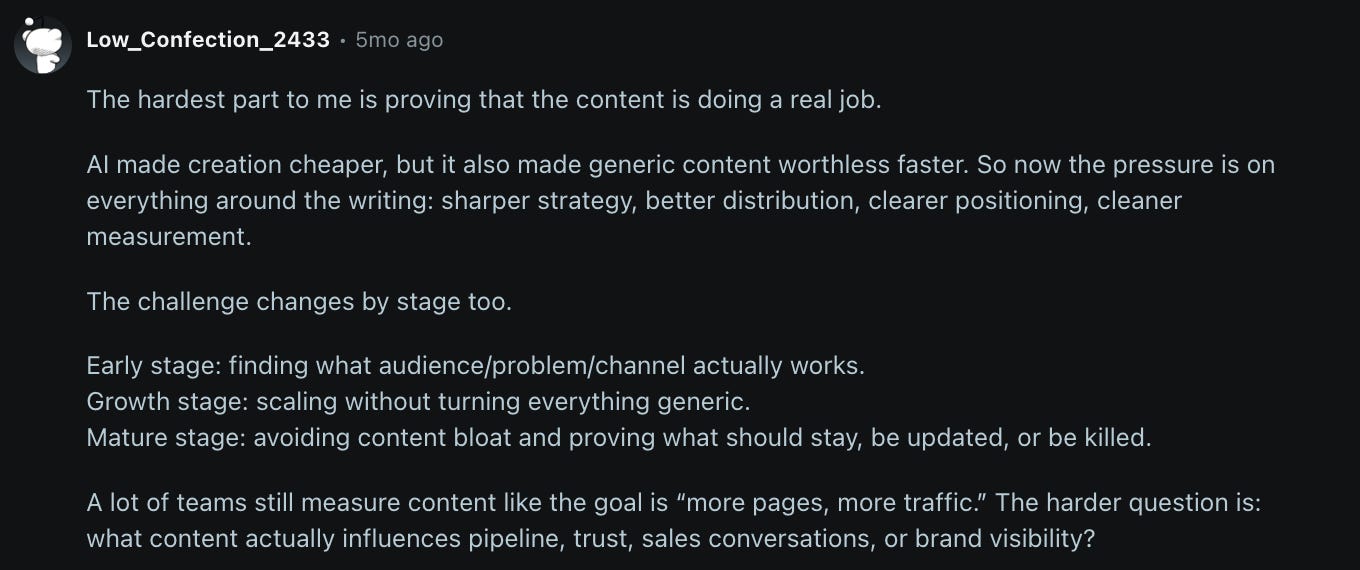
And I think that’s the right question.
Consider three articles:
Article A generates 20,000 visitors but no qualified leads.
Article B generates 2,000 visitors and 15 qualified leads.
Article C generates little measurable traffic but is repeatedly referenced in sales conversations.
Which performed best?
It depends on what each article was supposed to achieve.
A thought leadership article, a product comparison page, and an educational guide shouldn’t necessarily be evaluated using the same primary metric.
I’d start by assigning a clear job to every major piece of content.
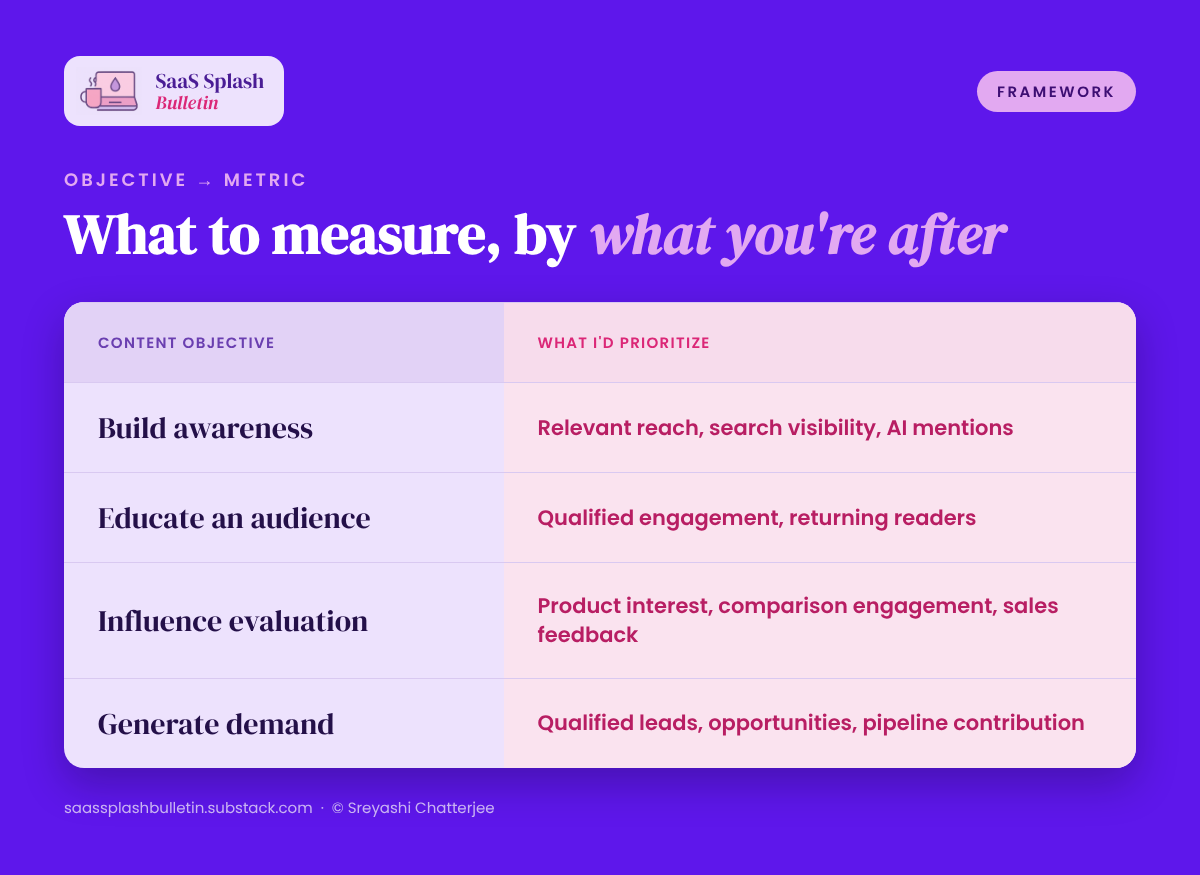
These are starting points, not perfect attribution models.
And that’s another part of judgment: recognizing when the available data is incomplete.
So how do we actually develop better judgment?
I don’t think judgment is something we automatically become good at after spending a certain number of years in marketing.
Experience helps, but only when we learn from the decisions we’ve made.
One practical habit I’d recommend is maintaining a content decision journal.
Nothing complicated. Whenever you’re making an important content decision, document five things:
The decision: What am I choosing to do?
The reasoning: Why do I believe this is the right choice?
The evidence: What information supports it?
The uncertainty: What am I assuming or potentially overlooking?
The outcome: What actually happened and what I learned.
For example, if you decide to create a competitor comparison series, record why you believe it will work.
Maybe sales frequently hears questions about those competitors. Maybe the queries show strong commercial intent.
Then revisit the decision after a reasonable evaluation period.
Did it attract the intended audience?
Did it contribute to meaningful sales conversations?
Were your original assumptions correct?
Over time, this helps you recognize patterns in your own decisions, including where your instincts are strong and where you tend to misjudge opportunities.
🚀 Need help growing your career in SaaS marketing?
In my 45-minute 1:1 calls, I can help you with:
Resume and portfolio reviews
Job interview preparation
Moving from content marketing to product marketing
Building stronger SEO, AEO/GEO, and analytics skills as a content professional
Content strategy, conversions, and freelancing
Share your questions and relevant links in advance, and I’ll come prepared with specific, actionable suggestions. ✨
45 minutes | ₹1,599
One last thought
I think we’re going to spend less time struggling with how to create content and more time deciding what deserves to be created.
AI can give us 50 topic ideas, analyze performance data, and help us publish faster. But it doesn’t remove the need to decide which ideas are worth pursuing, which content genuinely serves readers, and which results deserve our attention.
And developing that judgment requires something quite practical:
Making decisions, examining the reasoning behind them, and learning from what happens next.
That’s a skill I’m increasingly interested in getting better at.
What about you? Which content marketing decision do you find the hardest to make? They care whether it gives them enough information to make a better decision.
And perhaps that’s where our content strategy should begin.
📚 Check out my digital products & services purchased and loved by 270+ writers and marketers
AI+Human Content Playbook: For Content Marketers only. Essentially, for those under pressure to produce a large volume of content, it limits their ability to learn and experiment with other aspects of content marketing.
💡New update: A Claude skill.md file to accelerate your writing workflow! No price change.
SaaS Content Marketer Handbook: 1-YEAR handbook for content marketers joining a product startup, includes realistic goals, execution steps, and all the templates and frameworks you’ll need.
BOFU Content E-book: Get my updated BOFU Content e-book that covers three new chapters on BOFU content beyond alternatives and comparisons, BOFU attribution, and AI workflows for BOFU content.
💡New update: A ready-to-run Claude skill that writes BOFU comparison content end-to-end: "[Competitor] alternatives," X vs Y, product reviews, and "best [category] software" listicles.
Say hi on LinkedIn 👋
Onwards and upwards,
Sreyashi
Research partner: Jamila Piplyawala