


Hey friend, how’s it going? 🌻
We all have a list of people we follow religiously on LinkedIn. We subscribe to their newsletters, save their posts, and occasionally think, I wish I could create content like this. But what after that?
It’s one thing to get inspired by other creators in your field. It’s another to actually understand why their content works, what they consistently talk about, and how all those individual posts fit into a larger strategy.
So for this issue, I’m using one of my favorite content marketers, Ryan Law, as an example and breaking down how I would analyze a creator’s content strategy from scratch.
Ryan is the Director of Content Marketing at Ahrefs, and I’ve been following his work since his Animalz days. But this isn’t really about Ryan. You can apply the same process to any creator whose work you admire.
Let’s get into it 👇
📌 TL;DR
Start with at least three months of content, not the creator’s five posts you happen to remember.
Find their recurring content pillars, then look at the different angles they use within each.
Separate what they talk about from how they talk about it: direct promotion, indirect promotion, expertise, opinion, proof of work, etc.
Go beyond posts. Their headline, About section, Featured section, website, and newsletter tell you what they actually want their audience to associate them with.
Step #1: Start by collecting, don’t jump to analysis first
Pick one creator you genuinely admire. Then collect at least the last three months of their content.
You can use AI to make this part easier. Put the posts into a spreadsheet, remove reposts and reshares, and keep the content they actually created.
For my Ryan Law analysis, I created something like this:
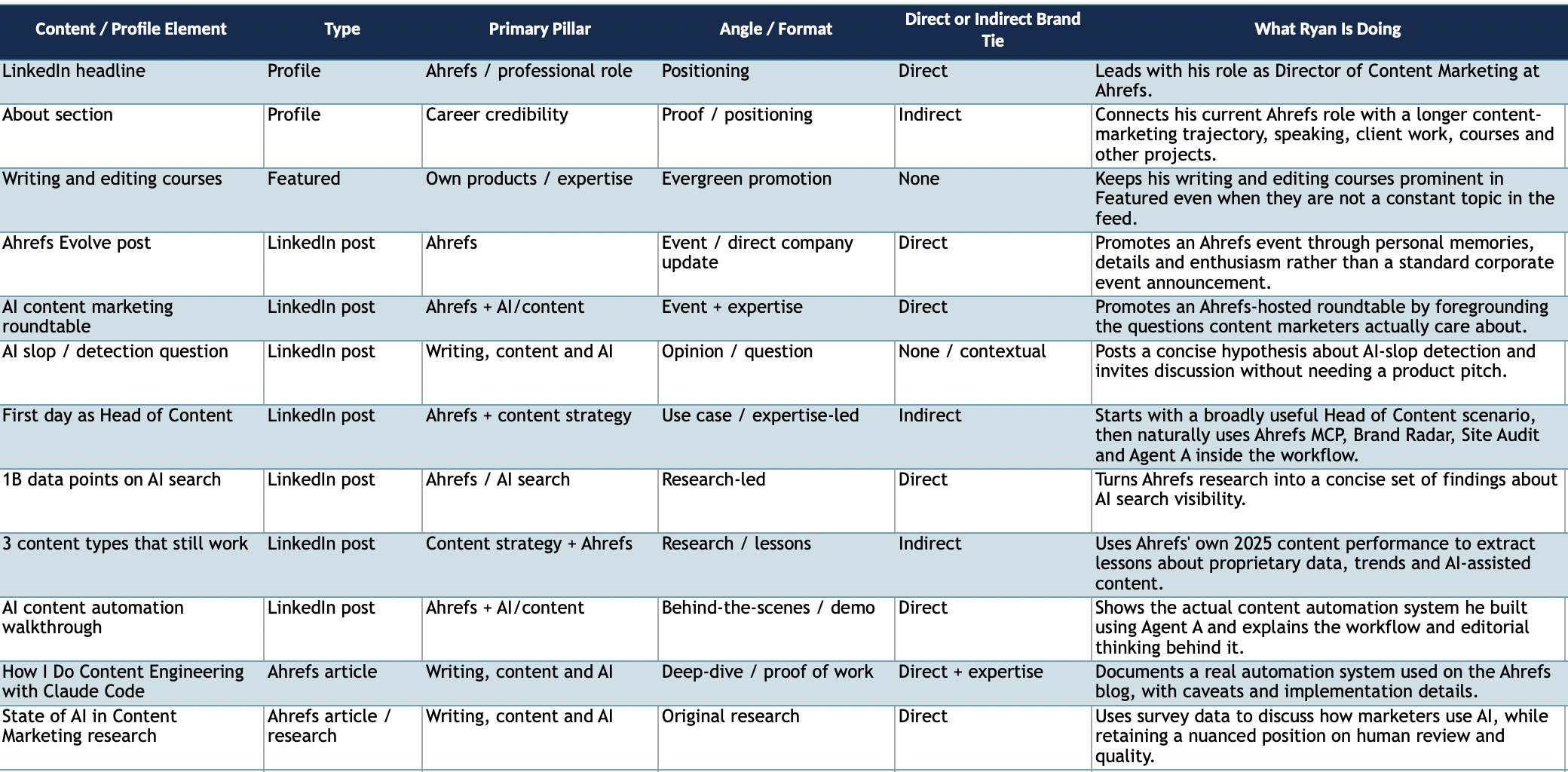
You don’t need anything particularly sophisticated at this point. I would simply track:
Post/topic
Content pillar
Angle or format
Whether there is a direct/indirect company or product connection
What the person is actually doing with the post
And then I would start looking for patterns. The question to focus on here is: What does this person consistently want to be associated with?
Step #2: Find their content pillars
Once you have enough posts in one place, the recurring themes become much easier to spot. With Ryan, for example, I see three broad areas.
1. Ahrefs and the work happening there
AI search, SEO, research, Ahrefs updates, events, product capabilities and the work his content team is doing.
2. Writing, content and AI
This is also naturally his area of expertise. He talks about writing, content marketing, AI-generated content, content workflows, and how the role of a content marketer is changing.
3. His own work and products
His writing and editing courses are an obvious example. He doesn’t talk about them nearly as frequently as he talks about Ahrefs or content marketing, but they are still part of how he has positioned himself.
And that last part is important. Frequency is also part of the strategy. Your content pillars don’t have to get equal airtime.
Someone might talk about their area of expertise 50% of the time, their company 30% of the time, and their own products only occasionally.
You’re trying to understand that distribution too.
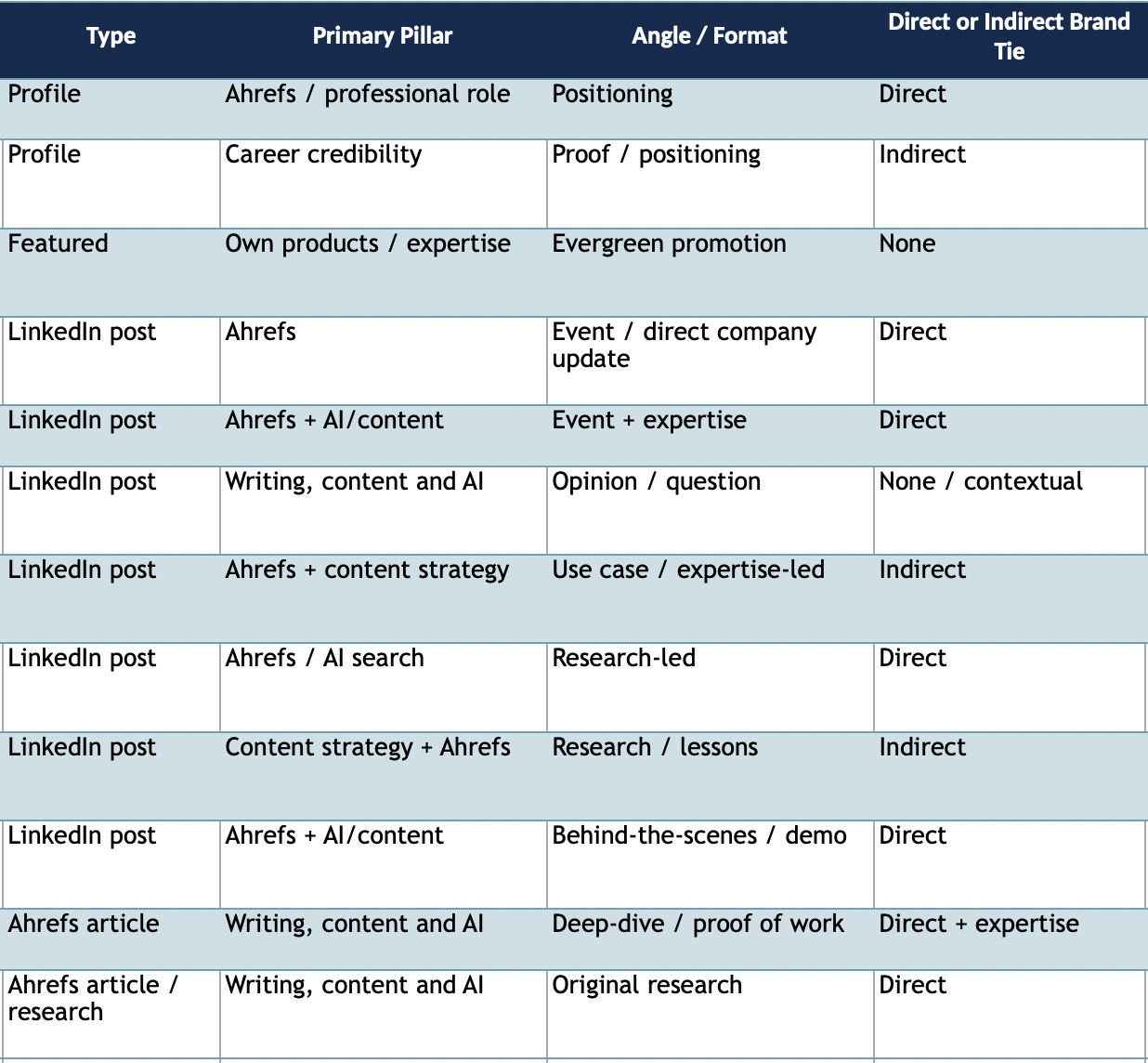
Step #3: Now go one level deeper. How are they talking about each pillar?
This is probably the most useful part of the exercise.
Knowing that Ryan talks about Ahrefs doesn’t tell me much.
I want to know how he manages to keep talking about Ahrefs without publishing the same kind of post every week.
And when you break it down, there are several approaches.
Sometimes it’s direct. He shares an Ahrefs event, a new piece of research, something his team has published, or something they’re working on.

Sometimes the research itself becomes the content.
For example, he has shared findings from Ahrefs’ AI search studies directly on LinkedIn, turning company research into useful, standalone insights.
Sometimes Ahrefs enters the conversation much more indirectly.
One post I particularly liked begins with what Ryan would do on his first day as Head of Content.
The premise has nothing to do with promoting Ahrefs. It’s a genuinely useful question for his audience.
But as he walks through what he would actually do, things like Ahrefs MCP, Brand Radar, Site Audit, and Agent A naturally become part of the workflow because those are tools he actually uses.
That’s very different from:
“Here are five reasons you should use Ahrefs.”
And this is exactly what I would look for when analyzing another creator.
For every pillar, ask:
What are the different angles they use?
Direct update?
Personal experience?
Opinion?
Research?
Use case?
Behind-the-scenes?
Something they learned at work?
A question?
A story?
Once you start looking at content this way, one “content pillar” can suddenly give you ten different directions.
Step #4: Look for the overlap between their expertise and their work
Ryan has one advantage that I think is worth calling out. He’s a content marketer working at Ahrefs. So there’s a huge overlap between what he personally knows about, what his audience follows him for, and what his company does.
If he’s talking about content marketing, AI search, or SEO, an Ahrefs mention doesn’t necessarily feel like he’s suddenly switched into employee-advocacy mode.
It belongs there. And if you’re working full-time, I think it’s worth doing this exercise for yourself too. Draw two circles:
What do I genuinely know enough about to talk about?
and
What problems does my company/product solve?
Where do those two overlap?
If you’re happy with the company you work for and believe in what you’re building, that overlap can be an incredibly useful content source.
You’re contributing to your company’s visibility, yes. But you’re also publicly building proof that you understand the problems you’re being paid to solve.
That’s useful for your current job and your own career.
Step #5: Don’t just study their feed. Study their profile.
This is something I think we miss when we’re analyzing creators. We scroll through their posts. But their posts are only one part of their strategy.
Go back to the top of their profile.
Look at:
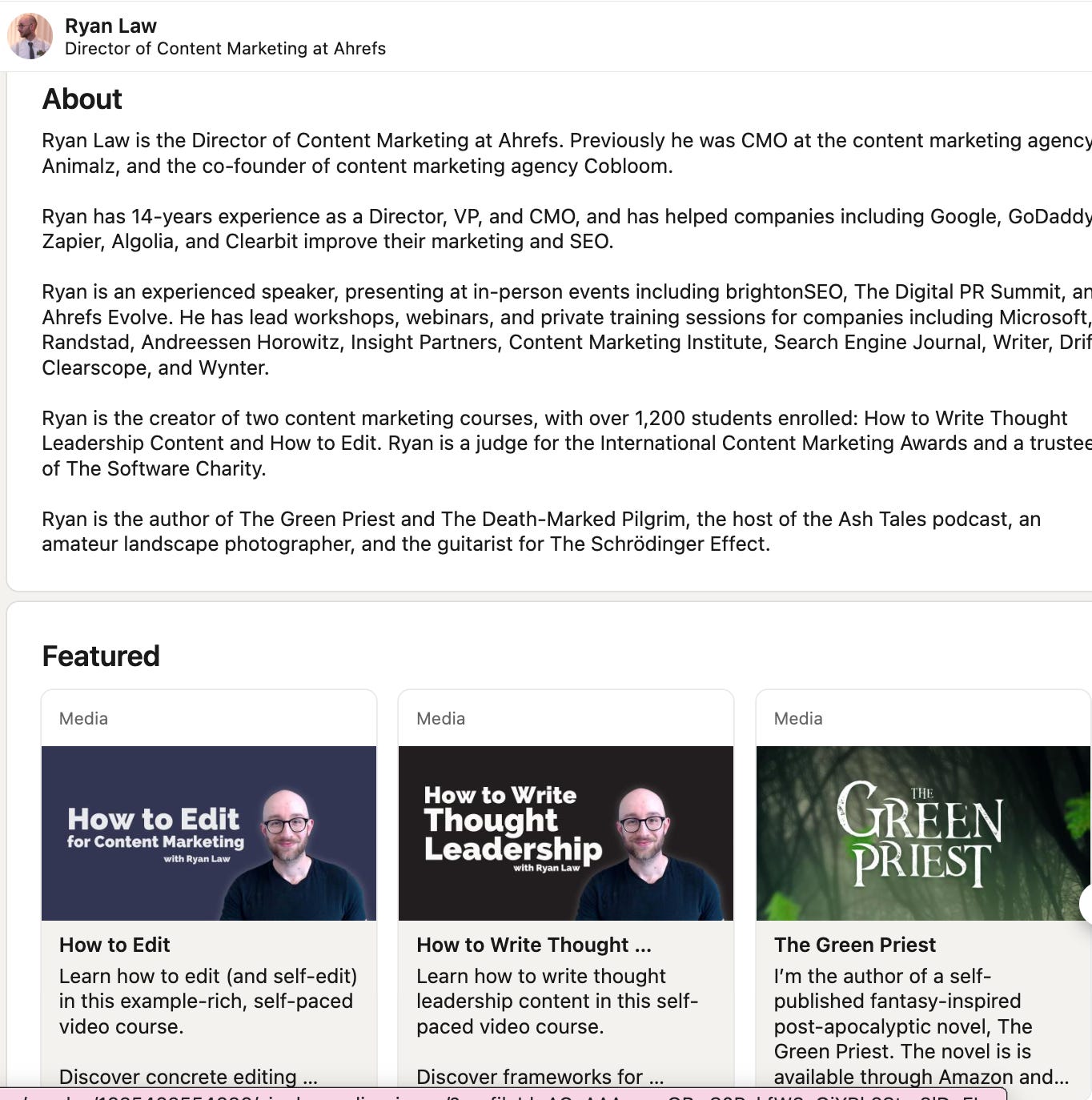
Their headline: What is the first association they’re trying to create?
Their About section: What experience and proof do they choose to emphasize?
Their Featured section: What gets permanent real estate?
Their current role: How do they describe what they’re doing?
Ryan is an interesting example here.
His current role at Ahrefs is immediately clear from his headline. But when you go to his Featured section, you’ll also find his writing and editing courses. He doesn’t need to publish a course-related post every week for those products to remain visible.
The profile is doing some of that work for him.
Which brings me to a distinction I’ve started finding useful:
Your feed tells people what you’re thinking about right now. Your profile tells them what you want to be known for.
Look at both.
Step #6: Go outside LinkedIn too
If the creator has a personal website, portfolio, Substack, or another publication, don’t stop at LinkedIn. Go there.
Look at what topics deserve long-form treatment.
Look at the case studies or projects they showcase.
Look at the proof they use.
Look at how they describe themselves when they aren’t constrained by LinkedIn’s profile format.
Even pay attention to recurring phrases.
Because at this point, you’re no longer analyzing someone’s LinkedIn strategy. You’re starting to understand their positioning. And that’s far more useful.
Step #7: Finally, bring it back to yourself
This is where I think most “inspiration” exercises go wrong. If Ryan talks about Ahrefs frequently, my takeaway shouldn’t automatically be:
“I need to talk about my employer more.”
If another creator has a successful course, my takeaway isn’t:
“I should launch a course.”
And if somebody writes long, opinionated posts that perform incredibly well, that doesn’t mean I suddenly need to start writing 2000-character LinkedIn posts.
Instead, after doing the analysis, I would answer these questions:
Creator I studied:
Their 3–4 recurring content pillars:
Angles they repeatedly use within those pillars:
How they talk about their work/company directly:
How they bring it in indirectly:
What their profile positions them as:
What proof they repeatedly use:
What I can genuinely adapt to my own situation:
What works for them but makes absolutely no sense for me:
That last question might actually be the most important one. Because the point of studying your favorite creators isn’t to reverse-engineer your way into becoming them.
It’s about understanding the decisions behind the content you already admire.
We save hundreds of posts because something about them worked on us.
I’ve started finding it much more useful to stop asking:
“How can I write something like this?”
and start asking:
“Why does this person keep creating this kind of content in the first place?”
That’s usually where the actual strategy is hiding.
📚 Check out my digital products & services purchased and loved by 270+ writers and marketers
AI+Human Content Playbook: For Content Marketers only. Essentially, for those under pressure to produce a large volume of content, it limits their ability to learn and experiment with other aspects of content marketing.
💡New update: A Claude skill.md file to accelerate your writing workflow! No price change.
SaaS Content Marketer Handbook: 1-YEAR handbook for content marketers joining a product startup, includes realistic goals, execution steps, and all the templates and frameworks you’ll need.
BOFU Content E-book: Get my updated BOFU Content e-book that covers three new chapters on BOFU content beyond alternatives and comparisons, BOFU attribution, and AI workflows for BOFU content.
💡New update: A ready-to-run Claude skill that writes BOFU comparison content end-to-end: "[Competitor] alternatives," X vs Y, product reviews, and "best [category] software" listicles.
Say hi on LinkedIn 👋
Onwards and upwards,
Sreyashi
Excellent breakdown! As a Senior Developer, I can absolutely confirm that robust RAG architectures and automated pipeline scaling are at their absolute peak right now.
Due to a recent shift in my technical focus, I’m actually offloading full Intellectual Property (IP) ownership rights to my production-tested 4-in-1 FastAPI Backend Suite (featuring an AI Meeting Summarizer, Auto-Social Poster, Reputation Manager, and a programmatic SEO engine).
It completely bypasses 3+ months of engineering cycles and is ready to deploy as a premium white-label asset. Selling the entire bundle (modular codebase +domain) for a flat fee of $8,000 via secure Escrow.
If any agency owners or technical directors here want to save thousands in development overhead and upscale your B2B offers instantly, feel free to drop a reply or send me a direct message!