


Hey friend,
How’s it going? 🌻
Welcome to my first official Substack edition of SaaS Splash Bulletin!
Let’s get started!
Let me ask you something.
The last time you shared your portfolio with a prospect, what did you show them?
A screenshot of an article sitting on page 1 of Google?
A featured snippet?
Traffic numbers from Ahrefs?
If yes, I get it. That was the move for years. It made sense. It showed that you knew what you were doing.
But that playbook is getting obsolete. And it’s time you start deciding what comes next.
So today’s edition is about exactly that: how to show your impact as a content writer in the GEO era.
Let’s get into it 👇
📌 TL;DR
Old proof of work is breaking (AI Overviews are reducing clicks)
AI Overview citations alone aren’t enough to establish your impact
My 3-tier framework to categorize visibility
5 steps to show impact properly + Bonus tips
The old way of showing proof of work
For a long time, the proof-of-work story was simple.
You wrote an article.
It ranked on page 1 of Google, or maybe it landed a featured snippet.
You screenshotted it, dropped it in your portfolio, and moved on.
If you had access to Ahrefs or Semrush, you could go a layer deeper: traffic value, keyword positions, and how your piece outperformed a competitor.
Freelance writers rarely have access to tools like GA4 or CRMs for client accounts. So the ceiling was always SERP rankings and maybe some traffic screenshots.
You couldn’t say “this article generated 12 demo requests.” But that was... fine. Until now.
Why the old playbook is breaking
Here’s what changed.
Ahrefs analyzed 300,000 keywords and found that 99.2% of keywords triggering AI Overviews are informational in intent
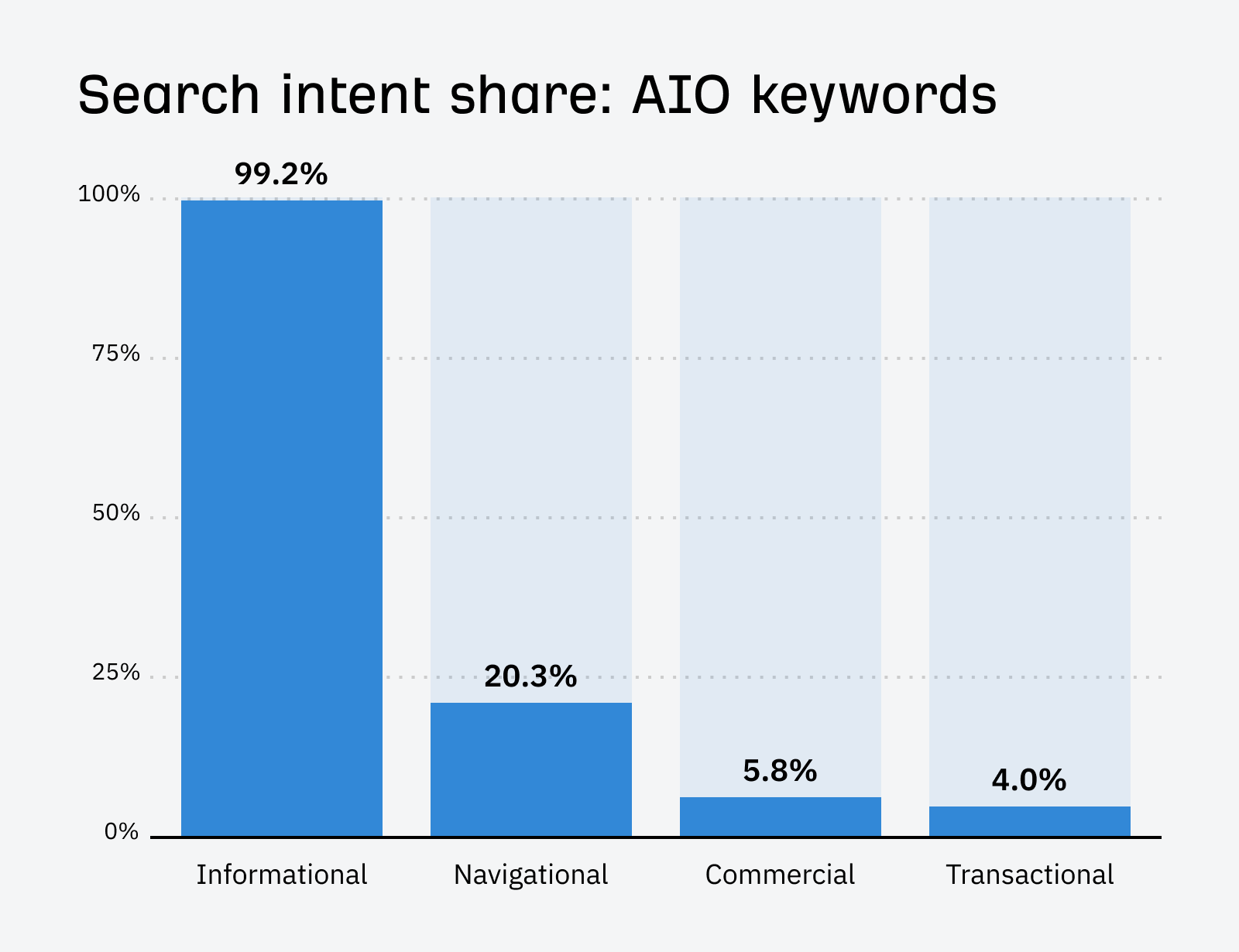
What does this mean?
The kind of articles you used to write for SaaS clients: what is X, how does Y work, benefits of Z, those are the exact ones being consumed in the AI Overview and never clicked on.
Gartner projects a 25% decline in traditional search traffic by the end of 2026, with some analysts predicting organic search traffic will decline 50% or more by 2028.
So when you say “my article is ranking on page 1,” the follow-up question is: are people actually clicking it?
Because position 1, with an AI Overview above it, is very different from what it was two years ago.
A Pew Research study tracking 68,879 actual Google searches found that users clicked on a traditional search result only 8% of the time when an AI Overview appeared, compared to 15% without one.
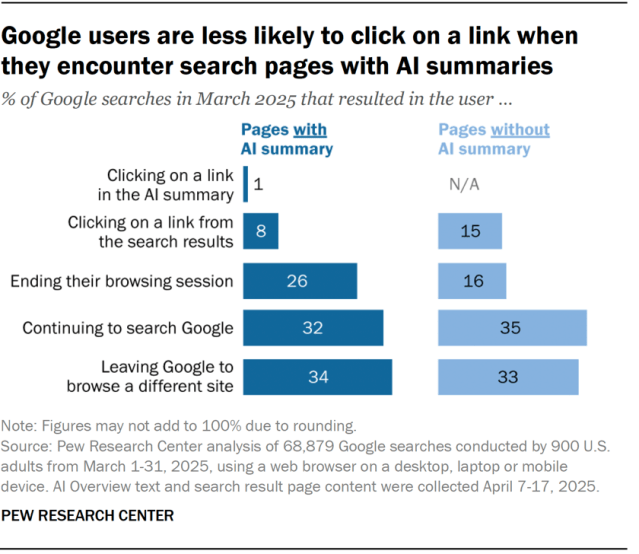
That’s nearly half the clicks, gone.
The new “proof of work” people are reaching for (and its problem)
Here’s what I see a lot of writers doing now, especially on LinkedIn.
They post: “My article is cited in AI Overview for [keyword]!” Screenshot attached.
That makes sense as a reflex. If the old benchmark was featured snippets, the new equivalent seems to be AI Overview citations.
But I want you to understand this fully before you use it as your main proof point.
According to Semrush’s study, 91.3% of queries triggering an AI Overview were informational.
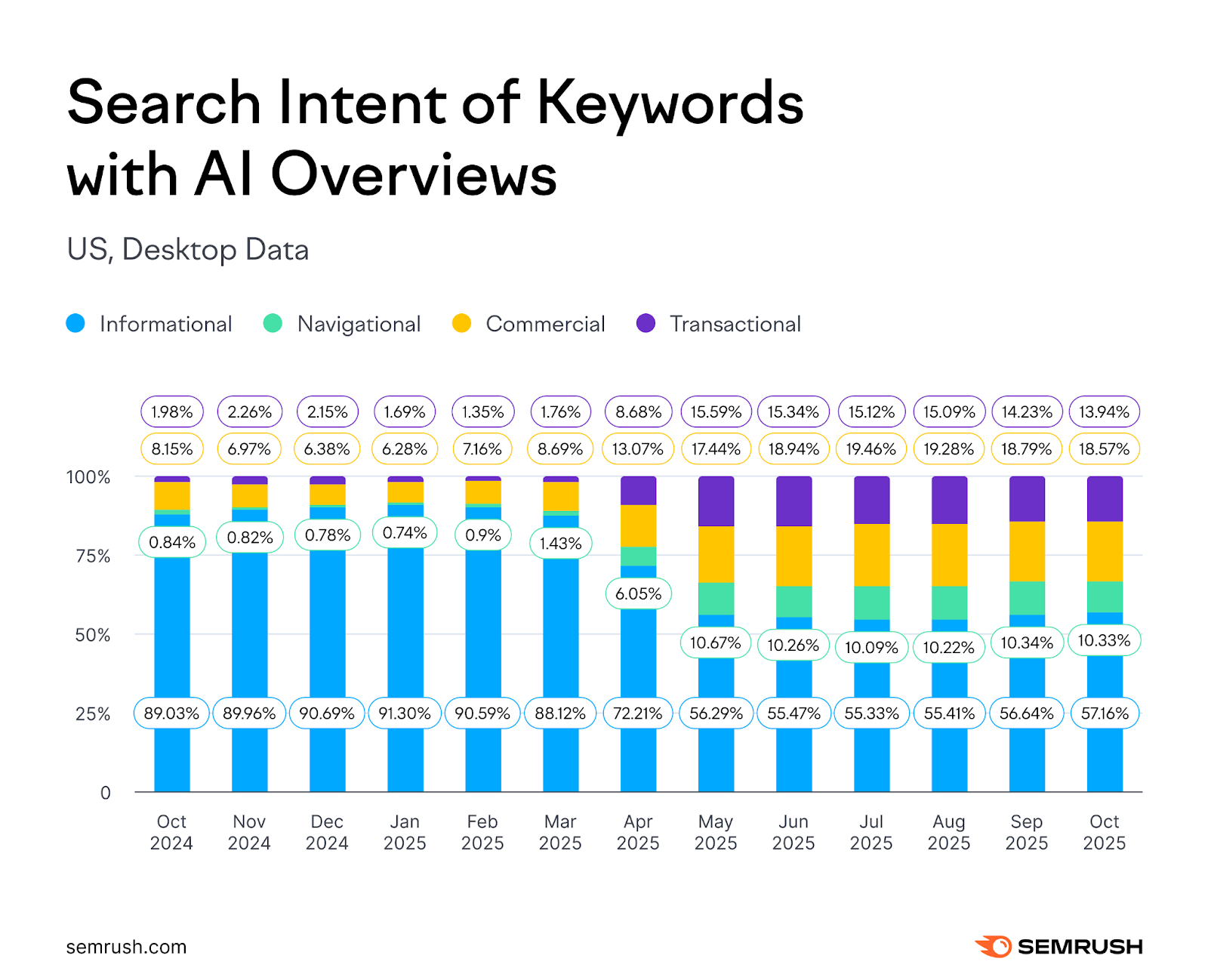
These are the “what is” and “how does it work” type queries. Your article being cited here means Google found it useful for summarizing a concept. That’s not nothing.
But it also doesn’t mean a reader clicked through, understood your client’s product deeply, and became a qualified lead. And the person reviewing your portfolio? If they’re aware of these aspects (and most are), they know this.
There’s also a subtler issue: AI tools are not neutral arbiters of quality. A SparkToro study ran 2,961 queries through ChatGPT, Claude, and Google AI across 12 different prompts and found significant inconsistency in brand and product recommendations: AI results varied dramatically depending on the query phrasing, model, and context.
This is the personalization problem I’ve run into myself: if you’re constantly talking about a client’s brand with an AI tool you’re logged into, the tool starts reflecting that familiarity back at you. Ask someone from a different geography or a fresh account the same prompt, and the results can look completely different.
So “my article is mentioned in AI Overview” as a lone signal? Fragile. Unless you contextualize it properly.
Schedule a 1:1 Freelance Positioning call with me, where I help you position yourself more effectively and create a custom GPT tailored to your positioning. Find out more here!
What actually works now: a step-by-step approach
Here’s what I’d do instead. And the good news is: this doesn’t require expensive tools.
Step 1: Choose high-intent prompts, not just topic-level ones
Don’t just search “what is [category] software” and screenshot whatever comes up. That’s too vague.
Think like a buyer. What would someone ask ChatGPT or Perplexity when they’re actually considering a purchase?
Something like “best [category] management software for mid-market companies” or “how do I choose between X and Y for [use case]?”
These are the prompts that matter. If your article is influencing the answer to those questions, that’s a story worth telling.
Step 2: Run these prompts in a clean, logged-out environment
Don’t run them in your own ChatGPT, Claude, or Perplexity account where you’ve been working with your client’s content. Use an incognito window. Or better, ask someone in a different city or country to run the same prompt.
AI tools show documented biases based on training data and ecosystem proximity and your personal usage history can skew results in your own sessions. If you want your portfolio to be credible, your screenshots need to be from neutral conditions.
Step 3: Categorize what you find into three tiers
Not all AI visibility is equal. Here’s how I’d frame it:
🥇 Mentioned and cited as a source: the article appears, and the source URL is linked. This is your strongest signal. It means the AI engine found the content trustworthy and specific enough to attribute.
🥈 Mentioned without citation: the brand or topic is referenced, but your article isn’t the visible source. This still has value, but it may be due to other factors such as review platform presence, backlinks, or brand authority. Don’t overclaim this one.
🥉 Not appearing: and that’s okay, depending on the intent stage. Not every article needs to show up in AI answers. A deep BOFU case study doesn’t need to rank in a “what is” AI Overview.
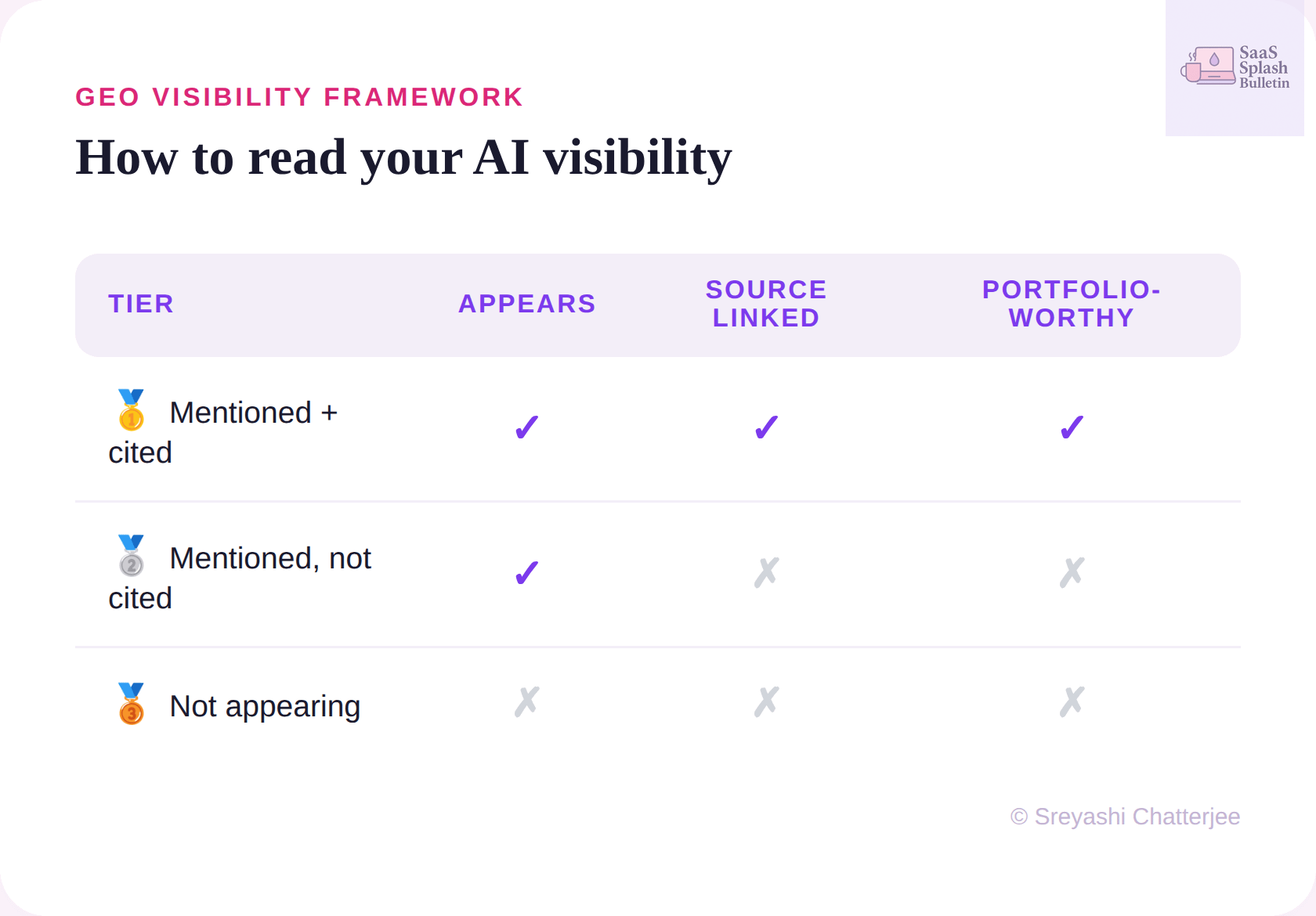
Present these tiers with context. Show the prompt. Show the output. Explain which stage of the funnel the article was targeting and what you were trying to achieve.
Step 4: Add a second layer — LLM traffic signals (if you have access)
If your client uses GA4, ask them (or their team) to share data on sessions from AI referrers like ChatGPT, Perplexity, or Claude.
LLM visitors convert at significantly higher rates than organic traffic. So even a small number of AI-referred sessions can be a powerful proof point.
50 sessions from ChatGPT that led to 8 demo signups is a better story than 5,000 organic sessions and nothing to show for it.
Step 5: Show the reasoning behind your content decisions
This is honestly underrated. One thing that separates good writers from strategic ones is being able to explain why you wrote what you wrote.
For example: “I wrote this article targeting the consideration stage. Here’s the prompt I anticipated buyers would use. Here’s how the article was structured to show up in AI-generated comparisons. And here’s how it performed.”
That kind of thinking is what clients are paying a premium for right now. Not just execution. Strategy.
One more thing worth knowing
Even “being cited in AI Overview” has a catch.
44.2% of all LLM citations come from the first 30% of the text — the intro. Which means if your article’s intro is weak, vague, or slow to get to the point, it’s less likely to be pulled into an AI response, even if the rest of the article is solid. The way you structure your opening paragraphs is now a GEO signal, not just a UX one.
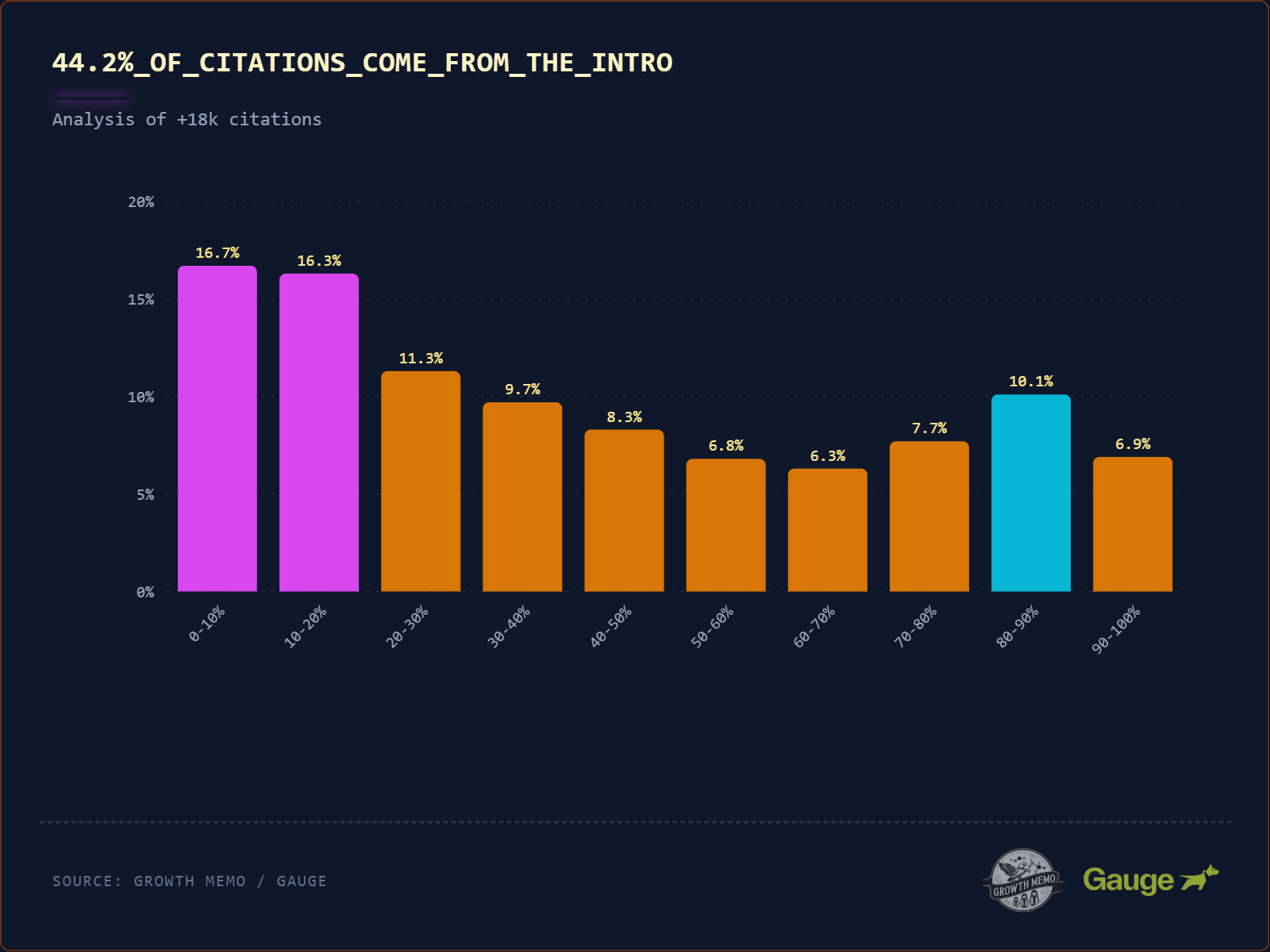
This is actually a skill you can talk about in your portfolio.
“I structure articles with front-loaded, citation-friendly intros to improve AI visibility” — that’s a concrete, differentiating thing to say.
The proof-of-work game hasn’t disappeared. It’s just gotten more nuanced.
The writers who understand the new rules and can explain them to clients — not just execute — are the ones who’ll hold their rates and build real longevity in this space.
That’s what GEO-aware writing looks like in practice.
📚 Check out my digital products purchased and loved by 200+ writers and marketers
BOFU Content E-book: Get my updated BOFU Content e-book that covers three new chapters on BOFU content beyond alternatives and comparisons, BOFU attribution, and AI workflows for BOFU content.
SaaS Content Marketer Handbook: 1-YEAR handbook for content marketers joining a product startup, includes realistic goals, execution steps, and all the templates and frameworks you’ll need.
AI+Human Content Playbook: It’s for CONTENT MARKETERS only. Essentially, for those under pressure to produce a large volume of content, it limits their ability to learn and experiment with other aspects of content marketing.
Say Hi on LinkedIn 👋
Onwards and upwards,
Sreyashi
One of your best editions, Sreyashi! Super informative!