


Hey friend, how’s it going? 🌻
I have been thinking about this question quite a bit lately, partly because I write my own newsletter on Substack, but also because I see more and more individuals and companies building newsletters directly on LinkedIn.
And I don’t think the answer is simply that one platform is better than the other.
It depends on who you are, what audience you already have, and more importantly, what you want the newsletter to eventually do for you.
So I researched and compared the two across discovery, thought leadership, AI visibility, subscriber relationships, and what happens as your newsletter grows.
Let’s get into it 👇
📌 TL;DR
If you’re an individual creator or subject matter expert trying to build an audience you own, I would lean towards Substack.
If you’re an established B2B company trying to reach more of the professional audience already engaged with your brand, I think LinkedIn makes a very strong case.
If AI search visibility is an important goal, LinkedIn currently has much stronger public evidence to support it. One 2026 study found LinkedIn appearing in roughly 11% of the AI responses it analyzed.
And if you’re an individual with an existing LinkedIn audience? The answer might not be LinkedIn or Substack at all. More on that later.
1. Reach and discovery
Let’s start with probably the biggest question when you’re launching a newsletter: Where will the readers actually come from?
For individuals, Substack has built a pretty serious discovery engine
One reason I think Substack works particularly well for individual creators is that you aren’t completely responsible for bringing every subscriber yourself.
According to Substack, more than half of new subscriptions now come from within the Substack network itself. It also says the platform has 5 million+ paid subscriptions, tens of millions of people reading, watching and listening every week, and more than 1 million posts being discovered by potential subscribers in its app every day.
That’s a substantial distribution system sitting around your newsletter. People can discover you through Notes, recommendations, the app, other publications, and Substack’s own network.
So if I’m an individual starting from scratch, this is pretty attractive.
I’m not only starting an email newsletter. I’m entering an ecosystem where readers are already actively looking for writers and publications to follow.
LinkedIn has a completely different advantage, especially for companies
Imagine you’re a B2B company with 30,000 LinkedIn followers.
You decide to start a newsletter. You don’t necessarily have to start building the audience from zero.
When a LinkedIn Page publishes its first newsletter edition, LinkedIn notifies its followers to subscribe. And there’s another interesting distribution loop.
When someone follows a person or Page that has a newsletter, LinkedIn can automatically invite them to subscribe to the newsletter as well.
So your company Page can keep feeding the newsletter.
Then, with each new edition, there is another distribution advantage: subscribers can receive notifications about it on LinkedIn and, depending on their settings, via email.
This is why I think LinkedIn newsletters make a lot of sense for companies that have already spent years building a following there.
Why send that audience somewhere else before you’ve even established whether they want your newsletter?
So my first distinction would be:
Substack gives an individual access to a network that can help them find an audience. LinkedIn offers an established company an easy way to activate an audience it may already have.
Of course, this changes if you’re an individual with 100,000 LinkedIn followers or a company with 200 followers. Which is why I wouldn’t choose either platform without considering where my existing distribution sits.
2. What kind of relationship do you want with your subscribers?
This is where the difference gets much bigger. On Substack, you’re building an email list. And crucially, you can export it. That matters a lot to me.
Because if I spent two years building thousands of subscribers and eventually decide that Substack isn’t right for me anymore, I haven’t necessarily lost the audience I spent three years building.
I can move.
LinkedIn works differently. You can see your subscribers. You can see new subscribers. You can even follow, connect with, or message them individually.
But LinkedIn’s documentation doesn’t describe an equivalent exportable email list.
Your subscribers remain LinkedIn subscribers.
And this is why, if I were an individual trying to build a long-term audience around my own name, I would be uncomfortable making LinkedIn the only home for my newsletter.
But there’s another side to this. Because LinkedIn knows something about your subscribers that an email newsletter often doesn’t.
Who they are professionally.
LinkedIn newsletter analytics can show subscriber demographics including:
Job title
Company
Company size
Seniority
Location
For a B2B company, that’s incredibly useful.
Imagine having 5,000 subscribers and being able to see whether you’re attracting individual contributors at small companies or senior leaders at the enterprise companies you’re actually trying to sell to.
That’s very different from knowing that 5,000 email addresses subscribed.
So this is another trade-off I would think about:
Substack gives you more ownership of the subscriber relationship. LinkedIn gives you much richer professional context around that subscriber.
For an individual creator, I value the first one more. For a B2B marketing team, the second one becomes extremely interesting.
3. If you want to build a community, Substack has a structural advantage
This is another reason I would lean toward Substack for individuals.
The newsletter doesn’t have to remain a one-way email forever.
You can have comments.
You can use Notes.
You can create subscriber-only conversations through Chat.
You can allow subscribers to start discussions themselves.
You can restrict conversations to paid subscribers or founding members.
And eventually, if you want to, you can turn part of the publication into a paid membership.
Substack says writers keep 90% of subscription revenue before credit card and payment processing fees. So there is a pretty natural progression available:
Reader → subscriber → regular reader → community member → paying subscriber
And all of that can happen inside the same ecosystem.
LinkedIn obviously gives you comments, reactions, and conversations too.
But I see the relationship differently.
People are on LinkedIn for lots of reasons.
They’re networking.
They’re job hunting.
They’re selling.
They’re reading industry content.
They’re checking notifications.
Your newsletter is one part of that experience.
With Substack, someone has made a much more deliberate choice to enter your publication’s ecosystem. That feels particularly valuable when the person is the brand.
4. Thought leadership is where the answer becomes less obvious
If I’m an individual expert, I like Substack because my publication can gradually become a body of work around me.
My archive lives together. People can discover other things I’ve written.
My subscribers can follow the publication rather than relying on an algorithm to show them my next LinkedIn post.
And over time, I can add community, paid content, products or services around that audience.
But LinkedIn has something Substack can’t replicate: professional context + existing professional distribution.
If I’m running content for a B2B company, I might actually want my thought leadership sitting right next to the company’s Page, employees, leadership team, customers, and industry conversations.
Someone can discover an article, click through to the company, see who works there, see what those employees are publishing, and continue exploring the brand.
And then I found something that made the LinkedIn argument even more interesting. AI search.
5. LinkedIn is becoming much more than a social distribution channel
This was probably the most surprising part of my research.
Semrush analyzed 325,000 unique prompts across ChatGPT Search, Google AI Mode and Perplexity in January and February 2026. From those responses, it identified 89,000 unique LinkedIn URLs. Across its dataset, LinkedIn appeared in roughly 11% of AI responses, making it the second-most-cited domain in the study.
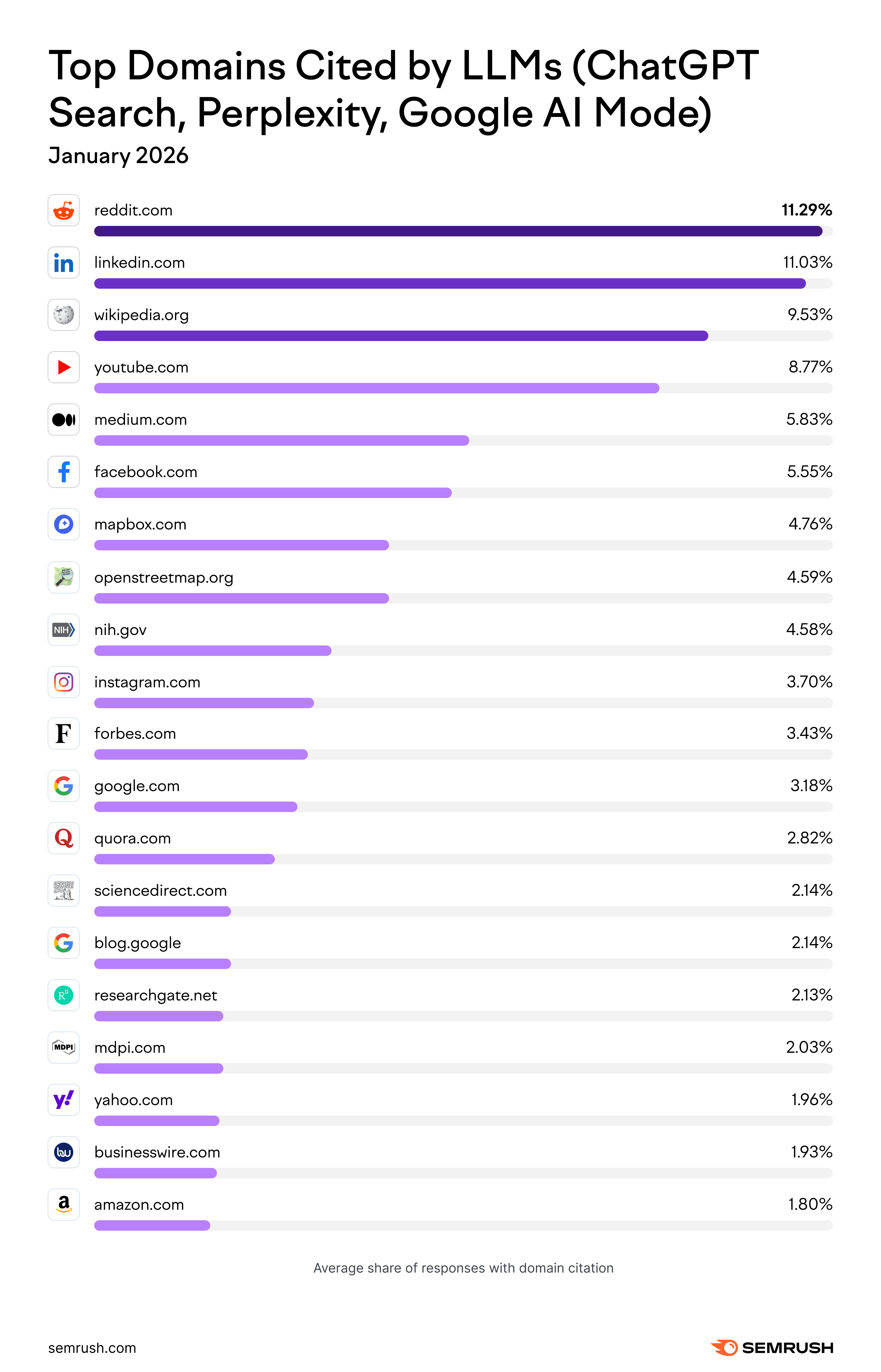
The percentage was even higher in some individual platforms:
ChatGPT Search: 14.3%
Google AI Mode: 13.5%
Perplexity: 5.3%
Now, this doesn’t mean publishing a LinkedIn newsletter automatically gets you cited by ChatGPT. Far from it. But it does change how I think about LinkedIn content.
Your company’s LinkedIn presence isn’t necessarily only content for people scrolling LinkedIn anymore. Some of that content can become source material for the systems people are increasingly using to research companies, products, and categories.
I would definitely use the Semrush chart showing LinkedIn’s citation rate across AI platforms.
This is probably the strongest visual/data point in the entire newsletter. And there was another finding I found important. The study didn’t only find individual creator posts.
It analyzed several types of LinkedIn URLs, including Company Pages, individual posts, long-form articles, job listings, and other LinkedIn content.
So if you’re a company thinking seriously about visibility in AI search, I don’t think LinkedIn should be treated only as the place where the social media manager distributes your blog posts anymore.
There is growing evidence that LinkedIn itself is becoming part of the information layer AI systems retrieve from. For B2B companies especially, that’s worth paying attention to.
6. What about Substack and AI search?
This is where my initial assumption proved partly wrong. I originally thought the argument would be:
If you’re publishing on Substack and care about AI/search visibility, you need to connect it to your own domain.
I couldn’t find evidence strong enough to make that claim.
In fact, Substack explicitly says it does work behind the scenes to help publications get indexed and ranked in search engines. It also offers SEO features such as sitemaps and Google Search Console verification as publications grow.
So having a normal yourpublication.substack.com A URL does not automatically mean your content is invisible to search engines. Substack’s SEO documentation literally states that it works to ensure publications are indexed and ranked in search engines.
You can also connect a custom domain to Substack.
At the moment, Substack charges a one-time $50 fee to do this. So you could have something like:
newsletter.yourcompany.com
instead of:
yourcompany.substack.com
Use the custom-domain setup page showing the $50 one-time fee and custom-domain option.
Would I personally use a custom domain if a company decided to build a serious publication on Substack? Probably yes.
I’d rather have a long-term publishing property connected to a domain the company controls. But I wouldn’t tell you that doing this will automatically improve your chances of being cited by ChatGPT.
I couldn’t find credible comparative research proving that. And that’s actually an important difference between the two platforms right now:
On LinkedIn, we have large-scale research showing substantial citation across major AI search platforms.
For Substack, we know the content can be indexed and optimized for search, but I couldn’t find a comparable large-scale study that compares how often Substack content appears in AI answers.
Until that data exists, I’d rather not pretend we know.
7. The analytics are also designed for slightly different goals
Substack gives you the kind of analytics I would expect when building a publication.
You can look at:
Subscribers
Paid subscribers
Open rate
Delivery rate
Link clicks
Traffic sources
Subscriber sources
Retention
Sharing
Notes
Revenue
You can also connect Google Analytics to get deeper visibility into page views, traffic sources, and conversions. Substack has a very screenshot-friendly metrics guide that shows Posts, Stats, and Growth views.
LinkedIn gives you something much closer to professional audience analytics.
You get:
Article views
New subscribers
Engagements
Email sends
Email open rate
Subscriber demographics
And again, those demographics can be broken down by factors such as seniority, company, and job title.
Use either the LinkedIn Newsletter Analytics page or its Post Analytics documentation showing email sends/open rate.
If I’m a creator, I probably care a lot about:
Where did my subscribers come from?
Which posts converted readers?
Are people staying?
Could this eventually become a paid product?
If I’m a B2B marketing team, I might care more about:
Are the right kinds of professionals actually reading this?
That’s a subtle difference. But it’s a meaningful one.
So, LinkedIn or Substack?
After going through all of this, here’s where I’ve landed.
If you’re an individual building your reputation from scratch, I’d lean toward Substack.
You get platform discovery, an exportable subscriber list, community features, and a clearer path towards eventually monetizing the audience.
If you’re an individual who already has a substantial LinkedIn audience → I wouldn’t rush to choose.
LinkedIn might be your best discovery channel.
Substack might still be the better place to build the deeper, more portable relationship.
Which means your strategy could simply be:
LinkedIn for discovery → Substack for depth and ownership.
That’s actually quite close to how I think about my own newsletter.
If you’re an established B2B company → I’d seriously consider LinkedIn.
Especially if you already have a meaningful following on the Page.
Your existing followers can be invited into the newsletter.
New followers can continue receiving invitations.
You get professional subscriber demographics.
Your newsletter lives inside the same ecosystem as your employees, executives, customers, and prospects.
And now there’s increasingly strong evidence that LinkedIn content is surfacing in AI search results, too.
If your company wants to build a serious owned media property → I wouldn’t make either platform the entire strategy.
This is where I’d think about:
Your website/domain as the owned content layer.
LinkedIn as professional distribution.
And potentially an email/newsletter platform as the subscriber layer.
Because maybe the mistake is assuming one platform has to do everything.
The question I would actually ask
When people ask:
“Should I start my newsletter on LinkedIn or Substack?”
I think we’re starting one step too late.
I’d first ask:
What do I eventually want to own?
An audience?
A community?
Professional reach?
Search visibility?
A paid publication?
A media property around my company?
Because a subscriber count can look identical across two platforms while representing two very different assets. And after researching this, that’s probably the biggest difference I see between LinkedIn and Substack.
Don’t start with where everyone else seems to be writing. Start with what you want the newsletter to become.
📚 Check out my digital products & services purchased and loved by 270+ writers and marketers
AI+Human Content Playbook: For Content Marketers only. Essentially, for those under pressure to produce a large volume of content, it limits their ability to learn and experiment with other aspects of content marketing.
💡New update: A Claude skill.md file to accelerate your writing workflow! No price change.
SaaS Content Marketer Handbook: 1-YEAR handbook for content marketers joining a product startup, includes realistic goals, execution steps, and all the templates and frameworks you’ll need.
BOFU Content E-book: Get my updated BOFU Content e-book that covers three new chapters on BOFU content beyond alternatives and comparisons, BOFU attribution, and AI workflows for BOFU content.
💡New update: A ready-to-run Claude skill that writes BOFU comparison content end-to-end: "[Competitor] alternatives," X vs Y, product reviews, and "best [category] software" listicles.
Say hi on LinkedIn 👋
Onwards and upwards,
Sreyashi
I think people on LinkedIn rarely read newsletter there