


Hey friend,
Suppose a content team does everything right. Clean pages, real research, keywords with actual intent behind them. And the traffic keeps sliding.
So they publish more, refresh what’s decaying, and it holds for a quarter before sliding again. Nothing was done badly.
The loop content strategy ran on for a decade, find the question, write the best answer, rank, get the traffic, is coming apart, because AI Overviews now answer the question before anyone clicks.
Which means content strategy has to answer two things instead of one: what deserves to exist, and what still creates value if nobody clicks. This is the workflow I use for both.
Let’s get into it.
Layer 1: Audience to pillars
The job here is to turn “who we sell to” into three to five content pillars, so every topic has a reason to exist before anyone opens a keyword tool.
Start with the buying roles. Not one persona, the actual set: the economic buyer, the champion, the person who uses the thing daily. They search differently, worry about different things, and need different content.
Then pull out pains and outcomes, using real sources:
Sales calls and demo recordings
Win/loss notes
Support tickets
G2 and Capterra reviews, especially the 3-star ones where people are honest
Reddit and Slack communities where your buyers complain to each other
You’re listening for the words they use, not the words your product page uses. Those are rarely the same, and the gap between them is where most content goes wrong.
From that, write your pillars as a pain paired with a promise. Not “Product Features.” Something closer to “getting visibility across teams without living in spreadsheets.”
Then attach intent to each pillar:
Awareness: frameworks, definitions, the mistakes people make
Consideration: use cases, templates, checklists
Decision: comparisons, pricing, implementation, ROI
The mistake: pillars that describe your product rather than your buyer’s problem. If your pillars make no sense to anyone outside your company, start again.
The rule: a topic that doesn’t ladder to a pillar doesn’t get written, however good the search volume looks.
Layer 2: Demand, read for intent
Now you can look at demand. Two parts to this: the keyword layer and the prompt layer.
For keywords, seed from your pillars rather than from a blank search box. Take the actual language from your ICP research and expand it. Pull questions, “also rank for” terms, and parent topics. Mine Search Console for queries you’re already getting impressions on, since that’s demand you’ve partly earned already.
Then cluster by SERP overlap, not by wording. If the top ten results for two queries are mostly the same pages, that’s one piece. If they’re not, it’s two, no matter how similar the phrasing looks.
The prompt layer is newer, and most people skip it. Take your money questions, the ones a buyer would actually type, and run them through ChatGPT, Claude, and Perplexity. Note what gets cited and what those pages do differently. That tells you what the answer layer rewards in your category, which is not always what Google rewards.
Now the scoring, and this is the part that matters most.
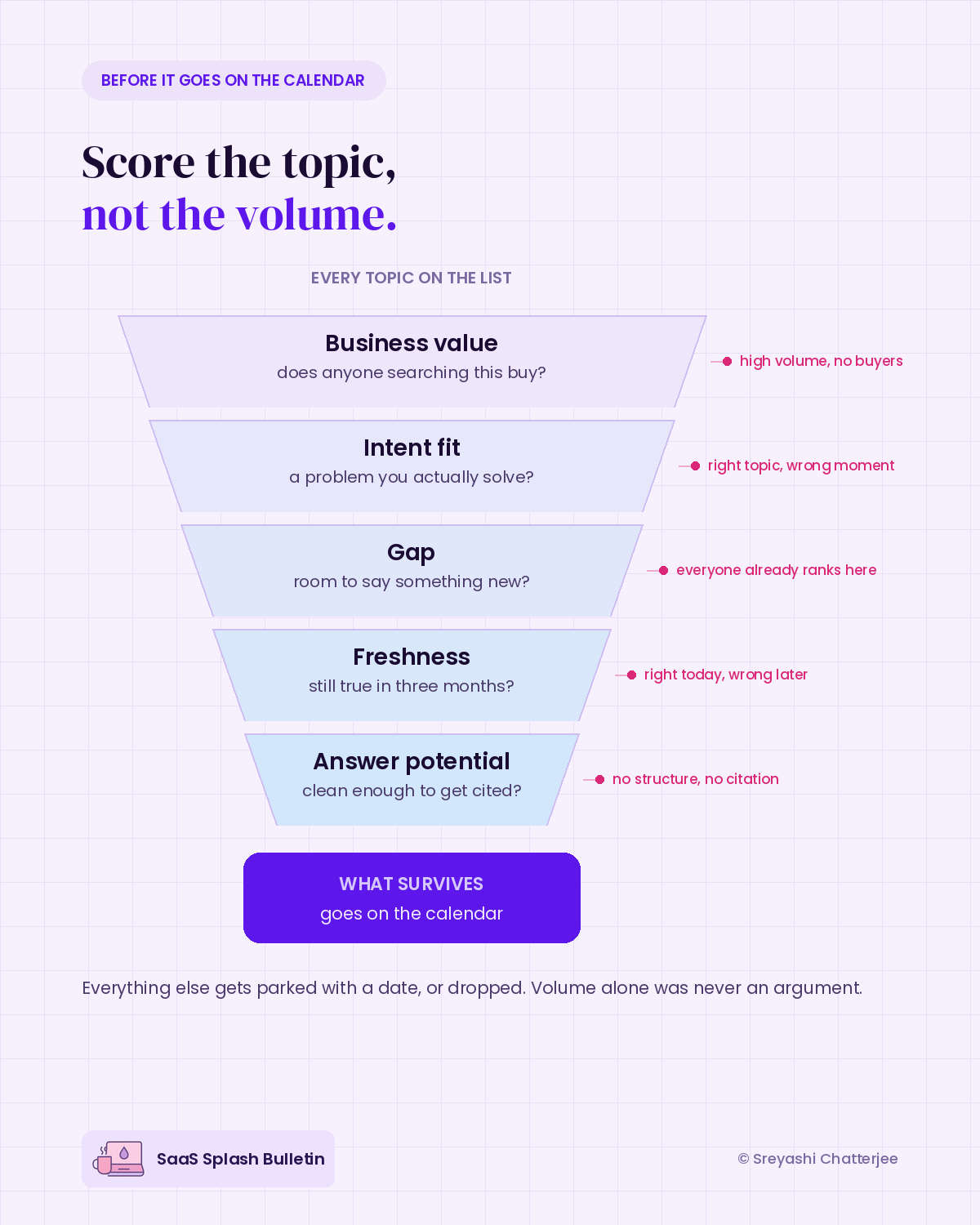
Do not prioritize on volume. Score on:
Business value: does someone who searches this ever buy?
Intent fit: are they solving a problem you solve, or just reading?
Difficulty and gap: can you realistically win it?
Freshness demand: does this need to be updated every quarter to hold?
Answer potential: can you answer it cleanly enough to be cited?
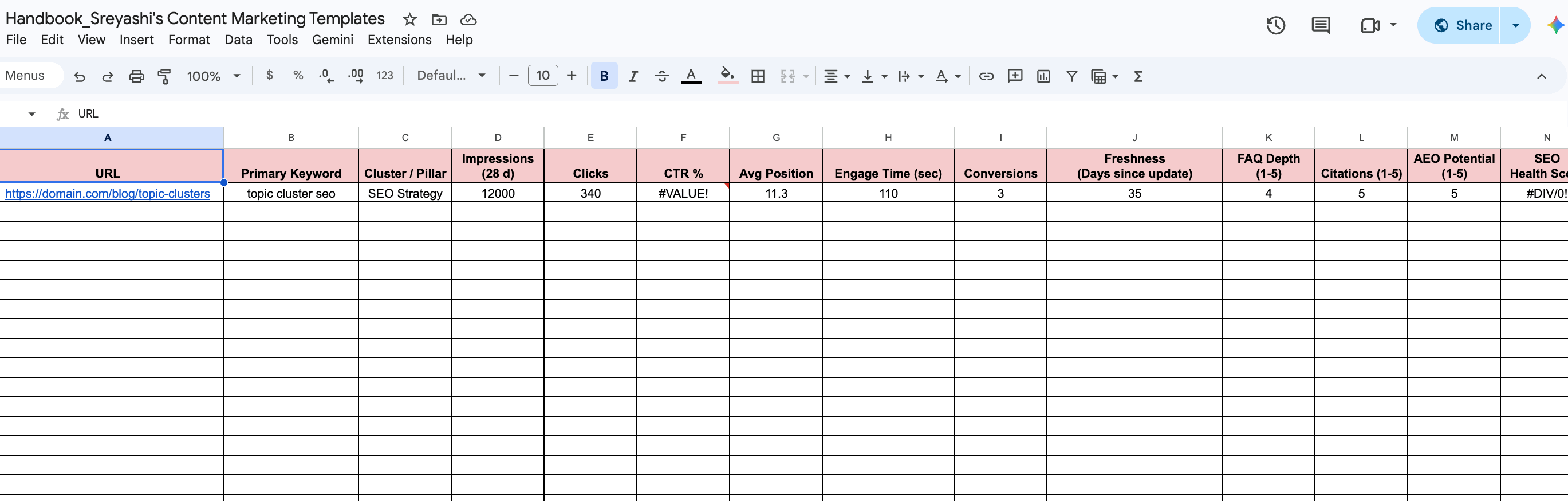
📝 You can find this template and all use cases mentioned in this e-book in my SaaS Content Marketer Handbook
The common mistake: treating volume as the proxy for value.
The rule: high volume with the wrong intent is a trap, not an opportunity.
Layer 3: Gaps, and what only you can write
Gap analysis usually gets run as a keyword exercise. Export what competitors rank for that you don’t, filter, done. That’s the shallow version, and it produces a list of topics everybody in your category already has.
The useful version asks a different question: which layer of the buying journey has nobody in this category claimed?
Look at your three or four real competitors and map what they actually cover.
Ask questions like:
Who owns the definitional content?
Who owns comparisons?
Who owns the practical implementation detail?
Who owns the objections buyers raise, but nobody writes about?
Almost every category has an unclaimed layer. Often it’s the uncomfortable one: pricing logic, what the tool doesn’t do, what implementation really takes, how to evaluate options in the category including the ones that aren’t yours.
Once you find the gap, decide how you’ll win the topic. There are four ways:
Format: a calculator, a template, a real teardown where everyone else has prose
Depth: the step-by-step version where everyone else stayed at concept level
Point of view: a real argument, not a summary of what’s already ranking
Freshness: the topic that changes often enough that most published pages are already wrong
That last one is underrated. Anything moving quickly- regulation, platform changes, pricing shifts- has a permanent freshness gap because most competitors publish once and walk away.
The mistake: writing the same page as everyone else, better. Better is not a strategy when the answer engine only needs one source.
The rule: if the piece could have been written by anyone in your category, it probably shouldn’t be written by you.
Layer 4: Production
You have pillars, scored demand, and a gap. Now sequencing, because everything can’t be first.
The order I use:
Ship the bottom-of-funnel pieces early. That’s the demand that already exists and converts.
Pair each one with a middle-of-funnel piece that links to it. The how-to feeds the comparison.
Keep one top-of-funnel piece per cycle to build the cluster out.
A calendar needs more than dates and titles. The columns that earn their place:
Target query and pillar
Funnel stage and the intent behind it
The ICP pain it addresses
The stated goal for that piece. Awareness, pipeline, sales enablement. Write it down before the piece is written.
Priority score from Layer 2
Status, owner, publish date
Refresh date, set at publish time
The AEO checklist for that piece
The goal column saves more arguments than anything else in the sheet. When someone asks three months later why an awareness post didn’t generate leads, the answer is already written down. It was never supposed to.
On AI in this layer. It earns its place in specific spots:
Expanding research: listing subtopics, grouping by funnel stage, finding angles you missed
Drafting briefs from your inputs, with the outline, questions, and sources
Entity passes: pulling out the tools, roles, and frameworks a page should mention
Repurposing a finished piece into other formats
Where it costs you: original point of view, anything requiring judgment about your specific buyer, and any claim that needs to be true. Every statistic gets checked. Every example gets grounded in something real.
The mistake: producing more without deciding what each piece is for.
The rule: AI does the research and the draft. The last stretch, the judgment and the point of view, is the job.
Layer 5: Feedback
A content report that consists of screenshots of traffic is not actionable.
What you’re actually reading for is diagnosis. Three patterns and what each one means:
High impressions, low CTR. Search is showing you, and people aren’t choosing you. That’s a title, meta, and opening problem. Sometimes it’s an intent mismatch: you’re being served for something you don’t really answer.
Good engagement, no conversions. People are reading and leaving. Either the CTA is weak, or the piece attracts the wrong reader. Check who’s landing before you rewrite the CTA.
Steady slide across the library. This is the decay curve, and it’s the one most teams catch too late. Look at 90 days and six months, not 30. A calm month can sit inside a long decline.
Then there’s the second curve, which is newer: AI visibility. A page can hold its ranking and still lose ground because the answer above it satisfies the query.
You can check this manually, which takes 15 minutes. Take your ten money questions, run them in ChatGPT, Claude, Perplexity, and Google’s AI Overview. For each one, note whether you’re cited, mentioned without a link, or absent. Log it. Run it again after refreshes. Tools exist for this, but most are expensive and imperfect, so the manual version is fine to start with.
The output of this layer isn’t a report. It’s a decision: refresh, restructure, consolidate, or let it go.
The mistake: reporting on what happened instead of deciding what to do next.
The rule: every measurement cycle ends with a list of pages and an action for each.
The layer that runs through everything
Answer engine optimization is not a step. It’s a set of habits that show up in every piece.
Six things that decide whether a page can be lifted into an answer:
Answer first. The first sixty to a hundred words should directly answer the question in the title, before any brand narrative. If a model has to hunt for your answer, it will use someone else’s.
Entities. Name the tools, roles, standards, and frameworks explicitly. Vague writing is unciteable writing.
Structure. Tables, clear headings, comparisons laid out as data rather than prose. Structured content gets extracted more readily.
FAQs from real questions. Not invented ones. Use what comes up on sales calls and in the People Also Ask section.
Specifics. Real numbers, real timelines, real named criteria. “Flexible pricing” is not citable. A pricing range with conditions is.
Freshness and schema. Date-stamp updates, keep facts current, add FAQ schema where it fits. Schema is a fifteen-minute job with a free generator and a validator, and it’s worth learning even if it technically belongs to someone else’s role.
One warning that applies especially to fast-moving topics: an AI engine confidently citing your outdated page is worse than not being cited at all. If you publish on anything that changes, build the update into the calendar at publish time.
Where this fits, and where it doesn’t
This workflow is built for B2B SaaS, where organic traffic is expected to generate pipeline rather than pageviews.
It works if you own content or write for a company that does, and you can get to the search and analytics data.
It doesn’t work if you need traffic this month. This compounds over quarters. Anyone promising otherwise is selling something.
It also doesn’t work if you can’t see the data. If nobody will give you Search Console access, fix that before anything else. Strategy without feedback is just publishing.
Guardrails
Five lines that keep the engine intact as it grows:
Intent before volume. Every time, no exceptions.
Every piece has a stated goal before it’s written. In the calendar, in writing, before the draft.
Nothing ships without something only you could have said. A number, an example, a real opinion, a screenshot of something you actually ran.
Refresh is scheduled, not reactive. Set the date at publish time.
Every claim survives a follow-up question. If you say a piece ranked, be ready to say for which query, in which market, and whether it held.
The question worth keeping
Here’s the filter I run everything through now:
Will this still create value if Google sends zero clicks?
It’s uncomfortable, because a lot of what we call good content only ever worked because search rewarded it. Take the clicks away, and there’s nothing underneath.
The things that survive the question tend to be the same things: research nobody else has, a genuine point of view, content that does a job at the moment someone is deciding, and formats that live somewhere you own.
Content calendars often don’t survive that question. That’s the useful part. Run yours through it and see what’s left.
That’s the whole shift, and it’s narrower than “AI killed content.” AI search is unkind to content that could have been written by anyone. It rewards content that could only have come from you, formatted so a machine can lift it.
Onwards and upwards,
Sreyashi 🌻
If you want this applied to your own site, that’s what my 1:1 calls are for. I’ll go through your data before we talk, and we’ll work out which layer is actually broken rather than starting from scratch.