


Hey friend,
How’s it going? 🌻
We’re in Part 3 of the #BeyondBlogs series, and this one is the one I’ve been most nervous to write. Because, very honestly, I have made some of these mistakes myself.
Anyway, let’s get started, but before that, quickly linking the first 2 editions of this series:
Part 3 is about what goes wrong.
Not the obvious stuff. Not “don’t send generic emails” (we covered that). I mean the subtler things. The mistakes that don’t show up immediately. The ones where the campaign looks fine on paper, the dashboards look decent, and somehow nothing moves. Those are the ones worth talking about.
Let’s get into it 👇
📌 TL;DR
Writing for one person means the whole buying committee gets nothing useful. ABM is one-to-account, not one-to-person.
Inbound metrics will lie to you in ABM. Traffic and downloads are not the signals you need.
The best intel for ABM content isn’t a persona doc. It’s a 30-minute conversation with a sales rep.
Doing account research once, before you write, is not the same as knowing what that account actually cares about right now.
Going dark after one great piece of content is how you lose the momentum you just built.
Mistake #1: Writing for the decision-maker but ignoring the buying committee
This is the one that gets content marketers the most, because it feels like the right call.
You know who the budget holder is. You write for them. You make the case, you speak their language, you address the business outcome they care about. That part is solid.
But here’s the thing about ABM accounts: the decision-maker rarely decides alone.
B2B deals involve somewhere between five and eight stakeholders. The senior buyer might approve the budget, but the IT lead is the one raising the security flag in the internal Slack channel. The finance person is the one asking about the ROI math. The person who will actually use the product every day is the one quietly making the case for or against it in the post-demo debrief.

If only one person in that group has what they need to feel confident, the deal stalls. And it won’t be obvious why, because the decision-maker loved what they saw.
So when content is written only for the top of the hierarchy, it creates a weird situation where the most important person says yes, and everyone else sits on the fence.
How to avoid it:
Before you write anything for an ABM account, map the buying committee.
Ask sales:
Who else is in the room?
Who has raised concerns before in similar deals?
Then audit your content against that map. Do you have something that speaks to each of them?
Not a full piece for every person, but something.
A short insight doc that addresses the IT angle.
A one-pager framed around what it means for the team doing the daily work.
A case study that mentions the finance team’s concerns by name.
The goal is coverage. If one person in the buying committee has no good reason to say yes, they become the quiet reason the deal doesn’t close.
Mistake #2: Using inbound metrics to judge ABM content
This one is a measurement problem, but it starts much earlier, in how content is briefed and what success looks like when you walk in.
In inbound content, the metrics that are typically tracked include:
Traffic
Downloads
Time on page
Scroll depth
Organic impressions
They tell you something is working. And so when content marketers are pulled into ABM work, they bring those metrics with them. It’s what they know how to report on. But those numbers will actively mislead you in an ABM context.
ABM content is not designed to reach a crowd. It’s designed to move five, fifteen, or thirty specific accounts forward. The entire point is that the audience is small and intentional. Which means traffic will be low, downloads will be low, and if you measure ABM content the way you measure a blog post, you will always conclude that it isn’t working, even when it is.
This often means: teams start optimizing for the wrong signals. A piece of ABM content gets quietly edited to be “more searchable.” A landing page gets broadened so the messaging appeals to more people. The focus drifts. And the whole point of ABM, that specificity, starts to erode.
How to avoid it:
Before an ABM content project starts, have an explicit conversation about what success looks like for this piece, specifically. Ask:
Which accounts is this for?
What stage are they at?
What does it mean if this content does its job?
The answers might be: this account had a follow-up call. This prospect replied to the email the sales rep sent after. This deal moved from consideration to negotiation.
These are not easy things to track. But they are the right things. Define them up front so you’re not defaulting to the easy-to-pull metrics.
Mistake #3: Creating content for ABM without talking to sales first
Content marketers are good researchers. Give them a vertical, an ICP, a set of company profiles, and they will do their homework. They’ll read industry reports, check LinkedIn, and look at what the company has published. That work matters.
But there is a kind of knowledge you cannot get from research alone: what actually happens in the sales conversation.
Sales reps know which objection comes up every single time. They know the exact phrase the champion uses when they’re trying to get internal buy-in. They know which concern, if left unaddressed, makes the deal go quiet. They’ve been in the room, or on the call, in a way that no amount of reading can replicate.
When content is built without that input, it tends to be technically correct but strategically off. It addresses the questions an outsider would assume the buyer has, not the ones the buyer is actually sitting with. Informed ABM audiences can feel the difference within the first paragraph.
How to avoid it:
Make a 30-minute conversation with a sales rep the first step of every ABM content project. A real conversation where you ask:
Where does this account type usually get stuck?
What have you been explaining over and over that you wish just... existed as a piece of content?
What would make your next conversation with this account easier?
Then build that. It will almost always be more useful than what the brief said to make.
Mistake #4: Treating the content brief as the research
Persona docs are genuinely useful. They save time, they create alignment, and they give content marketers a starting point that isn’t a blank page. Nobody is arguing against them.
But in ABM, a persona is a starting point, not a destination.
The difference between inbound and ABM isn’t just the size of the audience. It’s the specificity.
In inbound, you’re writing for a type of person: a Head of IT at a mid-market SaaS company, say.
In ABM, you’re writing for an account. And sometimes, for a specific person at a specific account who is dealing with a specific situation right now.
A persona tells you what that type of person generally cares about. It doesn’t tell you that this company just went through a leadership change, or that they’ve been public about a compliance challenge, or that their current vendor just had a very public outage. The brief won’t have that. The persona definitely won’t.
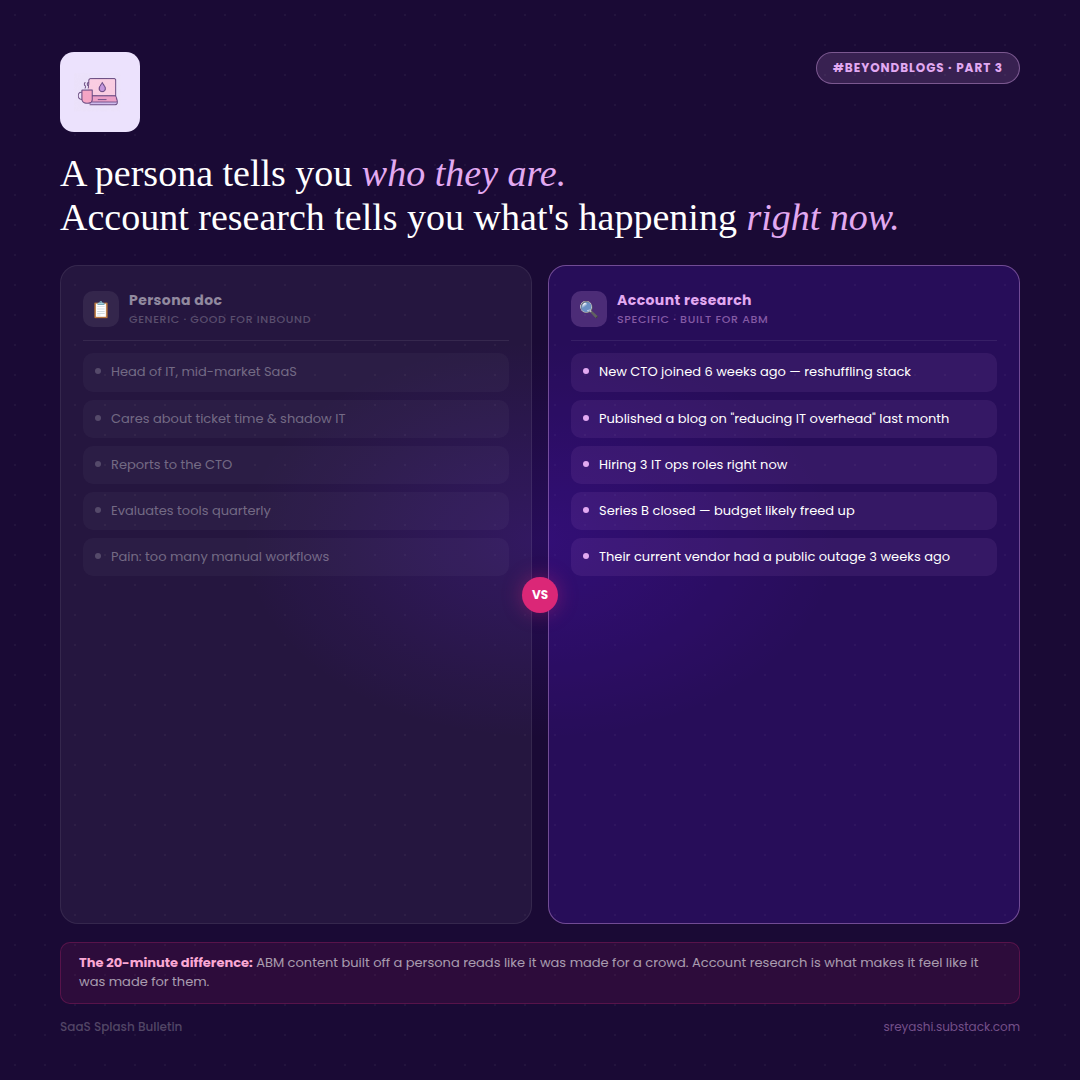
When content is built solely on the persona, it reads as if it were made for a crowd, even when the targeting is precise. That’s the paradox. You can have a perfectly targeted ad running to exactly the right account, driving them to a landing page that was written for someone vaguely like them. The targeting was specific. The content wasn’t.
How to avoid it:
Before you write anything for a named ABM account, spend 20 minutes on actual account-level research.
What has this company published recently?
What has their leadership been saying on LinkedIn?
Are there news stories, funding announcements, product launches, or industry pressures that are live right now for them?
Is there anything on their careers page that tells you where they’re growing?
That context is what makes ABM content feel like it was made for them. It’s a 20-minute investment that completely changes how specific you can get.
Mistake #5: Going dark after the first touchpoint
This one is the most fixable, and also the most common.
A good piece of content goes out. Maybe it’s a well-researched insight doc. Maybe it’s a sharp email with a genuinely useful angle. The account opens it. Maybe someone clicks. And then... nothing. No follow-up content, no next touchpoint, no clear idea of what happens after this moment.
ABM requires a cadence. Content that moves with the relationship. The first piece is not supposed to close the deal; it’s supposed to earn the right to the next conversation. But if there’s nothing planned for after it lands, the momentum you just built disappears.
Here’s how this usually happens: the content team was briefed on an asset, they made the asset, and the project was considered done. Nobody mapped out what comes next. Sales sends the content, waits for a response, and when the account doesn’t immediately reply, the outreach cools off. The account wasn’t uninterested. There just wasn’t a reason to re-engage.
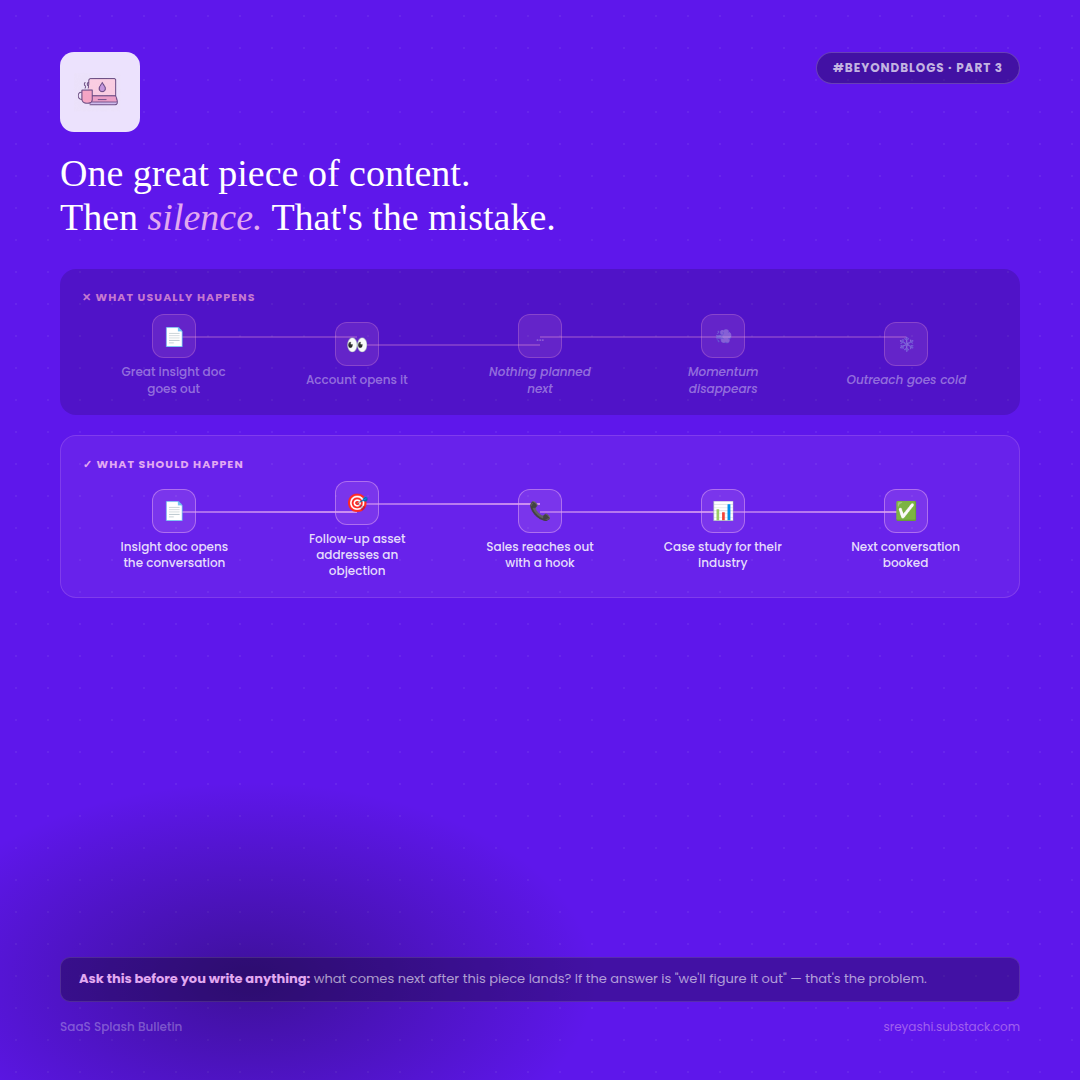
Meanwhile, in inbound, this problem doesn’t exist in the same way. Someone finds a blog post and can discover 12 more. The next touchpoint is already there. In ABM, you have to deliberately build that path.
How to avoid it:
When you’re briefed on a piece of ABM content, ask one question before you start writing:
What comes next?
What does the follow-up look like after this lands?
If the answer is “we’ll figure that out,” that’s a flag. Push for at least a rough sequence. This goes out first, then this, then the sales rep reaches back out with this.
You don’t need to build everything at once. But knowing where your piece fits in the sequence changes how you write it. The CTA you choose, the question you leave open at the end, and the thing you deliberately don’t explain all of these create a natural pull toward the next conversation.
Content that knows its role in a sequence is always sharper than content that’s trying to do everything in one go.
BTW...
If you’ve been in a situation where one of these was the reason a campaign didn’t work, I genuinely want to hear it. Not for data collection — just because the messy real-world version of this is so much more interesting than the clean theory.
Hit reply and tell me what happened.
📚 Check out my digital products & services purchased and loved by 250+ writers and marketers
AMA: SaaS Content Marketing | 45 Minutes: Strategy, writing, analytics, conversion, SEO, AEO, nothing is off limits. Share your website or portfolio in advance, and I’ll come prepared with specific answers rather than generic advice.
SaaS Content Marketer Handbook: 1-YEAR handbook for content marketers joining a product startup, includes realistic goals, execution steps, and all the templates and frameworks you’ll need.
AI+Human Content Playbook: For Content Marketers only. Essentially, for those under pressure to produce a large volume of content, it limits their ability to learn and experiment with other aspects of content marketing.
Say Hi on LinkedIn 👋
Onwards and upwards,
Sreyashi
P.S. Part 4 is coming, how to track ABM content performance, and which channels are actually worth your time.