


Hey friend,
How’s it going? 🌻
Something I’ve been putting off for longer than I’d like to admit: picking an AI visibility tool for Compport.
Not because I didn’t think we needed one. We did. When AI search is increasingly where buyers are discovering tools, you can’t just assume you’re showing up. You need to actually check.
But here’s the thing.
I’ve been running prompts manually. I’ve asked our US team to do the same: incognito windows, no saved history, no logged-in accounts. And even with all that, the results were all over the place. Same country, different users, different outputs. So before I committed to paying for a dashboard, I had a question I couldn’t shake: what exactly am I trusting here?
That skepticism didn’t go away. But I decided it wasn’t a reason to do nothing. It was a reason to go in carefully.
So I tested everything I could get my hands on. Free trials, demos, the works. Here’s how it went.
📌 TL;DR
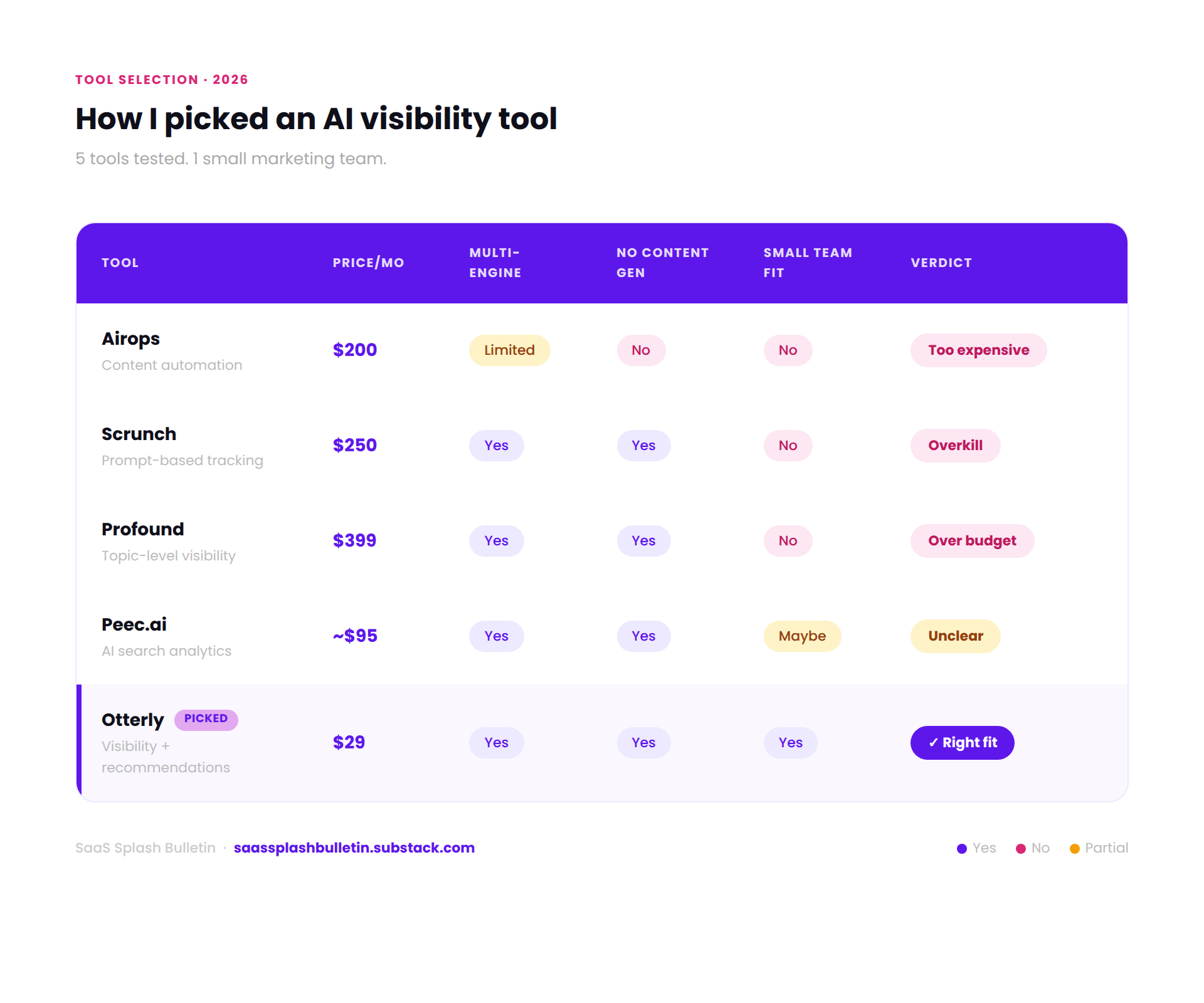
Airops is expensive and built for content automation at scale, not visibility tracking.
Scrunch is prompt-dependent and mostly manually replicable at zero cost.
Profound has the best features but is priced for teams with a real budget.
Peec.ai has a free trial too limited to form any real opinion on.
Otterly matched our budget, 15 prompts across major engines, actually usable from day one.
The tools I tested (and why most of them didn't make it)
AirOps
A content automation platform that added AI visibility tracking on top. Starts at $200/month, jumps to $2,000/month for multi-engine visibility.
I could see what Airops was going for. It’s not just a tracking tool. It’s a full content operations platform with workflow automation, CMS integrations, and AI visibility layered in. For a large content team running high volumes, it probably makes sense.
For me, it didn’t. I’m a content person who likes to be in control of what goes out. The outputs needed too much editing to be useful, and paying for automation only to have to babysit wasn’t a trade-off I was willing to make. The pricing doesn’t help either. There’s a steep cliff between the free plan and anything that actually tracks multi-engine AI visibility.
📚Note: Built for scale, not for small teams that value editorial control. Best for content teams producing 30+ articles a month with an established workflow.
Scrunch
Prompt-based AI visibility tracking. A usable plan starts at $250/month.
Scrunch is prompt-dependent. Whatever you track is only as useful as the prompts you put in. The auto-generated ones are lean branded, so you’ll need to add non-branded prompts yourself anyway. Most insights are things you could pull manually in 20 minutes.
It’s not a bad tool. It’s just hard to justify the pricing for a small in-house team.
📚Note: Useful for agencies managing multiple clients. Overkill for most in-house teams. Manual tracking can replicate much of what Scrunch offers at zero cost.
Profound
Topic-level AI visibility platform. Realistically starts at $399/month.
The topic-level visibility breakdown is genuinely useful. It tells you not just whether you’re visible, but where across themes and categories. Better than Scrunch in that sense.
But at $399/month and above for a plan that covers your actual needs, it’s a significant investment for a small marketing team. The features are good. The budget ask is hard to defend when you’re still figuring out how much to trust the data.
📚 Note: Most feature-complete option I tested, but priced for mid-market teams and above. The topic-level visibility dashboard is where it earns its keep, if you can justify the cost.
Peec.ai
AI search analytics tool. Starter plan at around $95/month.
Heard good things about Peec before I tried it. Clean dashboards, solid competitor benchmarking, nice UI. But the free trial was limited enough that I couldn’t get a real sense of whether it delivered on what people were saying. I spent more time figuring out the platform than actually getting useful data out of it.
Might be worth revisiting once we have a clearer sense of what we’re tracking. For now, it went on the shortlist but not the final call.
📚 Note: Promising, but the trial is too shallow to evaluate properly. Better suited once you already know what prompts and competitors you want to track.
Struggling with GEO?
Share your website in advance, and I’ll come prepared with specific answers rather than generic advice.
📢 AMA: SaaS Content Marketing | 30 minutes (Recently Launched)
How it works:
Book the call and share your question + any relevant links
I review before we meet
30 mins of focused, honest answers
And then there was Otterly…
I almost didn’t test it. The name kept getting confused with Otter.ai in search results, and I nearly skipped it entirely. I’m glad I didn’t.
Otterly’s Lite plan is $29/month. It includes 15 search prompts tracked across the major AI engines: ChatGPT, Perplexity, Google AI Overviews, and Copilot.
For a small marketing team just building a baseline, that’s enough to start.
What I actually liked:
No content generation, no automated publishing. Just monitoring. For a content person who wants control, that’s a feature, not a gap
Setup is fast. You’re not configuring a platform for two weeks before seeing anything useful
The Recommendations feature tells you what to do with the data, not just what it says
Simple overview reporting, easy to read, not a data dump
Integrates with Google Analytics, so you can connect AI visibility to traffic you already track
What I’m still watching:
Dashboard refreshes weekly, not in real time. You’re working from a snapshot, not a live signal
15 prompts feels right for now. I’ll probably hit that limit faster than expected once we get more structured
📚 Note: Right size, right price for a small team building an AI visibility baseline. The only tool where the Lite plan felt genuinely usable, not a teaser to push you to upgrade.
One thing I haven’t stopped believing
No tool fixes the variance problem.
AI search results still shift by user, by session, by geography, by whatever personalization bias is baked into someone’s account. What a tool gives you is a consistent reference point: a way to track direction over time, not an absolute truth.
That’s useful. It’s just not the same as certainty. If you’re thinking about investing in one of these, go in with that expectation set.
The real work is still in the content. The tool just tells you whether it’s showing up.
📚 I just reduced the prices of some of my best-selling digital products. Check those out 👇
BOFU Content E-book: Get my updated BOFU Content e-book that covers three new chapters on BOFU content beyond alternatives and comparisons, BOFU attribution, and AI workflows for BOFU content.
SaaS Content Marketer Handbook: 1-YEAR handbook for content marketers joining a product startup, includes realistic goals, execution steps, and all the templates and frameworks you’ll need.
AI+Human Content Playbook: It’s for CONTENT MARKETERS only. Essentially, for those under pressure to produce a large volume of content, it limits their ability to learn and experiment with other aspects of content marketing.
Say Hi on LinkedIn 👋
Onwards and upwards,
Sreyashi