


Hey friend,
How’s it going? 🌻
I have been coming back to the same question whenever I think about GEO: “How do we actually see what AI is saying about us?”
I’d been dodging a little, if I’m honest, because most of the answers out there point to tools (Profound, Scrunch, Peec, AirOps, etc.) that cost money or sit behind waitlists. And that’s not useful when someone needs to understand the problem before they can buy a tool to solve it.
So I decided to run the experiment manually. And you can do it too:
Pick a well-known brand
Ask AI about it — without naming it
See what comes back
Teardown the patterns
I did this for: HubSpot.
(It’s one of the most discussed SaaS brands on the internet, which means there’s a lot of signal to analyze.)
Here’s how it went.
📌 TL;DR
Ran 3 non-branded CRM prompts across Claude, ChatGPT, and Perplexity in incognito mode.
HubSpot showed up in every response, always at #1.
Only 4/9 responses cited a source — most mentions had no receipts.
One caveat came up every time: “gets expensive as you scale.”
Competitors showed up too — but mostly framed as “what you graduate to,” not same-stage alternatives.
📚 A quick note before we start
This isn’t a benchmark. This is a single snapshot from a single session. AI responses vary by instance, timing, prompt phrasing, and every personalization bias baked into your account.
To remove as much of that bias as possible, I ran everything in incognito mode.
Even then, if you ran the exact same prompts tomorrow, your results would probably be different. That’s kind of the point: AI visibility isn’t a fixed score. It’s a moving pattern. And tracking the pattern is the work.
Okay, let’s get into it.
Phase 1: The setup
I picked 3 non-branded prompts. Meaning: HubSpot’s name doesn’t appear anywhere in the question.
Why non-branded?
Because branded prompts (“Is HubSpot worth it?”) show you how AI defends a brand. Non-branded prompts show you whether AI discovers the brand on its own. And discovery is the whole game in GEO.
The three prompts:
What’s the best CRM for a B2B SaaS company scaling from startup to mid-market?
What tools do marketing and sales teams use to align on pipeline and revenue?
Which CRM has the best marketing automation built in?
I ran all three in Claude, ChatGPT, and Perplexity. 3 prompts × 3 engines = 9 responses to analyse.
Everything in incognito. No follow-ups, no “tell me more” threads. Just the first response, exactly as AI served it.
Phase 2: What happened
HubSpot came up in every single response. First. By name. Without being asked about.
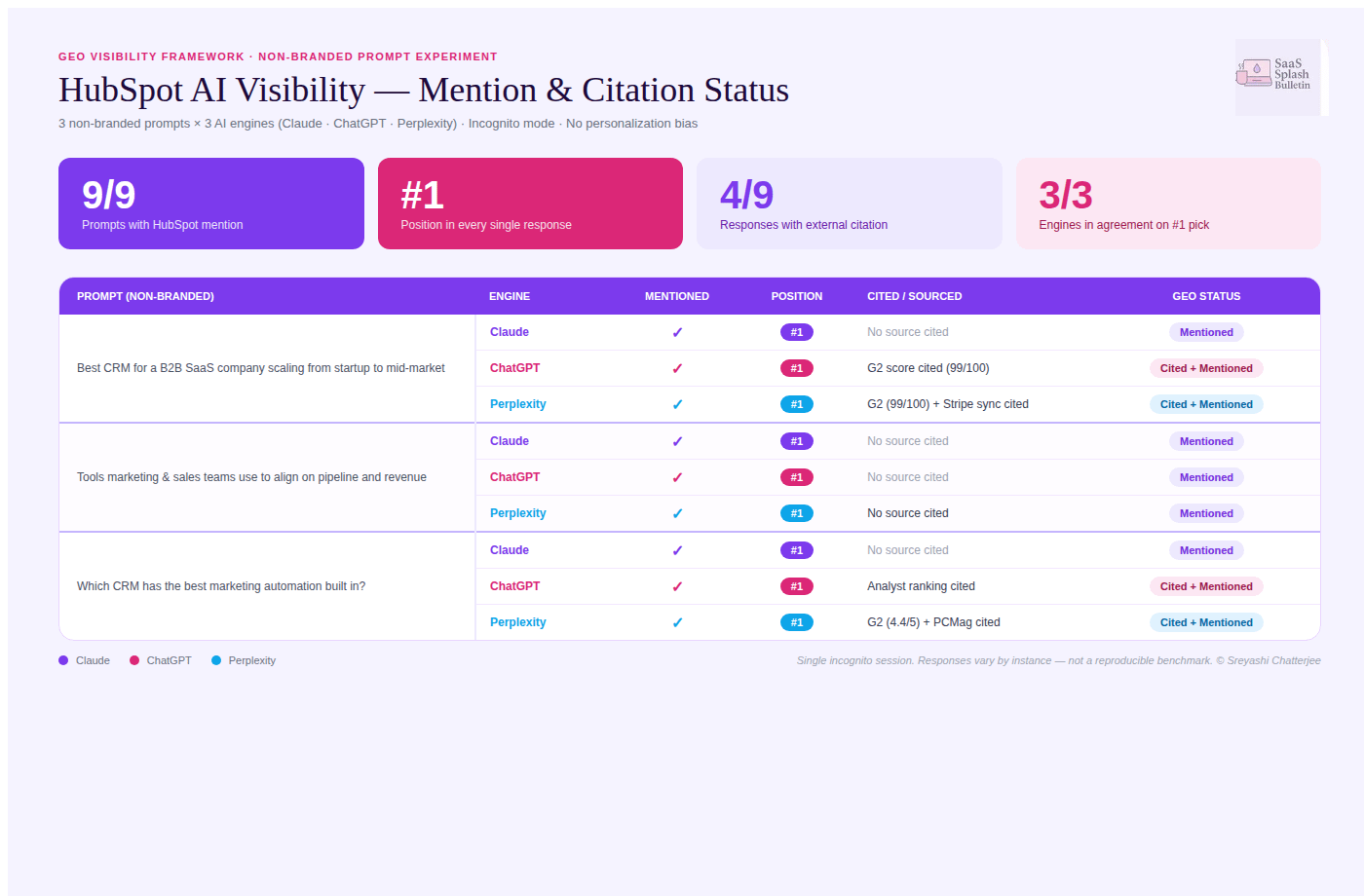
Numbers worth sitting with:
9/9 prompts mentioned HubSpot
#1 position in every single response
4/9 responses actually cited a source (G2, PCMag, Stripe)
3/3 engines agreed HubSpot was the top pick
If I were a HubSpot content marketer, I’d be thrilled. If I were a competitor, I’d be re-reading my content roadmap.
But here’s where it gets interesting.
Phase 3: What AI actually says (the qualifier teardown)
Mentions are one thing. But the language around a mention is where the real intel lives.
I pulled every positive adjective and every caveat AI used. Across all 9 responses.
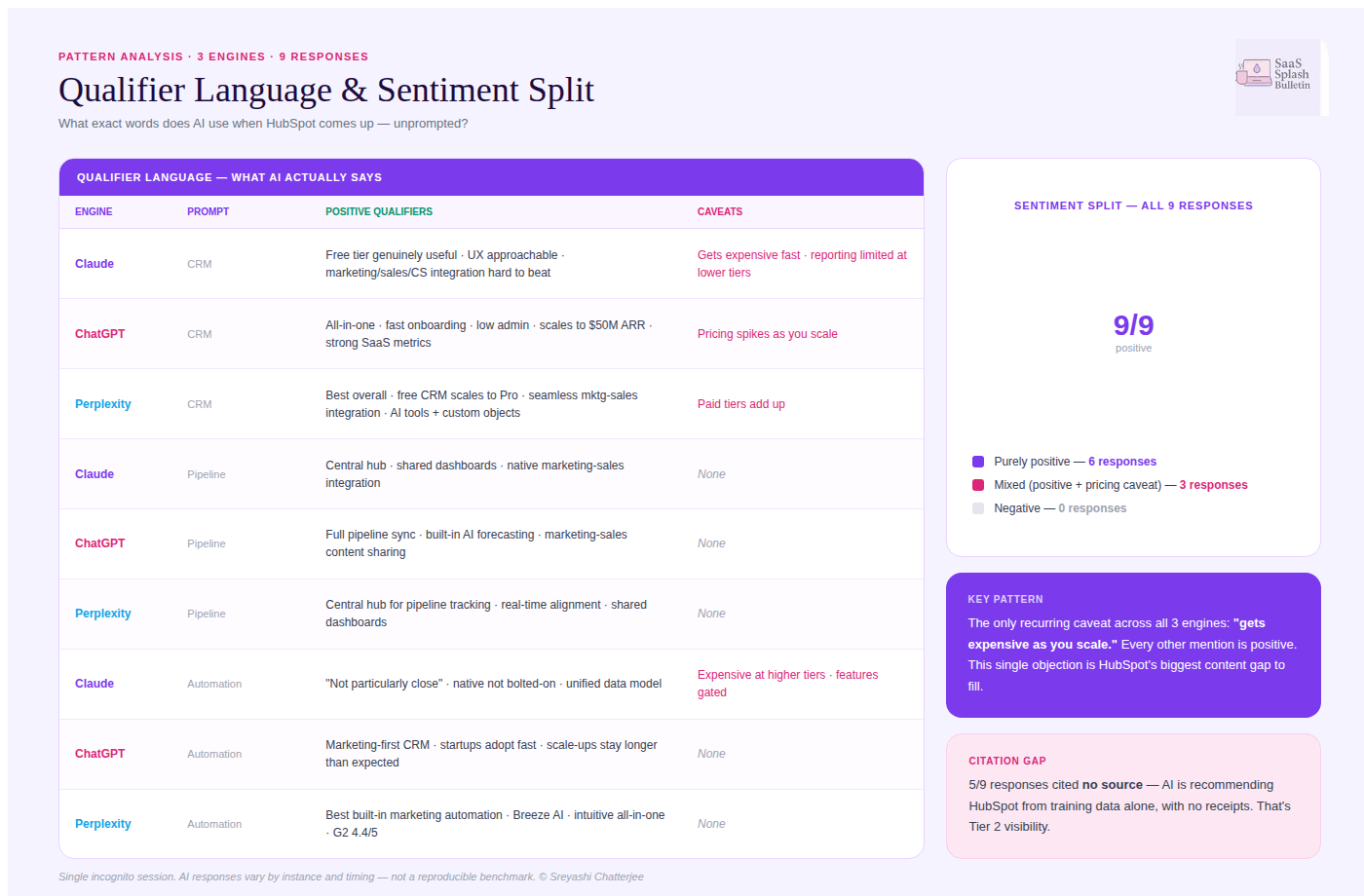
A few things jumped out:
The sentiment is overwhelmingly positive
6/9 responses were purely positive — no caveats, no “but”. 3/9 had mild pricing caveats. 0 were negative. For an experiment testing the internet’s collective memory of a brand, that’s a strong result.
The caveats are identical
Every single caveat across all 3 engines was some version of “gets expensive as you scale.” That’s it. One recurring objection. Which tells you exactly what content HubSpot’s competitors should be writing (and what content HubSpot should be countering).
The citation gap
This is the part I want you to really look at. 5/9 responses cited no source at all. AI recommended HubSpot from training data alone — no receipts, no links, no “according to.” Claude cited nothing. Perplexity was cited the most. ChatGPT sat in the middle.
Using the framework I shared in a past edition (Cited + Mentioned / Mentioned / Not appearing), HubSpot lands mostly in Tier 2 — Mentioned but not cited.
Which is still good. But it’s not where a brand of HubSpot’s size should sit.
Phase 4: Who else shows up
When AI recommends HubSpot, who else does it recommend? And how does it frame them?
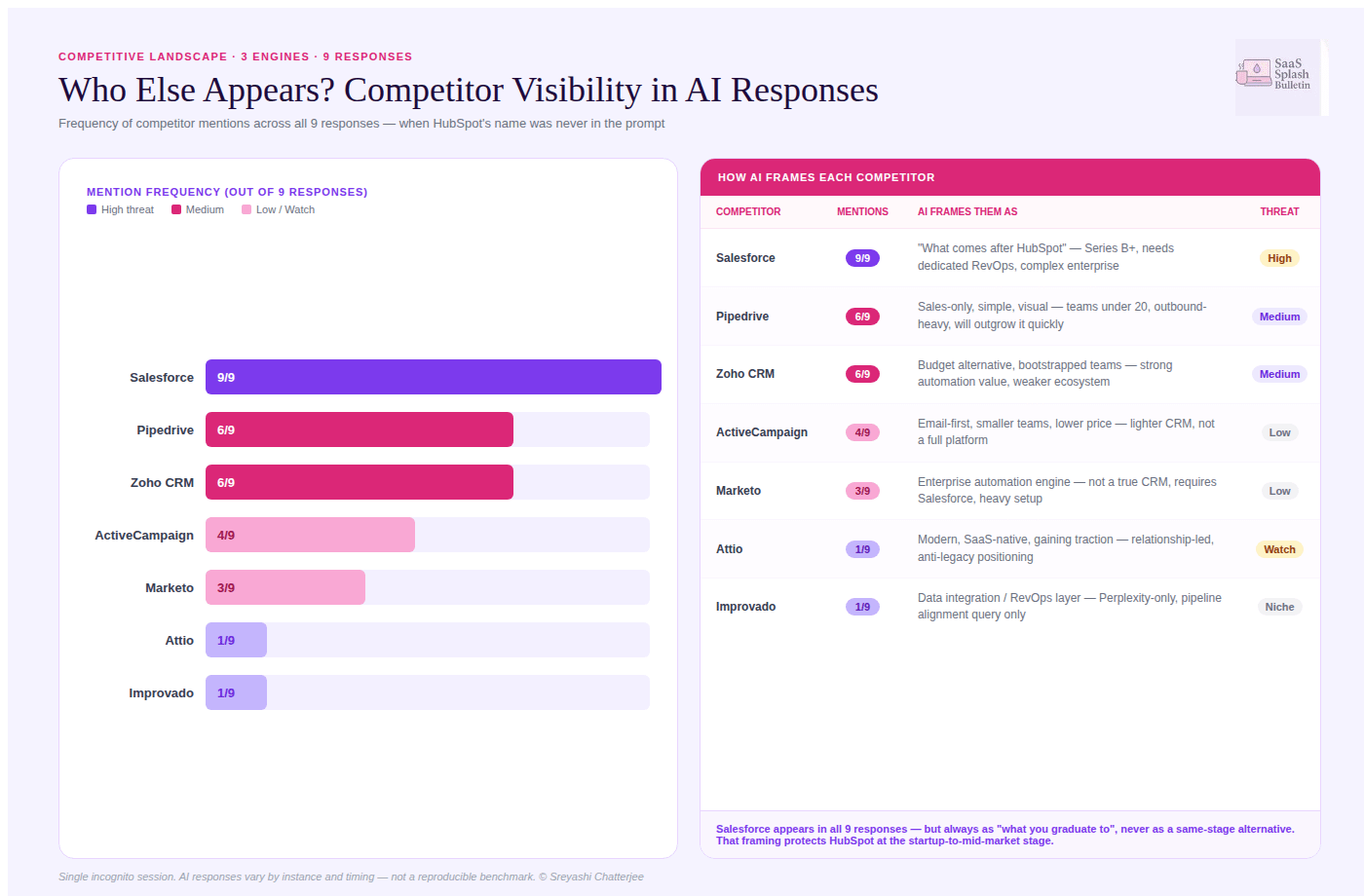
Salesforce appears in all 9 responses. Every single one. But, and this is the part I find fascinating — it’s never positioned as a same-stage alternative. It’s always “what you graduate to.” Series B+. Needs RevOps. Heavy setup. That framing is doing a lot of work for HubSpot, quietly. It turns Salesforce from a competitor into the future state, which means HubSpot gets to own the present.
Pipedrive and Zoho show up 6/9 times each, framed as budget/simpler alternatives.
ActiveCampaign and Marketo appear as adjacent-category tools rather than direct CRM competitors.
And then there’s Attio. 1 mention in 9. But Claude specifically flagged it as “gaining traction with SaaS companies.” That’s an early signal worth watching.
So what do you do with this?
If this is your brand, you’d run the same audit monthly.
Track mention rate
Track which engines cite you and which don’t
Find the caveats
Fix them in your content
If this isn’t your brand but your client’s is in a similar category, you now know what competitive space looks like at the top. And you know where the content gaps are.
If you’re a content marketer reading this, the takeaway is smaller and more useful:
Run at least one non-branded audit per client, per quarter. No tool required.
Pay attention to qualifiers, not just mentions. The language AI uses is borrowed from somewhere. Find the source.
Track the citation gap. That’s where the next year of GEO work lives.
And if you want to do this for your own brand or your client’s, you can always book a 1:1 consultation call with me :)
📚 Check out my digital products purchased and loved by 200+ writers and marketers
BOFU Content E-book: Get my updated BOFU Content e-book that covers three new chapters on BOFU content beyond alternatives and comparisons, BOFU attribution, and AI workflows for BOFU content.
SaaS Content Marketer Handbook: 1-YEAR handbook for content marketers joining a product startup, includes realistic goals, execution steps, and all the templates and frameworks you’ll need.
AI+Human Content Playbook: It’s for CONTENT MARKETERS only. Essentially, for those under pressure to produce a large volume of content, it limits their ability to learn and experiment with other aspects of content marketing.
Onwards and upwards,
Sreyashi