


Hey friend,
How’s it going? 🌻
The job market is brutal, especially for content marketers! The last thing you want to do now is apply for the wrong jobs or go to an interview unprepared.
I’ve been on both sides of this conversation.
Applied for roles where the JD looked exciting, and reality hit by week two.
Watched genuinely good content marketers take jobs that dimmed them.
Not bad decisions. Just no real filter for what they were walking into. The AI era has made this harder. More job titles. More noise. More “AI-first” companies.
So here’s how I would approach a job search in 2026 as a content marketer.
Let’s get into it 👇
📌 TL;DR
Figure out which type of content marketer you are before you read any JD
Three paths exist right now: specialist writer / AI-savvy workflow builder/brand and campaign thinker
“AI-native” in a title means nothing without the right follow-up questions in the interview
The JD is only half the picture. How leadership thinks about content matters just as much
Green flags and red flags in a JD are learnable. You just have to know what you’re looking for
Before you read any JD, figure out which bucket you’re in
AI has split this field into three paths. Applying for the wrong one wastes your time and puts you in a role that won’t let you grow the way you actually want to.
Bucket #1: You’re primarily a writer, and you’re very good at it
You are someone with a portfolio that shows range, performance, and an understanding of formats beyond SEO articles.
Think: survey reports, thought leadership, founder LinkedIn content, case studies that actually tell a story. These are the things that still have real value in a world where Claude can produce a decent 1,500-word blog in minutes.
There are fewer of these roles now. Not zero, but fewer. And the ones that exist are asking for more than writing skills.
Companies genuinely hiring for strong writers want portfolio and performance data.
Did it rank?
Did it convert?
Did it get cited in AI search engines?
They’re evaluating your judgment about what to write and why, not just how well you write.
This is already playing out at hiring tables everywhere. Companies are briefing experienced writers properly and getting back technically fine work. Clean sentences, correct structure. Nothing wrong with it. But nothing that sounds like them either. So they close the doc, open an AI tool, and spend weeks shaping the output with someone who actually knows the product.
✅ What to look for in JD:
Portfolio plus performance requested (not just samples)
Format variety beyond blogs
A senior editor you’d report to rather than a growth PM who treats content as a checkbox
🚨 When to Avoid:
JDs where the primary KPI is volume. “Publish X articles per week at scale” is a different job, and a shrinking one.
Bucket #2: You think in workflows, not just pieces
Being AI-savvy is not knowing how to use ChatGPT or Claude to produce a decent draft. Everyone does that. That is not a differentiator.
Genuinely AI-savvy in a content role means you can build content systems. Look at a content operation and figure out where automation adds real value. Brief, build, and QA an AI workflow. Understand that the AI output is the first draft, not the deliverable, and know how to close that gap consistently.
The numbers back this up: Content Marketing Manager listings dropped 73% since 2023.
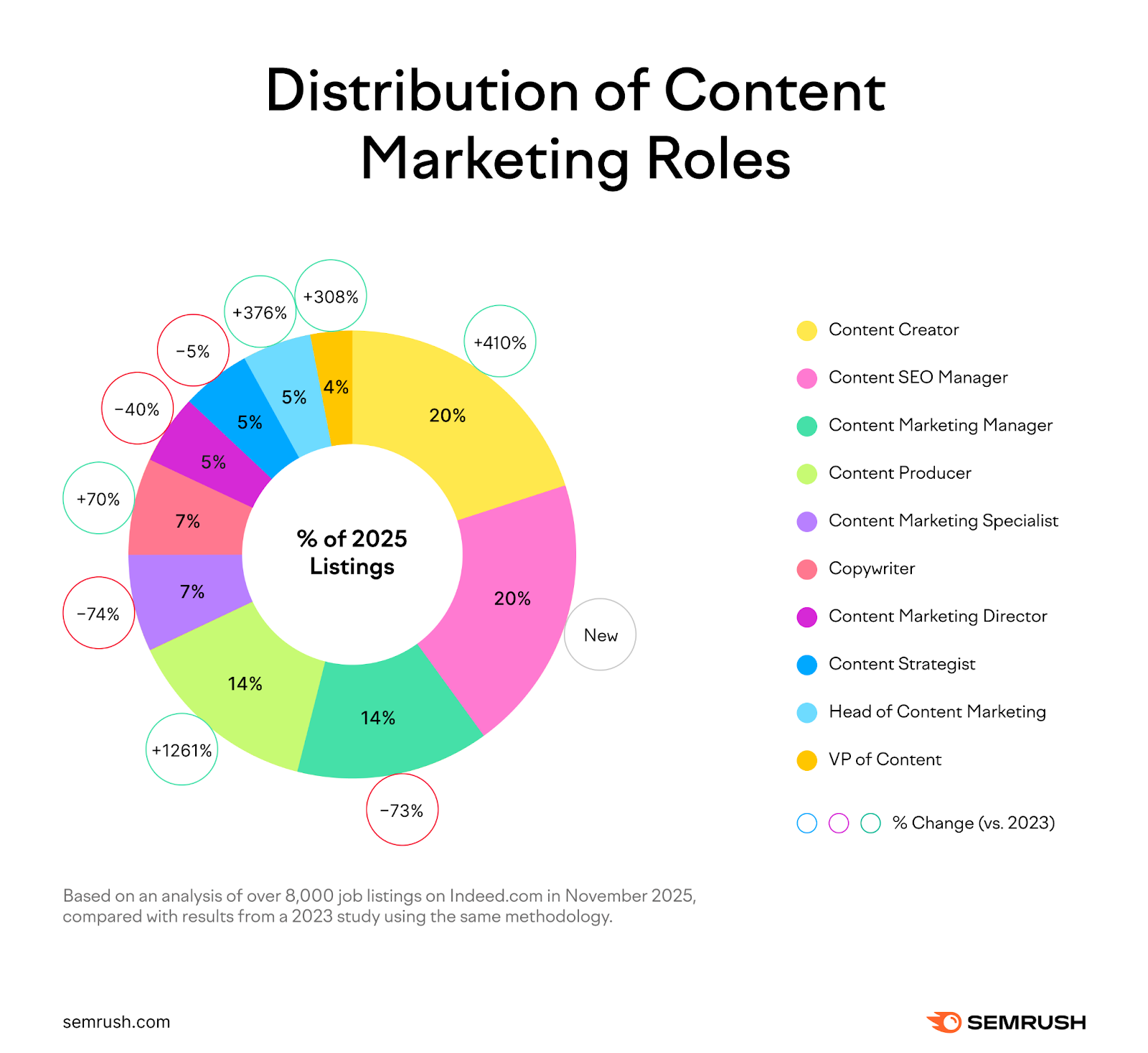
Real B2B SaaS JDs are already shifting. One I came across recently asked for “a genuine understanding of how AI-driven search (AEO/GEO) is changing content discoverability” as a baseline requirement, not a nice-to-have. These aren’t outliers anymore.
✅ What to look for in JD:
Workflow-building and content ops mentioned
AEO/GEO alongside content knowledge
Cross-functional scope
Outcome-based success criteria rather than a publish cadence
🚨 When to Avoid
“AI-native” titles with nothing behind them.
Ask the interviewer/recruiter questions like:
What does your current content workflow actually look like?
What have you tried to automate?
What didn’t work?
If they can’t answer this specifically, you know what you’d actually be walking into.
Bucket #3: Your strength is ideas, campaigns, and brand
You come from content, but where you shine is the bigger picture.
Brand storytelling
Executive thought leadership
Campaigns
Events
LinkedIn strategy
Work that requires a real point of view, strong taste, and the ability to hold a narrative together across formats and channels.
This is genuinely the most evergreen path. Not because AI can’t help here, it can, and it does. But because the ideas still have to come from somewhere. Brand campaigns are still at least 50% human-dependent. The creative instinct to know when something lands versus when it’s clever but pointless? That’s still yours.
✅ What to look for in JD:
Cross-functional ownership (not just a content calendar)
Thought leadership and campaign work
Senior access to where strategy actually happens
Mentions of positioning and narrative work
🚨 What to be careful about
Companies that say “brand” but mean social media management
Roles that promise strategy, but the day-to-day is execution without any input.
You’ll usually only find this out in the interview by asking about the last campaign they ran and who made the creative decisions.
Not sure which bucket you belong to? Book a content career advice chat with me 👇
Ask me any questions you might have for your Content writing/marketing career
Transitioning from writing to marketing
Where content marketing is heading with AI in the picture
How to approach new content projects
How to approach new content jobs at agencies/product startups
Anything else that is bothering you
What to look for in the company, not just the JD
You can have the right role description and still be in the wrong place.
The way founders and leadership perceive content determines almost everything about your experience.
If they understand that content takes time, compounds, needs distribution, and works differently from a paid ad, you’ll have space to build something.
If they think you'll publish a blog and magically get traffic by next week, you’ll spend most of your energy explaining your job rather than doing it.
Also, during an interview, ask the interviewer about AI specifically. Ask what they’re using it for and what hasn’t worked.
There’s a real split right now between companies that have accumulated tool subscriptions without changing anything and companies that have genuinely rebuilt workflows. The first type will hand you five logins and expect magic. The second type will have real opinions.
You want the second type.
Green flags vs. red flags in the JD itself
💚 Green flags:
Specific content formats mentioned, not just “content”
Portfolio plus performance data requested
AEO or GEO mentioned alongside SEO
Cross-functional scope explicitly stated
Outcome-based success criteria, not just output targets
Language that suggests you’d have strategic input: “shape our narrative,” “own the content roadmap”
🚩Red flags:
High volume is the primary KPI
No mention of distribution, measurement, or iteration
AI trainer or content reviewer roles dressed up as marketing jobs. These exist, and they’re growing; they’re just a different career track entirely
JDs so vague you can’t picture what a good Tuesday in this role actually looks like
The question nobody asks, but probably should
What’s the culture of content like inside this company?
Not externally. Internally. With the teams you’d work with every day.
Content marketing is cross-functional work, even when you have a seat at the table. You’ll always be asking product for input, sales for intel, and CS for customer stories. If those teams don’t understand why content matters, your job becomes twice as hard and twice as lonely.
The most underrated skill for a content marketer, especially in a startup, is the ability to say no. Not rudely. With a reason.
“This will take X time and add Y value relative to what we’re trying to do right now.”
If the environment punishes that, you’ll spend your time on work that doesn’t connect to anything, doesn’t move any metric, and doesn’t show up on your resume in a way that matters.
Look for places where prioritization is a conversation, not a battle. Those environments exist. They’re worth holding out for.
The honest part
The AI era hasn’t made content marketing jobs harder to find. It’s made them harder to evaluate.
The JD is no longer enough. The title is no longer enough. “AI-native” means nothing without context. And “great growth opportunity” can mean genuinely interesting work, or it can mean three jobs for the price of one.
Know which bucket you belong in. Know what company culture you need. Learn to read the signals before you say yes.
That’s how you stop taking roles that look right on paper and start building something that actually compounds.
📚 Check out my digital products & services purchased and loved by 250+ writers and marketers
AMA: SaaS Content Marketing | 45 Minutes: Strategy, writing, analytics, conversion, SEO, AEO, nothing is off limits. Share your website or portfolio in advance, and I’ll come prepared with specific answers rather than generic advice.
SaaS Content Marketer Handbook: 1-YEAR handbook for content marketers joining a product startup, includes realistic goals, execution steps, and all the templates and frameworks you’ll need.
AI+Human Content Playbook: For Content Marketers only. Essentially, for those under pressure to produce a large volume of content, it limits their ability to learn and experiment with other aspects of content marketing.
Say Hi on LinkedIn 👋
Onwards and upwards,
Sreyashi