


Hey friend, how’s it going? 🌻
For a while now, I’ve had this habit of checking what AI actually says about brands. Running prompts, watching who gets named, who gets cited, who gets ignored. You’ve seen me do it here before with the HubSpot teardown.
I had some observations in the process: pages that were ranking perfectly fine on Google. Solid positions, steady impressions, nothing wrong on paper. And yet when I asked ChatGPT or Perplexity the exact question those pages answered, they weren’t there. A different page was getting pulled instead.
That’s when I understood this: content doesn’t decay on one front anymore. It decays on two.
(Remember the blog lifecycle issue, where I tracked a single post from indexing all the way to the keep, refresh, or delete decision? This is the same decision. Just scaled to your whole library. And with a second scoreboard you probably aren’t watching yet.)
That second scoreboard is what this issue is about.
Let’s get into it 👇
📌 TL;DR
Your content now decays on two curves: Google rankings and AI citations. They move independently. A page can hold its Google spot and quietly disappear from AI answers.
A content audit in 2026 has one real job: moving your pages from Invisible to Mentioned to Cited.
The phases aren’t complicated. Most of the work is in the part everyone skips: actually making the call on each page.
AI engines lean toward fresher content. One study of about 17 million citations found that AI-cited pages are roughly 26% “fresher” than pages ranking in Google’s top 10 (Ahrefs).
You can hand this whole process to Claude as a reusable skill, so you run it once a quarter instead of rebuilding it from memory every time.
Refresh beats writing new. A page that already has authority comes back in weeks. A fresh one takes months.
Why bother auditing at all (the honest version)
For years, a content audit was more like a regular chore. Find the dead pages, prune them, refresh a few, move on.
Now you’ve got two engines deciding whether your content gets seen, and they don’t agree with each other.
Google decides what ranks
AI engines decide what gets quoted
A page can sit comfortably on page one of Google and still be completely absent when someone asks ChatGPT the exact question that page answers. So the audit is how you figure out, page by page, where you actually stand on both scoreboards.
I keep coming back to the same three-tier way of looking at it:
Invisible. AI doesn’t bring you up at all, even when the question is yours to own.
Mentioned. You get named, but no link, no source credit.
Cited. You get named and pulled as the source. The whole point.
A content audit in the AI era is the exercise of finding every page that sits in Invisible or Mentioned and figuring out what it would take to move it up. That’s the frame. Everything below serves it.
AI engines recommend brands and entities, not just URLs. Even the big benchmark sites are feeling this.
The phases (the actually-do-this version)
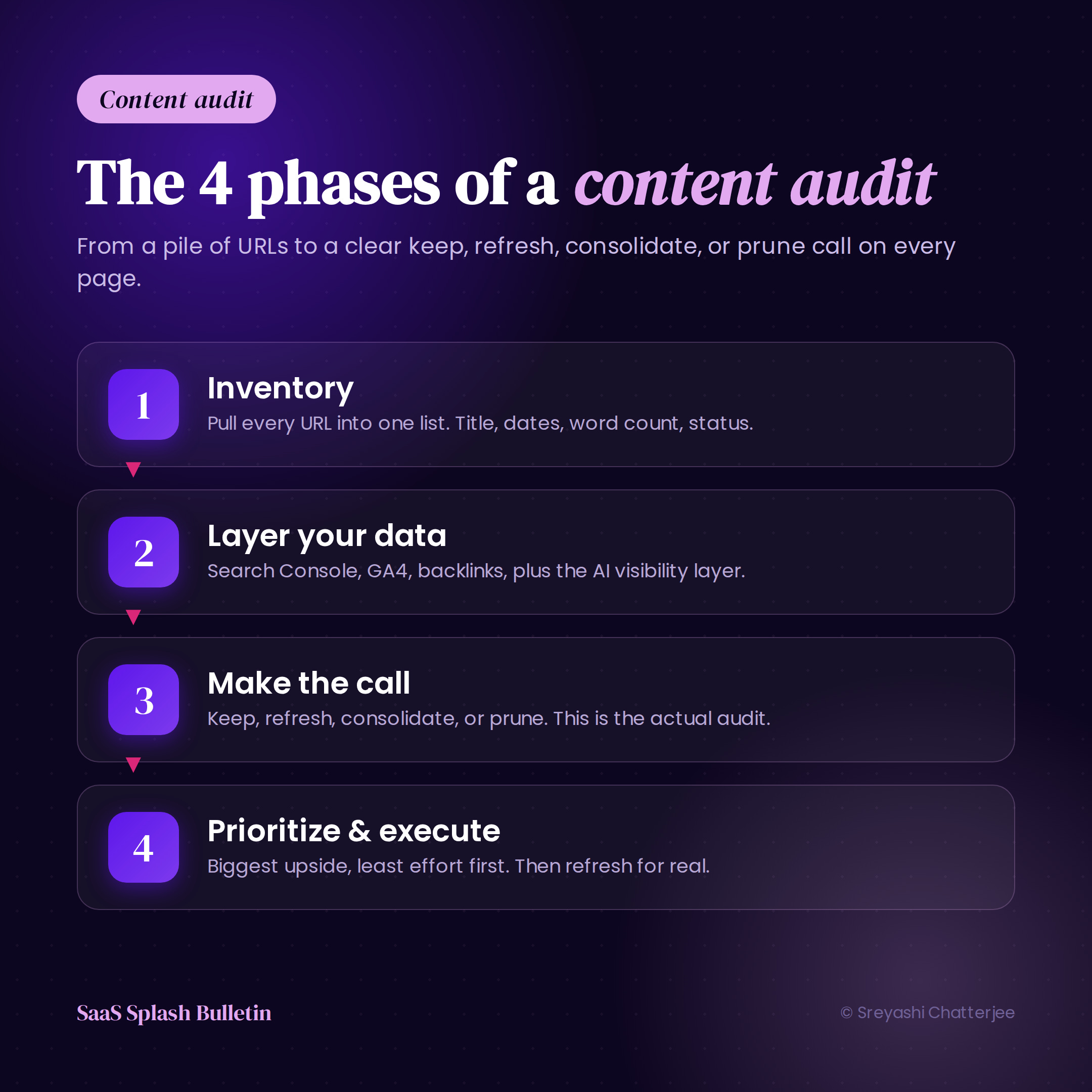
Phase 1: Get everything into one list
Pull every URL you have. Export your sitemap or your CMS list, then run a crawl to catch the orphan pages nobody links to anymore. Screaming Frog is free up to 500 URLs, which covers most of us.
For each page, grab the basics: title, publish date, last updated date, word count, and status code. Don’t try to audit the whole site in one sitting. Start with the blog. Finish a section before you touch the next one.
Phase 2: Stack your data layers
Three free sources do most of the heavy lifting:
Search Console for clicks, impressions, and position, broken down by page and by query. Look at the 12-month trend, not last week’s numbers.
GA4 for sessions, conversions, and engagement. What’s actually doing business, not just getting visits.
A backlink check (Ahrefs or Moz free tier), so you know which pages have links worth protecting before you go deleting anything.
Then the layer most audits skip entirely. The AI visibility layer.
Take your money prompts. The “best tool for,” “alternatives to,” and comparison-style questions, not the informational fluff. Run them manually in ChatGPT, Claude, and Perplexity.
Note three things:
Where do you show up
Where a competitor shows up instead of you
Where you get pulled as a source but never named.
That last one is real, by the way. I’ve watched ChatGPT lift content straight off a site to build its answer without ever naming the brand. Cited, but not mentioned. You only catch it if you’re looking.
Phase 3: Perform the actual audit
Four calls, one per page:
Keep. Ranking well, stable, getting cited. Leave it alone. (Editing a page that’s already working can re-trigger indexing for no reason at all.)
Refresh. Still has a real keyword, still holds some backlinks, structure is fine, but the information is stale, or it’s started slipping. Most of your pages will land here.
Consolidate. Two or three pages quietly fighting over the same intent. Merge them into the strongest one, and redirect the rest.
Prune. No links, no rankings, no traffic, and the topic is covered better elsewhere. Delete and redirect.
Strip your bias out before you decide.
There are three that wreck audits: traffic nostalgia (”but this one used to do so well”), brand attachment (”I wrote this, I like it”), and keyword thinking (”but it technically targets a keyword”). Judge what the page does now. Not what it once meant to you.
If a few of your “keep” calls start feeling uncomfortable, good. That discomfort usually means you’re being honest.
Phase 4: Prioritize, then actually do it
Don’t work in publish-date order. Start where the upside is biggest for the least effort:
Pages sitting at positions 8 to 15. They’re one good refresh away from page one.
Pages that lost the most ground in the last few months.
BOFU pages before top-of-funnel ones. They’re closer to revenue, and they’re the backbone of your AI search visibility.
And when you refresh, refresh for real. Update the stats and dates, yes. But also front-load a direct answer under each heading, tighten the page into clean, scannable sections, add a table where one belongs, and fix the internal links. Changing the date and nothing else is a shortcut both Google and AI see straight through.
Find a content audit template and a whole template stack to get you going in your first year as a Content Marketer at a product startup.
🎁 Bonus: Now turn the whole thing into a Claude skill
Here’s what saves you from running this from memory every quarter.
You can hand the process to Claude as a skill. A skill is just a saved instruction file that Claude reads automatically whenever you start an audit, so you stop re-explaining yourself every single time.
One honest caveat first, because it matters more than the build. You can’t make an AI that audits your content for you. You can make one that assists.
What goes inside it:
Context first. Your product, your ICP, your category, your competitors, and your money prompt. Every audit starts from this, so Claude isn’t guessing who you are.
The phases are written as steps. The four above, in order.
The inputs you’ll feed it. Your crawl export, your Search Console export, your GA4 numbers, your manual AI-visibility notes.
The output you want. A table, one row per URL: the call (keep, refresh, consolidate, prune), the reason, the priority. Plus, a separate list of every prompt where a competitor is cited, and you aren’t.
A couple of worked examples, and a few hard “never do this” rules.
No code required. The simplest version is a Claude Project. Drop your instructions in, upload your exports, and ask it to run the audit. Save it. Next quarter, swap in fresh exports and run the same thing again.
No code required. A skill sounds technical, but you don't write it by hand. Claude has a built-in skill creator that just interviews you, asks what your audit should do, and writes the file for you. The difference that makes it worth doing: a skill works in every chat and every project, not just one. Build it once, and "run my content audit" pulls up the whole method anywhere. (If you'd rather keep it simple, a Claude Project works too; you drop the instructions and your exports in one workspace, but those instructions only live inside that project. The skill is the version that follows you everywhere.)
You build it once. You reuse it forever. That’s the whole appeal.
The quick wins to expect
I’m tagging each one so you know which scoreboard it moves.
[AI] for AI search
[Google] for classic search
[Both] for the ones that count twice
1. Stale pages start getting cited again. [AI]
Refresh a page with current data and a clean answer up top, and AI engines often re-pull it fast. Freshness is one of the few levers that move quickly here.
(Worth knowing: this hits hardest in Perplexity and ChatGPT. Claude leans more on what it already knows, so for Claude, being mentioned across other sites matters more than your publish date.)
2. Lost traffic comes back in weeks, not months. [Google]
A refreshed page keeps its existing authority and backlinks, which is exactly why it climbs again quickly. A brand-new page on the same topic would take you half a year to reach the same spot.
3. Your cannibalizing pages stop fighting each other. [Both]
When three thin posts split the authority for one keyword, merging them into one strong page concentrates everything. Google and AI both prefer one clear, authoritative source over three half-answers.
4. You catch decay while it’s still cheap to fix. [Both]
A page that’s lost a chunk of its clicks over a couple of months needs a light refresh. The same page, ignored for a year, needs a full rewrite. The audit is how you catch it at the cheap stage.
5. Your best pages get easier to quote. [AI]
Clear headings, a direct answer under each one, a table, and the right schema. None of it is glamorous. All of it makes your page easier for an AI to lift a clean sentence from. And getting quoted is the game now.
6. You finally see where you’re invisible. [Both]
The AI visibility layer shows you every prompt in which a competitor is named, but you aren’t. That gap list is basically your content roadmap for next quarter, already written.
📚 Check out my digital products & services purchased and loved by 250+ writers and marketers
AMA: SaaS Content Marketing | 45 Minutes: Strategy, writing, analytics, conversion, SEO, AEO, nothing is off limits. Share your website or portfolio in advance, and I’ll come prepared with specific answers rather than generic advice.
BOFU Content E-book: Get my updated BOFU Content e-book that covers three new chapters on BOFU content beyond alternatives and comparisons, BOFU attribution, and AI workflows for BOFU content.
AI+Human Content Playbook: For Content Marketers only. Essentially, for those under pressure to produce a large volume of content, it limits their ability to learn and experiment with other aspects of content marketing.
Say Hi on LinkedIn 👋
Onwards and upwards
Sreyashi