


Hi friends! 👋
A few months ago, I shared that we’d finally selected an AI search visibility tracking tool: Otterly.AI.
At the time, I was evaluating how different tools could help us understand where our brand appeared across AI search engines, how we compared with competitors, and whether we could use those insights to improve our content strategy.
Now, after using Otterly for almost six months, I have a much better understanding of what it does well, what I find useful, and where I think there’s room for improvement.
As someone whose work has gradually expanded from content marketing and SEO into GEO/AEO, I have three main expectations from a tool like this:
Give me a clear picture of our brand’s overall AI search visibility.
Help me understand what’s happening with the specific prompts we’re tracking.
Show me where AI engines get their information and what I can do to improve our visibility.
Everything else is a bonus.
So, in this week’s SaaS Splash Bulletin, I’m reviewing Otterly from that perspective.
🔖 Further reading: How we selected our AI visibility tracking tool
📌 TL;DR
Overall visibility tracking: Otterly brings brand coverage, positioning, sentiment, and competitor performance into a single dashboard. It’s useful for understanding trends without manually checking several AI engines.
Prompt monitoring: One of the more valuable features, especially when you’re tracking a limited set of strategically important prompts and want to investigate individual AI responses.
Citation analysis: Helps identify which websites AI engines rely on, including your own domain, competitors, and third-party sources. The categorization needs careful interpretation.
Recommendations and GEO audits: Useful starting points for identifying potential improvements, but not every suggestion is specific or important enough to act on.
My overall assessment: Otterly is useful for ongoing visibility monitoring. The bigger question is how effectively you can translate its data into marketing decisions.
What is Otterly.AI?
Otterly.AI is an AI search visibility monitoring platform that helps businesses track how their brands appear in AI-generated answers.
Instead of tracking traditional Google keyword rankings, you monitor prompts that potential buyers might ask AI search engines.
Otterly then collects responses and analyzes whether your brand appears, where it’s positioned, which competitors are mentioned, and what sources are cited.
It supports monitoring across major AI search experiences, including ChatGPT, Perplexity, Google AI Overviews, Google AI Mode, and Microsoft Copilot, with coverage depending on your subscription and available integrations.
The basic concept is straightforward. But what matters is how much detail you get once the data starts coming in.
#1 Overall AI Visibility Dashboard: How Much Can You Actually Understand?
This is usually where I start.
When you’re responsible for SEO and AI visibility, you don’t necessarily want to inspect every individual prompt every morning. You first want to understand the bigger picture.
Are we becoming more visible? Are competitors appearing more frequently? Are we being mentioned positively? Is our position improving?
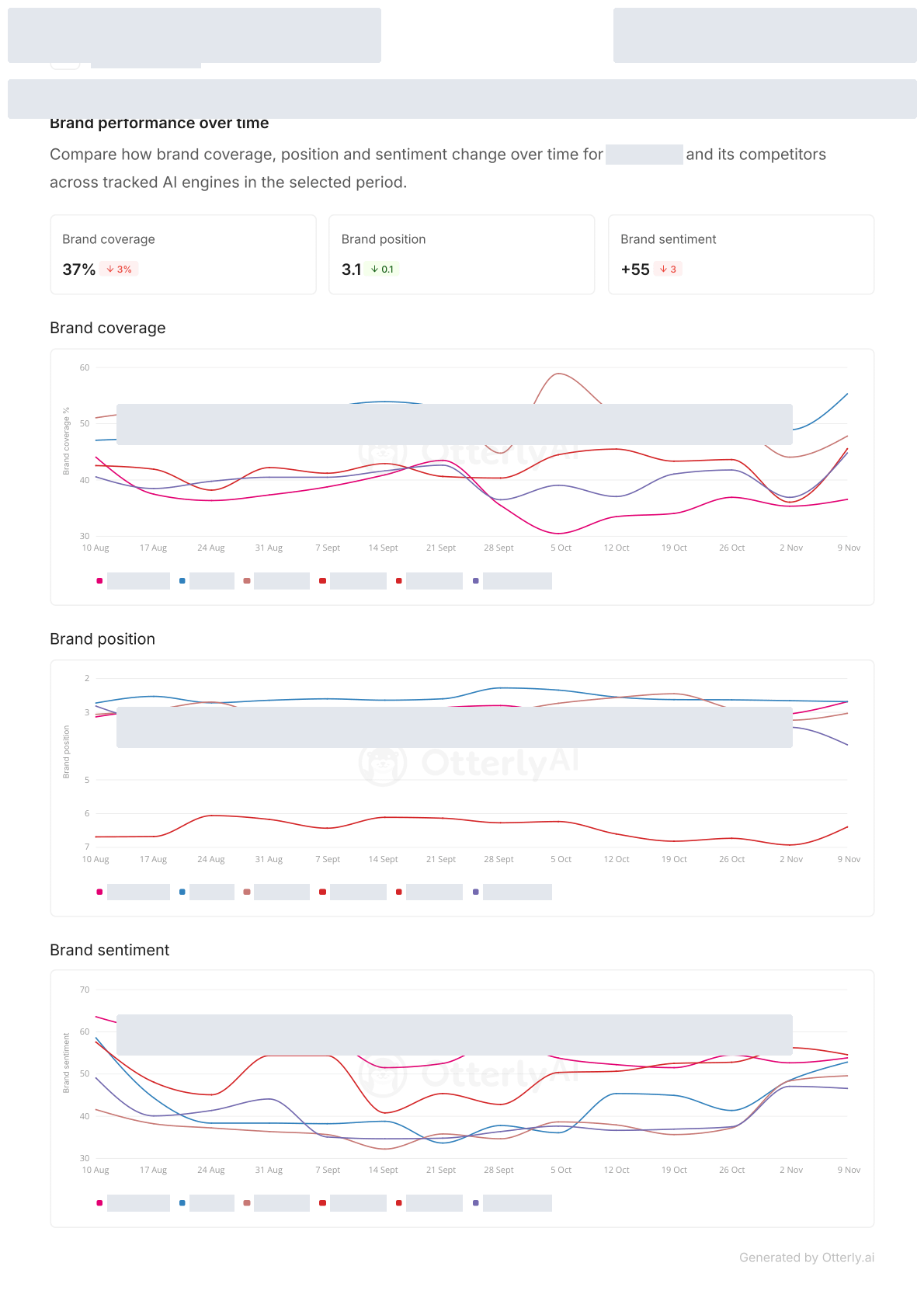
Otterly’s dashboard provides three primary metrics.
Brand coverage measures how often your brand appears in AI responses generated for your tracked prompts. It gives you a percentage-based view of your visibility.
Brand position indicates where your brand typically appears within those responses. Unlike traditional search rankings, this isn’t a fixed position on a results page.
Brand sentiment analyzes how positively or negatively your brand is discussed in the responses.
You can monitor these metrics over time and compare them with competing brands.
What I find useful
The biggest advantage is having these metrics together.
You can see changes over time rather than relying on isolated searches, and competitor trends provide context that your own visibility score cannot.
For example, a decline in your brand coverage is more interesting when you can see whether competitors experienced similar fluctuations or whether the decline appears specific to your brand.
The historical charts are particularly helpful for identifying patterns worth investigating.
What to keep in mind
These metrics reflect the prompts, engines, geography, and time period you’re monitoring. They are not a measure of your brand’s visibility across every possible AI search.
Sentiment also needs context. A positive score doesn’t automatically mean an AI engine is recommending your product.
⚖️ My verdict: A useful starting point for ongoing monitoring and competitor benchmarking. But I would treat the dashboard as a way to identify questions worth investigating, not as a complete measure of GEO performance.
#2 Prompt Monitoring: The Feature I Care About Most
We’re tracking a relatively focused set of prompts, so I want to extract as much information as possible from each one.
Knowing that a brand appeared in 30% of responses is interesting. But I also want to know:
Which AI engines mentioned it?
Was the brand recommended or simply referenced?
Which competitors appeared in the same response?
Was our domain cited, even when our brand wasn’t mentioned?
What did the actual AI response say?
Otterly provides considerably more detail than a simple count of mentions.
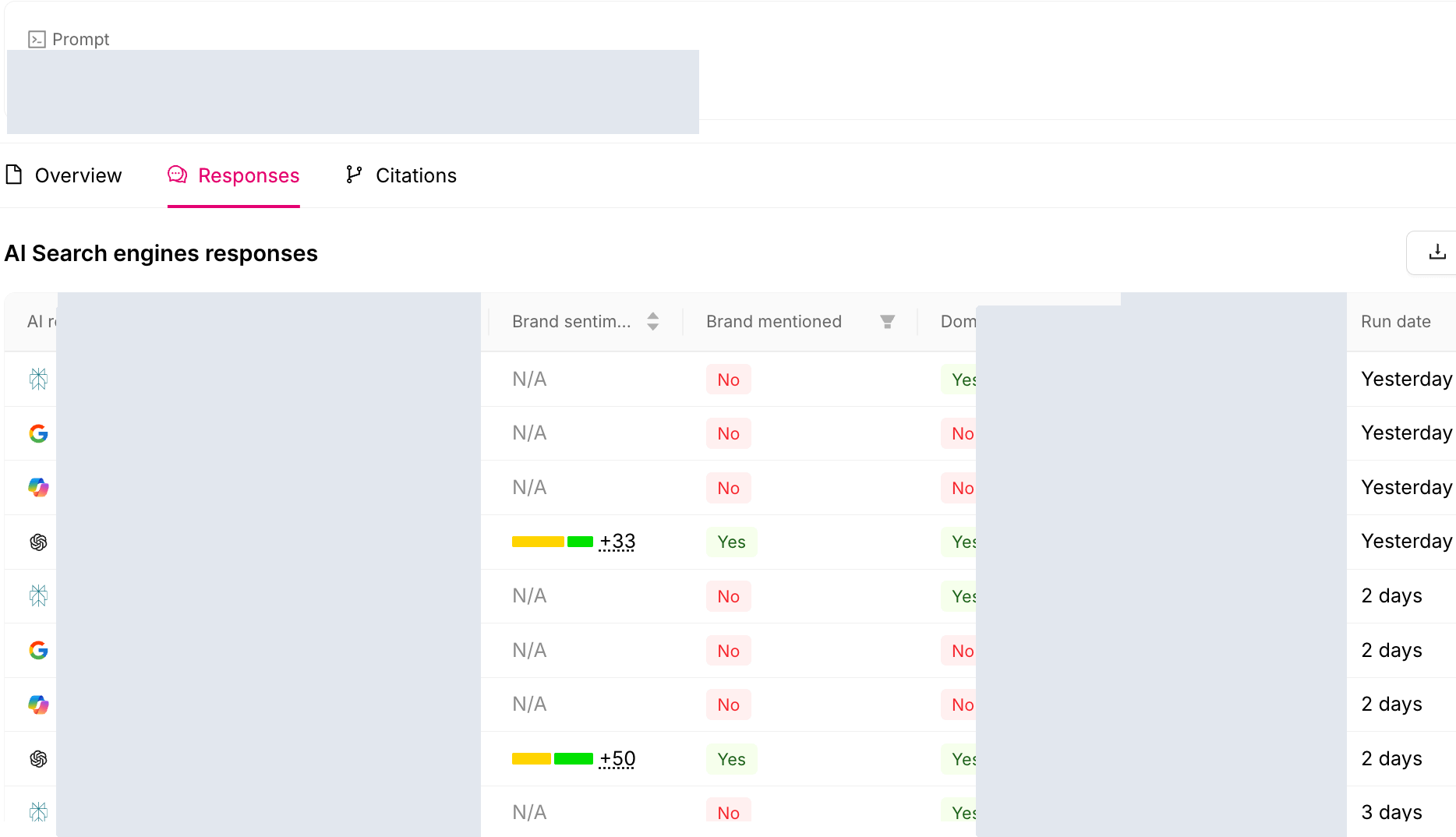
For individual prompts, you can review an overview, AI-generated responses, and citation data.
The responses view shows the AI engine, the generated answer, whether your brand was mentioned, whether your domain was cited, sentiment where available, competitors appearing in the response, and the run date.
Why this matters
One distinction I particularly appreciate is brand mentions versus domain citations.
An AI engine can cite an article from your website without explicitly recommending your product.
Conversely, it can recommend your brand without linking to your website.
Those are two different outcomes, and treating them as the same would give you an incomplete picture of visibility.
Otterly also retains results from different monitoring runs, allowing you to investigate changes rather than relying on a single response.
This is useful because AI-generated answers aren’t always consistent. The same prompt can produce different recommendations across engines or over time.
Where the value comes from
You could manually enter prompts into ChatGPT, Perplexity, or other engines and record the results.
But once you’re checking several prompts across multiple engines repeatedly over weeks or months, the process becomes tedious.
Otterly’s value is in collecting and organizing those observations.
⚖️ My verdict: One of the strongest parts of the platform for my use case. Individual response data makes aggregated visibility metrics more meaningful, particularly when you’re monitoring a focused set of buyer-intent prompts.
#3 Citations and Recommendations: Can You Turn Visibility Into Action?
This is where AI visibility monitoring becomes more interesting for content marketers.
It’s one thing to know that your brand is appearing in AI-generated answers. It’s another to understand which sources are influencing those answers.
Otterly’s citation analysis shows the URLs and domains appearing as sources across monitored responses.
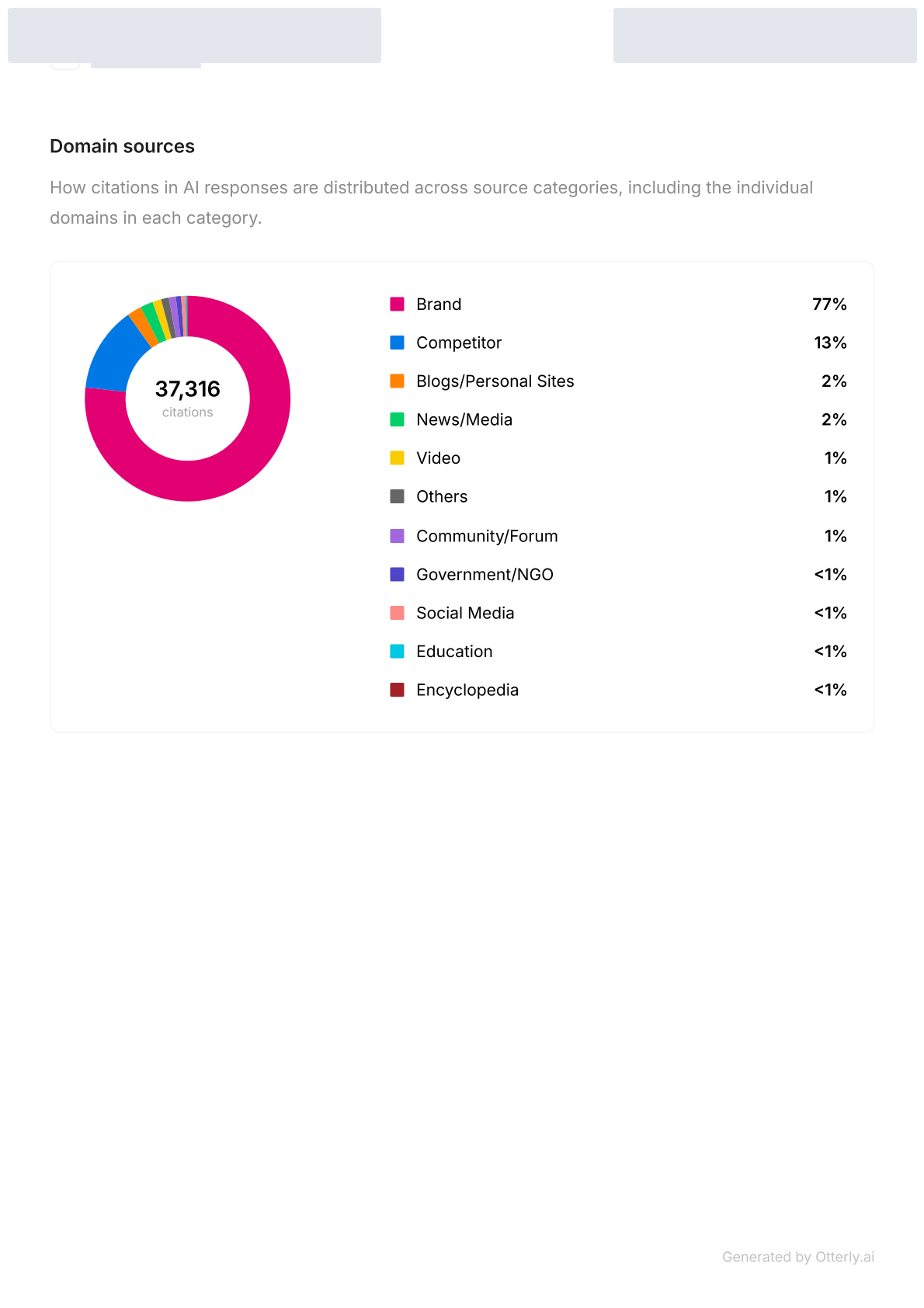
You can investigate individual citations, review changes over time, and see how citation sources are distributed across categories such as brands, competitors, blogs, news websites, and communities.
What I find useful
For content marketers, this opens up several questions.
Are AI engines citing our own website or relying more heavily on third-party content? Are comparison articles appearing frequently? Are review platforms being cited? Which pages or domains consistently surface for important prompts?
This can help identify content worth reviewing, third-party platforms worth investigating, and gaps in your brand’s representation.
But there’s an important caveat.
Citation categories are not always as straightforward as they appear.
For example, the report groups a large proportion of citations under the category Brand. On closer inspection, that category can also include third-party websites.
So I wouldn’t interpret the Brand percentage as the proportion of citations coming directly from your company’s website.
The underlying domain and URL data is more useful than the category label alone.
What about recommendations?
Otterly also provides optimization recommendations intended to help improve AI search visibility.
I see these as starting points rather than a ready-made strategy.
Some suggestions can help identify content improvements or opportunities worth exploring. Others need more context before you can decide whether they’re relevant to your product, audience, or existing content.
The recommendations available also depend on your plan.
⚖️ My verdict: Citation analysis is useful, particularly at the individual URL and domain level. Recommendations are worth reviewing, but I wouldn’t implement them without first validating their relevance.
⭐ More AI Search Tool Reviews
I’ve previously reviewed two other AI visibility tools in GrowthPact:
Have another AI marketing tool you’d like me to review? Or are you building one and looking for independent, hands-on feedback?
Reply to this newsletter or leave a comment. I’m happy to explore tools and share an unbiased assessment of what works, what doesn’t, and what could be better.
Other Otterly Features Worth Exploring
Beyond these features above, Otterly offers several supporting capabilities.
AI Prompt Research: Suggests prompts based on topics, keywords, or URLs. Useful for discovering new questions to track, although I’d still manually validate their relevance to buyer intent.
Content Checker: Evaluates content structure, readability, metadata, and AI readiness. I found some recommendations quite specific, but not everything needs to be implemented.
Crawlability Checker: Checks whether AI crawlers can access your website and identifies potential restrictions. Particularly useful for spotting technical issues that content teams might otherwise overlook.
Query Fan-Out: Shows related questions and search variations AI engines may explore when answering a prompt. Helpful for identifying content gaps and understanding broader search intent.
Reporting and Analytics: Offers downloadable reports, CSV exports, and reporting integrations. Useful for stakeholder reporting, although I think the reporting experience could be more intuitive.
Team Management and Support: Supports multiple team members and offers chat support. Convenient for collaboration, though not a deciding factor for me.
A closer look at the Content Checker
I tested Otterly’s Content Checker on a real B2B SaaS website.
The audit covered three broad areas: how accessible the page content is to crawlers, how well the content is structured for AI search, and the quality of structured data and technical signals. What I found interesting was the level of detail in some recommendations.
Rather than simply suggesting that a page needs better readability, it identified opportunities around summary blocks, section structure, jargon, specific claims, and content formatting.
That can be helpful when you’re trying to identify potential improvements without auditing every page manually.
However, some recommendations are prescriptive, particularly regarding the addition of FAQs, summaries, and additional content blocks.
Not every page needs those elements. And adding them doesn’t automatically improve AI visibility.
I’d use this feature to generate an initial audit checklist, then decide which recommendations actually improve the page for its intended audience.
⚖️ My verdict: A helpful supplementary tool, but not a replacement for editorial judgment or technical SEO expertise.
What I Like About Otterly.AI
These are the aspects I find most valuable.
1. It brings different AI search signals together. Instead of checking several engines individually, I can review visibility, competitors, prompts, and citations in one place.
2. Prompt-level analysis goes beyond basic mentions. Seeing actual responses, brand mentions, domain citations, and competitor appearances helps me understand what the visibility metrics represent.
3. Historical monitoring makes the data more useful. A single AI response tells you relatively little. Tracking changes over time makes it easier to investigate recurring patterns.
4. Citation analysis offers useful content research opportunities. The ability to investigate domains and URLs provides more context than a visibility percentage alone.
What Could Be Better About Otterly.AI
There are also a few areas where I think the experience could improve.
1. Reporting could be easier to navigate.
Although Otterly offers exports and reporting-related capabilities, I haven’t found the reporting experience as straightforward as I’d like. For marketers preparing regular updates for stakeholders, a clearer reporting workflow would be valuable.
2. Recommendations could be more actionable.
Some suggestions are reasonable, but I would like stronger prioritization: which changes are likely to matter most, what evidence supports them, and how difficult they are to implement.
3. Source categorization needs greater clarity.
When third-party websites appear under broad labels such as Brand, it’s easy to misinterpret the citation breakdown. Clearer definitions would make the data easier to explain in reports.
4. GEO audit suggestions need editorial judgment.
Recommendations such as adding summaries, FAQs, or more structured content can be useful, but they shouldn’t become a universal checklist for every page.
I’d prefer recommendations that more clearly distinguish technical issues from optional editorial improvements.
🚀 Need help growing your career in SaaS marketing?
I was recently featured on Topmate’s list of proven digital marketing mentors in India! 🎉
I offer weekend 1:1 sessions where we can discuss your career challenges, from SEO, AEO/GEO, and content strategy to portfolio reviews, interviews, and transitioning into product marketing.
Here’s how I make these calls worthwhile: You share your questions beforehand, I come prepared with actionable suggestions, and wherever possible, I offer post-call support.
45 minutes | ₹1,599
⚖️My Final Verdict: Is Otterly.AI Worth It?
After six months of using Otterly, I’d say it’s a good choice for B2B marketers who want to track AI search visibility without investing in an overly complex platform.
What I find most useful is the ability to monitor specific prompts, compare visibility across AI engines, and identify which websites are being cited. These insights help me decide which prompts need attention, which competitors to investigate, and which content opportunities are worth exploring.
However, the recommendations could be more actionable, the citation categories need clearer definitions, and the reporting could be improved.
Would I recommend it? Yes, particularly for small and mid-sized marketing teams getting serious about GEO/AEO. Just don’t expect the tool to build your strategy for you.
Have you used Otterly or another AI visibility tool? I’d love to hear your experience.
📚 Check out my digital products & services purchased and loved by 270+ writers and marketers
AI+Human Content Playbook: For Content Marketers only. Essentially, for those under pressure to produce a large volume of content, it limits their ability to learn and experiment with other aspects of content marketing.
💡New update: A Claude skill.md file to accelerate your writing workflow! No price change.
SaaS Content Marketer Handbook: 1-YEAR handbook for content marketers joining a product startup, includes realistic goals, execution steps, and all the templates and frameworks you’ll need.
BOFU Content E-book: Get my updated BOFU Content e-book that covers three new chapters on BOFU content beyond alternatives and comparisons, BOFU attribution, and AI workflows for BOFU content.
💡New update: A ready-to-run Claude skill that writes BOFU comparison content end-to-end: “[Competitor] alternatives,” X vs Y, product reviews, and “best [category] software” listicles.
Say hi on LinkedIn 👋
Onwards and upwards,
Sreyashi