


Hi friends! 👋
If you’ve been exploring AI search visibility tools lately, you’ve probably noticed something: almost every platform promises to track your brand mentions, monitor competitors, analyze citations, and help improve your AI visibility.
And the demos look impressive!
But when you’re a content marketer responsible for choosing a tool, the real question is whether those features give you information you can actually use to make better content decisions.
I’ve spent the past several months exploring, evaluating, and working with AI search visibility platforms. And I’ve realized that some features are genuinely useful, some are nice additions, and others look more impressive in a demo than they are in everyday use.
So, in this edition of SaaS Splash Bulletin, I’m sharing what I’d look for when selecting an AI search visibility tool, including the questions I’d ask during a product demo.
Let’s get into it 👇
📚 My Previous AI Search Visibility Articles
📌 TL;DR
Prompt quality comes first: A tool is only as useful as the prompts you track. Prioritize relevant, unbranded buyer-intent queries over automatically generated branded prompts.
Look beyond visibility scores: Competitor benchmarking, topic-level performance, and historical trends help identify where your brand is actually falling behind.
Citation analysis is a must-have: You should be able to inspect actual AI responses, distinguish brand mentions from website citations, and identify exact source URLs.
Recommendations need to be actionable: Generic suggestions like adding FAQs aren’t enough. Look for specific content gaps and evidence-backed improvements.
AI traffic and reporting matter: Check whether you can track referral traffic by engine and landing page, and easily export reports.
Don’t pay for features you won’t use: GEO audits, crawler monitoring, and advanced integrations can be helpful, but your team size, budget, and requirements should determine their value.
Before You Start: Know What You Need
You don’t need a detailed GEO strategy before evaluating tools. But you should have a basic idea of what you’re trying to accomplish.
Are you primarily interested in brand mentions, competitor visibility, content optimization, or AI referral traffic? Are you monitoring one brand or multiple clients?
These answers determine which features are essential and which you can skip.
Now, let’s get into the features I’d prioritize.
1. Prompt Research and Tracking
What to look for: A tool that lets you add your own prompts, discover relevant ones, organize them by topic or intent, and monitor their performance over time.
Why it matters: The quality of your tracking depends on the quality of your prompts. If a tool recommends questions like “Why is [your brand] the best solution for X?”, your visibility score might look great, but it won’t tell you much about how real buyers discover products.
I’d prioritize prompts reflecting actual buyer questions, especially unbranded, middle- and bottom-of-funnel searches.
What I’d test during a demo: Ask the tool to generate 10 prompts for your product category. Check how many are genuinely relevant, how many are overly branded, and whether you can edit or replace them.
2. AI Engine Coverage and Tracking Frequency
What to look for: Coverage across the AI search engines your audience uses, with clear information about tracking frequency, geography, and historical data.
Why it matters: Your brand might appear frequently in ChatGPT but rarely in Perplexity or Google AI Overviews. If you’re tracking only one engine, you’re getting a partial picture.
Also, AI responses change. A single snapshot isn’t enough to establish whether your visibility is improving.
What I’d test during a demo: Ask which engines are included in your preferred plan, how often prompts are checked, and whether you can filter results by engine, country, and date.
3. Brand Visibility and Competitor Benchmarking
What to look for: Brand coverage, position, sentiment, competitor comparisons, and ideally topic-level visibility.
Why it matters: An overall visibility score is useful, but it doesn’t tell you where you’re performing well or poorly.
For example, if you sell an HR platform with multiple solutions, you might be highly visible for one product category but practically invisible for another.
A topic-level breakdown helps you identify those gaps and prioritize your content efforts accordingly. Similarly, competitor tracking helps you understand whether changes in visibility are specific to your brand or part of a broader trend.
What I’d test during a demo: Ask the vendor to compare your brand against three competitors across two different product categories. Can you identify which topics need attention?
4. Prompt-Level Responses and Citation Analysis
What to look for: Access to actual AI-generated responses, brand mentions, cited URLs, competitor appearances, and historical results for individual prompts.
Why it matters: This is one of the most important capabilities for content marketers.
There’s a big difference between an AI engine mentioning your brand and citing an article from your website.
For example:
Your brand could be recommended without your website being cited.
Your article could be cited without your product being mentioned.
A competitor could appear in the answer because an independent review website recommends them.
Each situation suggests a different opportunity.
I’d also want to see the exact URLs AI engines cite, not just broad domain categories. That helps identify which articles, comparison pages, review platforms, or communities deserve closer investigation.
What I’d test during a demo: Open an actual tracked prompt. Can you see the complete AI response, distinguish brand mentions from domain citations, inspect source URLs, and compare responses over time?
5. Actionable Content Recommendations
What to look for: Recommendations that connect visibility gaps to specific content improvements, supported by evidence.
Why it matters: Most content marketers don’t need another tool telling them to improve readability, add FAQs, or update headings.
We need to know which pages deserve attention, what’s missing, and why a particular change might help.
For example, if competitors consistently appear in response to a high-intent prompt, can the tool help you understand which sources support those recommendations and what your content might be missing?
I would also distinguish between genuine technical issues and optional content suggestions. Not every recommendation deserves implementation.
What I’d test during a demo: Ask the tool to analyze one existing article and suggest three improvements. Are they specific, supported by evidence, and practical enough to implement?
6. AI Referral Traffic and Reporting
What to look for: AI referral traffic by engine and landing page, alongside reporting dashboards, historical comparisons, and export options.
Why it matters: Visibility is one part of the picture. You also want to know whether AI search is sending visitors to your website.
Ideally, you should be able to identify which pages receive traffic from AI platforms and compare that with your visibility data. However, remember that referral traffic and AI crawler activity are different metrics. A bot crawling your website doesn’t mean a visitor arrived from an AI-generated answer.
Reporting matters too. If you’re presenting GEO performance every month, you shouldn’t have to manually combine five exports to build one useful report.
What I’d test during a demo: Ask the vendor to show AI referral sessions by engine and exact landing page, then export a monthly performance report. Check what the report includes and what you’d still need to add manually.
Features I’d Consider Nice to Have
These are useful, but I wouldn’t make them deciding factors unless they solve a specific problem for my team.
GEO content audits: Helpful for identifying content and technical issues, but recommendations still need validation.
AI crawler monitoring: Useful for technical SEO teams investigating crawler access and restrictions.
Query fan-out research: Helps explore related questions and identify potential content gaps.
Team collaboration: Important for agencies and larger teams, less critical for individual marketers.
Advanced sentiment analysis: Adds context to brand mentions, but I’d still verify important findings manually.
Don’t Forget the Hidden Costs
A tool’s advertised starting price rarely tells the full story.
Before signing up, I’d confirm:
Prompt limits: Are you paying per prompt, engine, or monitoring run?
Plan restrictions: Are the features you actually need available in your chosen tier?
Historical data and exports: How much data can you access, retain, and download?
Implementation effort: Will you need developer support, additional integrations, or significant time to maintain tracking?
A cheaper plan isn’t necessarily better if you need to upgrade immediately to access the features that matter.
🚀 Need help growing your career in SaaS marketing?
I was recently featured on Topmate’s list of proven digital marketing mentors in India! 🎉
I offer weekend 1:1 sessions where we can discuss your career challenges, from SEO, AEO/GEO, and content strategy to portfolio reviews, interviews, and transitioning into product marketing.
Here’s how I make these calls worthwhile: You share your questions beforehand, I come prepared with actionable suggestions, and wherever possible, I offer post-call support.
45 minutes | ₹1,599
My 30-Minute AI Visibility Tool Evaluation Checklist
If I were evaluating a new platform today, here’s how I’d spend the demo.
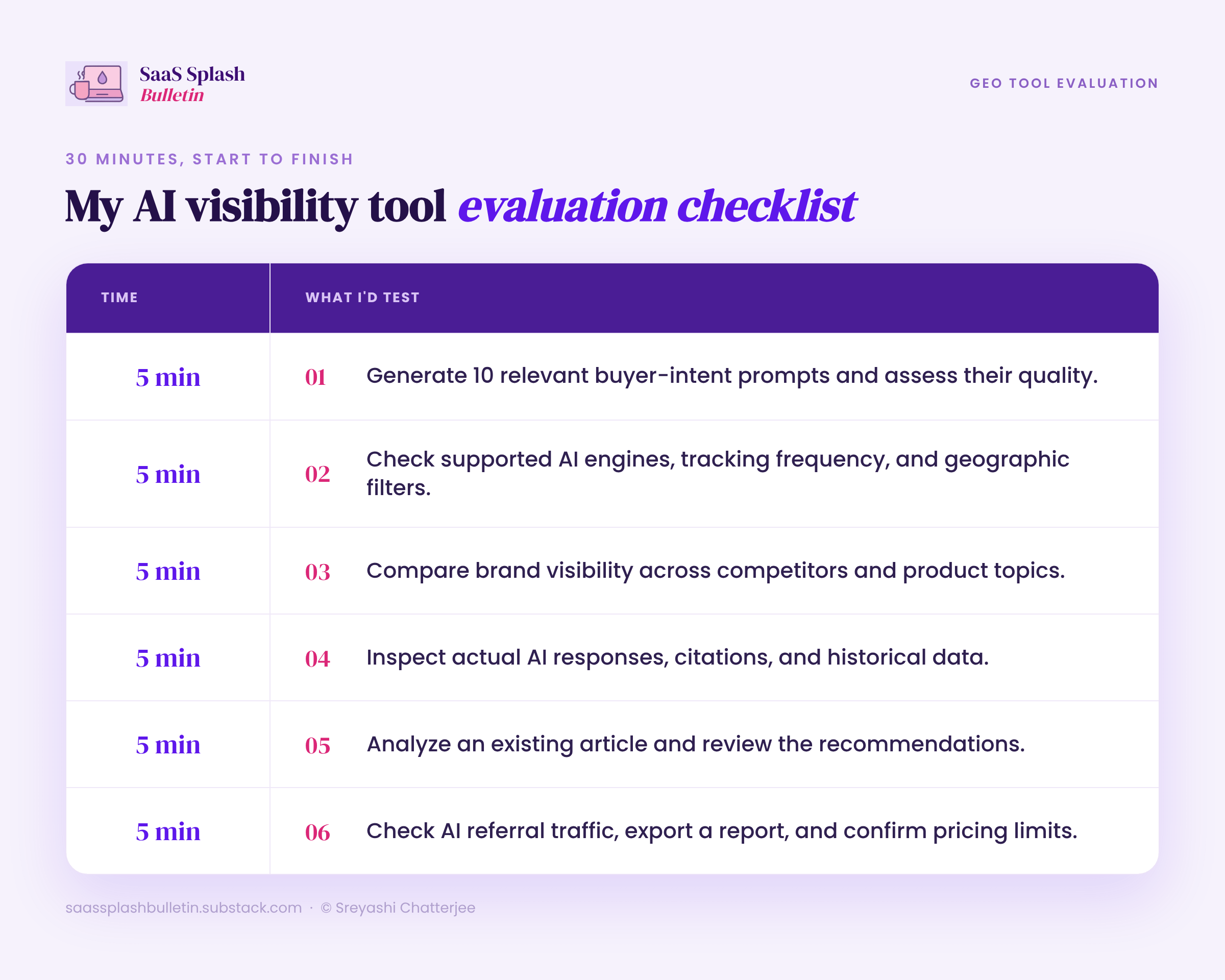
My rule: Don’t settle for screenshots of sample dashboards. Ask vendors to demonstrate these capabilities using your own brand, competitors, prompts, or content wherever possible.
And if they offer a trial, use it to verify the results before committing to an annual subscription.
Final Thoughts: What Would I Actually Pay For?
If I had to prioritize, these would be my essentials:
Must-haves: Relevant prompt tracking, multi-engine monitoring, competitor benchmarking, actual AI responses, and URL-level citation analysis.
Strong differentiators: Topic-level visibility, genuinely useful content recommendations, and page-level AI referral analytics.
Everything else depends on your team’s requirements and budget.
One thing I’ve learned from evaluating these platforms is that a feature is only valuable if it either saves you meaningful time or helps you make a decision you couldn’t confidently make before.
If you’re only tracking a handful of prompts, you might not need a paid platform yet. But if you’re regularly monitoring multiple products, competitors, and AI engines, a good tool can make the work significantly easier.
The trick is knowing what you’re paying for.
Have you evaluated an AI visibility tool recently? What’s one feature you wish these platforms had that they don't?
I’d love to hear your thoughts.
📚 Check out my digital products & services purchased and loved by 270+ writers and marketers
AI+Human Content Playbook: For Content Marketers only. Essentially, for those under pressure to produce a large volume of content, it limits their ability to learn and experiment with other aspects of content marketing.
💡New update: A Claude skill.md file to accelerate your writing workflow! No price change.
SaaS Content Marketer Handbook: 1-YEAR handbook for content marketers joining a product startup, includes realistic goals, execution steps, and all the templates and frameworks you’ll need.
BOFU Content E-book: Get my updated BOFU Content e-book that covers three new chapters on BOFU content beyond alternatives and comparisons, BOFU attribution, and AI workflows for BOFU content.
💡New update: A ready-to-run Claude skill that writes BOFU comparison content end-to-end: “[Competitor] alternatives,” X vs Y, product reviews, and “best [category] software” listicles.
Say hi on LinkedIn 👋
Onwards and upwards,
Sreyashi
A practical checklist beats a feature list when you are picking one of these tools. Having the questions written down first saves a lot of second-guessing.
Strong agree on separating brand mentions from website citations. In a batch of 120 small SaaS sites I checked, 28 had pages cited as sources in AI answers but zero brand mentions. A tool that blends those into one visibility score would have told them they were visible. For getting onto a buyer's shortlist, they weren't. One blended score is the first thing I'd push back on in a demo.